

It comes to us all at some point in our lives … the calling. But do we listen? do we miss the opportunity to open ourselves to new potential both physically and mentally as a human being. Yoga is a choice. You can choose to ignore the calling and carry on regardless (yoga is for everyone but might not be considered so) or you can make the decision to practice because inherent in you is the realisation that it might just bring those health benefits you’ve been searching for. If you start your practice and then continue with patience and perseverence, not setting yourself any egotistical goals just for the form of the body, but for deeper and more meaningful wisdom of health for the lifetime journey, then you begin to experience changes for the better. You return time and again to your natural built-in state of preservation and maintenance because you feel the improvements taking place in your life. Remember, you are the Guardian of your well-being, and Yoga is your guide.
Category: karma
YouTube Yoga Channel
https://www.youtube.com/@Y0GAWithAlicia
attune to this channel
many informative videos to assist with your yoga journey whether you’re just about to start or if you have been practicing for a while
my direction is clear, complete and well studied and practiced
you can contact with any questions via dogstar.yoga.online@gmail.com
enjoy and be happy
Biostrata ……….. continues 7
Mind is intelligence, awareness, consciousness, perception, mind exists in and with everything. It is the inherent and most basic quality of active prana. Therefore you will see that the human body, being made up of prana and displaying infinite complex behaviour patterns, is also Mind.
Consciousness makes us see ourselves sometimes as ‘bodies’ and other times as ‘minds’.
It is always the observation (the point of view) which changes, not that which is being observed, and so it is, with every single one of us human beings, we can all be observed as mind, body or spirit.
Now upon having gathered the knowledge of all of the above we can now look at the true nature of Mind and consider too the 3 sections it is divided into …. Conscious, Subconscious and Unconscious.
The human ‘conscious’ mind belongs to the Sensory Stratum, the ‘subconscious’ and ‘unconscious’ belong to the Cellular Stratum, with the ‘unconscious’ reaching all the way down to the Pranic Stratum (after passing through the molecular and atomic strata too).
The conscious mind possesses a number of faculties, ‘Consciousness’ being just one of them. Consciousness (otherwise termed ‘Awareness’) is introspective and results from exclusive components which make up a unit, i.e the consciousness of ‘cells’ and/or ‘molecules’ and the intelligence displayed therein of those components/units. When awake and fully conscious, we rely on the combined consciousness of all cells for our normal functioning, together all combinations give us our Awareness. During sleep however, ‘sensory’ consciousness can become ‘patchy’ as not all cells are still functioning, some have suspended their activities. Sensory experience (in sleep) is fragmentary and incomplete and inclined to seem slightly less ‘real’ than that of the fully awake sensory consciousness. Hence the phenomenon ‘Dreaming’.
All levels of the Biostrata need each other, no one level can exist without the others for this is all about a progressive, unifying process in the development of inert Prana to Human Being.
Communication throughout the Biostrata is strictly from one stratum to the adjacent stratum so it is not possible for say, the Sensory Stratum to communicate directly with the Molecular Stratum, the communication must pass through all intermediate strata wherever the communicating strata are not adjacent with each other. This communication is much the same as any form of communication, whereby it is an influencing of awareness of one entity, reaching out to the awareness of another.Usually this communication is for one of two reasons. Either for controlling the units of another stratum, or for the purpose of being controlled by the units of another stratum.
Consciousness is unique, it belongs to one unit and is its inherant part. when a number of units of one stratum unite they constitute a ‘complete’ unit in a higher stratum and thereby produce a ‘collective unit consciousness’ .. i.e another ‘one exlusive unit’.
Awareness (Human Consciousness) is the ‘agent’ for all communication in the Sensory Stratum, it is not only a ‘receiver’ susceptible to other strata but it is also a ‘transmitter’ which has capability of influencing all units of its own, and other, strata.
The Human Consciousness is better able to communicate with strata below its own level rather than the levels above and this makes it more understandable to us how we can appreciate being ‘stuck’ in the Sensory Strata, often unable to progress upwards to the Spiritual Strata. Consciousness marks the extent of our singular development within the Biostrata, having ascended from the Pranic Stratum and being made up of units of the Cellular, Molecular and Atomic Strata, you will understand that when any unit of the Sensory Stratum is communicating with units of the lower strata, it is indeed actually communicating with parts of itself. Whenever we use our physical apparatus such as moving limbs or swallowing morsels of food we are communicating within the Cellular Stratum, making appropriate cells action and respond in accordance with our wishes, and those cells composed of molecules and atoms are all receiving communication from the Sensory Stratum, continuing, automatically, down and down the entire number of components until the Pranic Stratum is reached and all necessary communication has been actioned. You will recognise for instance, when you are hungry, you are made aware of this by Sensory Consciousness, it is a message from the Cellular Stratum telling you (human consciousness) that you must eat. Therefore these are the busiest lines of communication, the interchange of influences between the Sensory Stratum and all strata below.
If you take yourself to your current level of Sensory Stratum you might think that communication on this level is the easiest but alas, even with all the lines of help brought about by Post, Radio, Telephone etc there still remains some of the most difficult, if not impossible obstructions regarding communications between human beings on a Sensory Level.
When a human being (one unit of the sensory stratum) communicates with another human being it is possible for there to be awareness of who is the receiver and who is the transmitter, both can occupy consicousness at the same time, however, when one human is communicating with another, what has to be remembered is that communication is happening with a ‘separate’ consciousness and therefore, this is not as easy as communication with one’s own component cells. If you have little understanding of your own Sensory Self and all parts below (and above if possible) then you will have greater challenge in communicating with other conscious beings (especially if they have little or no understanding of their development).
Finally, to reach up and communicate to the strata above proves the most challenging and is probably the Sensory Stratum units’ upmost difficult communication. When a human being ‘reaches up’ it is doing so into the ‘unknown’ and the awareness is that of the actual reaching rather than of which level is being reached. The Spiritual Stratum is intuitive and when the Sensory Stratum does manage to communicate with the Spiritual Stratum it receives intuition and inspiration. Human consciousness must expand and transcend the Sensory Stratum if it is to successfully communicate with the Spirit and the Godhead of the Biostrata. Only when Human consciousness has made itself receptive by negating the significance of all sensory stimuli can it expand, can it reach up, can it communicate with a unit of the Spiritual Stratum and thereupon receive Intuition and Inspiration.
Biostrata ….. continues 6
Now the true nature of development is taking place. Between the Sensory Stratum and that of the Godhead, rests the Spiritual Stratum.
As shown already, the trend is ever upwards as the units of one stratum come together to form units in a higher stratum. Just as the cells join to form human bodies, human bodies also join and unite to form spiritual units.
The spiritual stratum is perhaps the most complex of all the Biostrata for the human bodies from the sensory stratum unite in specialized groups to form a plethora of interrelated unit types, those such as ‘family’ which is first in the field of spiritual unit types what with its genetic bonds and those qualities of unique loyalty. Then coming up closely behind the family unit is the vast and ever-widening racial unit. There are far less racial units than family units in the Spiritual Stratum and here is where complexity kicks in even more so for both family and racial units are dependent upon each other for their components (human bodies) and therein lies the fact that each race becomes composed of a greater number of families because more and more we find families belonging to more than one race. Parents of differing races come together to make new families. Atop of all this we then have the multi-complex combining of units via nations, cultural societies, religion and religious organizations, politics and political groups, idealists and their seedlings. Despite all of this mixed up overlapping, the spiritual intelligence is of the highest order, it is the link between the sensory (human) intelligence and the godhead infallible. Spiritual intelligence is infallible at its very best and far more reliable than sensory intelligence at its very worst.
Again, reverting to your triangle Biostrata diagram you will see that the Spiritual Stratum is but one step from the Godhead Infallible. But what is infallibility?
The Godhead holds ‘exclusive’ rights to infallibility, being the most elevated level of intelligence. Being at the most elevated level of intelligence is always by courtesy of the Godhead for the complete Biostrata is an extension of the Godhead. All essential and absolute qualities for Life becoming ever more fallible and as yet, less vital as disintegration and dissipation co-exist in ever readiness to dilute existence back to the basic Pranic stratum, and as such behaviour and intelligence and all extensions exist only as an inert promise to great propensity.
Within the Biostrata, there are three possible states to existence and they are Life, Stagnation and Deterioration.
True Life exists when progress within the Biostrata is in upward motion, moving toward the Godhead. Any movement in the opposite downward motion is a resulting deterioration, life diminishing descent toward death. Stagnation is the state of there being such an enormous variety of inanimate substances present in the Universe about us. Inhibiting influence causes stagnation within a stratum, almost stopping the upward trend of the Life-state. Life forms from every level of evolution all play a role appropriate to its biostrata status and all of these so to contribute to the ascendance or descendance through life and death.
Life status is an ascent, Death status is from descent but stagnation occurs in an outward direction on a horizontal plane. All interact and influence each other and this can have a stabilizing effect but also ensures no single state can gain supremacy without a struggle. Life is indeed a struggle, a continual battle against Stagnation and Death. But deterioration does not just happen, it is brought on by units failing to resist the lure of stagnation. Instead of resisting stagnation, those units who collaborate will eventually lose their vitality and thus must surrender to Deterioration.
Dependent upon which state is exerting the greater influence at the time when stagnation is allowed to succeed on one particular level will rely heavily on whether Life continues or Death ensues and from this we can learn that Stagnation means remaining too long with the bounds of one stratum.
You will see this clearly in this so-called civilized world that there is far too much stagnation. Within the consciousness of almost every human being there is a choice to stay outbound in direction over the whole of the Sensory (mind) stratum of the Biostrata rather than continuing to expand upwards to the Spiritual Stratum and eventually the Godhead. Stagnating in the Sensory Stratum not only increases the struggle for existence but it so weakens life’s upward ‘thrust’ too – as a result, Deterioration’s chances of gaining supremacy greatly improve.
One of the biggest and most valuable lessons to learn from this piece of knowledge is that the most successful, wholesome form of life and living can be experienced whilst ascending the Biostrata. It would be most prudent to seek avoidance from stagnation and deterioration. Remembering that all of this applies to the impermanent Self (the bodily vehicle) for the Essential Self moves in one direction only, and that is toward Godhead enlightenment.
We have only to resist Stagnation in order to deter and delay Deterioration and prolong life as the impermanent Self thus hastening the Essential Self’s ascent to the ultimate haven of spiritual bliss – the Godhead.
Yoga Nature
Yoga is a Science. It is an Art. It is an Order to which every boy and girl, man and woman can adhere toward in their lifetime to become healthy and whole. Dedication, discipline and direction are all required to bring oneself from infancy to healthy normal maturity. During all stages of growth, maintenance of one’s general health and well-being requires self-control and perseverance. An understanding of the self will lead to the development of mind body unification and ultimately physical welfare. The science of Yoga encompasses all aspects of ‘how to’ gain a normal state of health. It is profound, there are foundations to be laid, it is a way of life.
The fundamental birthplace of Yoga teaches the path of a natural mode of living. On this modern planet in which we inhabit, this can prove challenging. Can we return to ‘Nature’? Have we time to turn our view away from the dazzling mad rush of modern civilisation? Fashion and Social ambition demeans and befools us. In short, it controls us. The repercussions thereafter, obliterate us. In the cradle of Yoga, one can receive nourishment, warmth and protection. In your Yoga practice you gain first, nature, second, nature, third, nature. A return to whence it began.
The ordinary way, true earth, natural magnetism, is still with us. The most vigorous races of the world still live, still inhabit this wondrous earth, as they have done for centuries. They require little other than what nature gives. This last remaining vital force is bestowed on us all.
Attention now, to the self, is inherent. It is how nature, and all living beings, will survive. Observation and awareness to ‘natural magnetism’ and ‘vitality’ will teach all that a Yoga Nature and the answers therein, will show earth’s way. The Earth is like a battery, charged with magnetism and ready and willing to give forth its strength to all beings. Apply the ‘test of nature’ to all theory and know that it has valuable ‘order’ and is a trusted friend.
Seeking to maintain a healthy, normal, natural body? Assume the title of ‘Yogi’, reverse the trend of ignorance, and endeavour to lead the Yogi plan of physical life.
One can be loyal, as far as possible, to the continuous practice of Yoga, in order to gain insight and experience of Nature’s plans and methods. All systems and techniques within Yoga will indicate how to reach normal functions of the body. With this adherence followed, a natural state of health and well-being can be achieved. Yoga’s key note is ‘Health’ and its main purpose is to help all conform to a standard of healthy living. That which keeps a human healthy can make an unhealthy human healthy. Yoga (and all branches thereof) exploits a sane, natural, normal and healthy manner of living, and if followed, will benefit all. Yoga stays close to nature and advocates a return to natural methods of life in preference of those which mislead us into obliteration.
Yoga will demand your attention and observation and will teach you how to take command over your rebellious self. Yoga will call to action your responsiveness, your ‘will’, and will show you how to do everything you can to achieve health and well-being. Yoga will re-ignite your belief in the Intelligence behind all Life. Engagement with the great Life Principle will allow us to survive, to all be well within our bodies.
Put your yearning for something new into Yoga practice; through this you will get a good fair start on the road to the knowledge you seek.
Namaste
Namaste is a word from the ancient Sanskrit language.
Its best interpretation/meaning is ~ the light within me bows and honours the light within you and together we are one, connected by a soul recognition of the universe and beyond.
it is a gentle yet profound reminder to not ‘sell our soul’ or ‘buy into anything that disconnects us from it’
Hatha Yoga / Styles
Regardless of your age and/or level of fitness you can find a style of Hatha Yoga that will appeal and be most appropriate for your particular body and/or personality. Throughout all styles of Hatha Yoga, basic asanas (postures) and pranayamas (breathing exercises) remain the same, however it is within their order, how they are approached and where attention is focused that differentiates them. The emphasis may be on the postures, the breath, the rhythmic movements, the philosophy or a combination of non-exhaustive factors. There will always be the specific characteristics which reflect any particular teacher’s approach too. All styles and all teachers have their own personalities and it is about finding one which suits you.
Ananda Yoga ~ this method combines physical and spiritual with its purpose to clear and energize the systems of your body in preparation for meditation. Every posture looks toward expanding or heightening self-awareness. It is enhanced through affirmations which are a distinctive feature of this system. This style utilizes series of poses called ‘energization exercises’ which involve tensing and relaxing different parts of the body synchronised with breathing exercises to send energy to all parts. There is emphasis placed on relaxing deeply into the poses reflecting the intention that Hatha Yoga is a preparation for meditation.
Ashtanga Yoga ~ this yoga system is a rigorous practice and can be compared with the training of an elite athlete. There are 240 postures done in six successive series which are all linked by the breath (vinyasa flow). This style of Hatha Yoga represents the most intensive form with its purpose to create heat which in turn produces a cleansing/detoxifying effect on the body. There are equal emphasis placed on strength, flexibility and stamina within Ashtanga practice (also known as ‘Power Yoga’).
Integral Yoga ~ this combines all paths of yoga to benefit all aspects of the individual. One approach is made through asana (postures), pranayama (controlled breathing), selfless study, chanting, prayer, meditation and self-inquiry. Integral Yoga is more meditative than anatomical. This approach encourages one to be ‘at ease in body, peaceful in mind and useful in life’.
Iyengar Yoga ~ this is probably the most widely known technique of Hatha Yoga and is prescribed by yoga master B.K.S Iyengar. It is rigorously scientific and therapeutic and concentrates on alignment, correcting those structural imbalances of the physical body. One will pay close attention to the placement of hands, feet and pelvis as well as gaining alignment of the spine and appendicular frame (arms and legs). There is much attention to detail within Iyengar Yoga and props (wooden blocks, belts, straps, blankets, bolsters) are made available to assist in achieving great symmetry of the skeletal frame and progressing in extension within the posture.
Kripalu Yoga ~ this style of Yoga has been described as ‘meditation in motion’. There is less concern with the structural detail of the poses more rather how the student feels mentally and emotionally whilst holding the posture. This style encourages a gentle, compassionate and introspective approach and due to the nature of holding the position for a longer time, it helps the practitioner to explore and release any emotional/spiritual obstructions. There are 3 stages to this style of practice, willful practice, will and surrender and surrendering to the body’s wisdom. There are differing intensities offered, gentle, moderate and vigorous. On top of all of this there is spontaneity encouraged through sequences of postures and too in individual postures to be guided by the body’s internal awareness.
Kundalini Yoga ~ this is the ancient practice which is designed to unlock and bring forth the reservoir of energy located deep within the base of the spine. The use of breath, posture, chanting and meditation are all encouraged to stimulate and consciously awaken the ‘kundalini’ through the chakras of energy centres positioned along the spine. The most common breathing exercises to be emphasised are : alternate nostril breathing, diaphragmatic breathing and a dynamic technique called ‘breath of fire’.
Sivananda Yoga ~ this style of Hatha Yoga incorporates a 5 point method of practice. It includes proper exercise, breathing, deep relaxation, vegetarian diet and positive thinking and meditation. The practice herein follows a routine of breathing exercises, sun salutations, a series of postures and then relaxation. Short Mantra chants and prayers will always begin and end each class.
Viniyoga ~ this style is ‘middle of the road’ between exacting Iyengar Yoga and demanding Ashtanga Yoga. Its basis is within the realm of ‘organized course of yoga study’. There is the combination of asana, pranayama, meditation, text study, counselling, prayer, ritual, chanting and using the powers of imagination. There is a tailoring of the postures to the physical needs of the individual student, the emotional needs and also the cultural heritage. Breathing is considered to be one of the most important parts of the movement and inhalations and exhalations are consciously coordinated and articulated in varying length and ratios. This style of yoga is tutorial on a private one-to-one basis.
Bikram Yoga ~ this style is also known as ‘hot yoga’ for it is practiced within temperatures of 80 degrees or more (supplemented by a humidifier). The 90 minute class consists of 26 hatha yoga postures repeated twice over and there is a pranayama exercise at the beginning and the end of the session. A brief relaxation concludes the class. This style of yoga is exhilarating and an excellent routine for the physically and mentally fit.
Final Examination
the Sanskrit for Prana is ‘moving force’ or ‘life force’ … this force is the fundamental energy and source of all knowledge, it is an upward moving breath which causes spiritual evolution.. it is all-pervading and self auto-energizing… prana is a vital energy .. it permeates the Universe and all individuals at all levels and it’s aim is to both maintain and destroy further creation …… it is both ‘being’ and ‘non-being’, a physical energy, a mental energy (where the mind gathers information) and an intellectual energy (where information is examined and filtered). Sexual, spiritual and cosmic energy are also activities of Prana. It is the creator of all things; life is moving because of it … when there is death, individual breath then dissolves into the cosmos. Without Prana there is no life. Pranayama is the ‘science of Prana’ .. it is first and foremost awareness of the breath. It is the ‘focusing of attention’ to and the ‘observation of’ the breath…. breathing is a dynamic process and there are practical ways to keep attention to it; by focusing on its entrance and exit to the body via the nostrils… by listening to the breath by gently contracting the vocal chords… by following the breath through all areas it passes… through Pranayama one can prepare for the stillness of meditation… the ‘out’ breath is a most important aspect of the body’s elimination processes for one can utilise it as a mechanism to free the mind of any blockages and thus lead to the manifestation of greater clarity…. Pranayama aims to achieve this ‘following of breath’ through the offering of many and various breathing techniques and breath ratios… Pranayama is also the movement of Prana toward Apana (an eliminative derivative of Pranic energy) and Apana toward Prana…..
an excellent way of re-connecting either during or after an argument is to move into the ‘spooning’ position and to lie front to back with the person at the back resting a hand on the front person’s anahata chakra (heart centre)…. both can then lay relaxed and non-goal orientated simply breathing into the abdomens … for greater benefit it is recommended that the faster breather follow the slower breather… this is most often seen as man following woman, but of course, there are exceptions
kundalini is the feminine (shakti, dynamic, creative and energetic) aspect of potential energy which rests at the base of the spinal cord and when awakened, will rise it’s ascension through the psychic centres, the seven chakras (wheels) which lie along the axis of the spine (all of which are consciousness potential) .. this risen kundalini energy will then unite above the crown of the head with its polarity Shiva (the masculine, static quality identified with unmanifest consciousness) and thus pure consciousness unity fuses with the absolute…. the potential of kundalini energy is far-reaching and thus its release must not be forced … it is an awakening and occurrence must happen naturally and with consideration and care …….
familiarity with tantra can help a person to enjoy life to the fullest for tantra is a ‘positive attitude’ toward life… ultimately taking a generally positive attitude toward life will evoke great discovery, adventure and peak experiences … the enjoyment of ‘all and everything’ will be a direct result of this … the same familiarity with tantra will lead to a greater connection to this planet, to nature and to the universal cosmos, it will allow for a higher sense of self which will promote greater values for the self and the universe as a whole… once fundamental good changes become channelled (through processes of tantra) then higher growth ensues …. longevity is a product of all of the above ……….
in the context of tantra the ‘guru’ is one who removes the darkness of ignorance and replaces it with the light of intelligence .. the guru is an essential part of life, his ‘role’ being the essence of all mystical systems …. the guru can be found within all but sometimes this inner relationship is difficult to connect, follow and understand … an external guru can assist with this first linking with the inner ‘self’ guru and thus enlightenment can then continue … the guru aids inner discipline, spiritual energy and primary intention ……..
visualisation is used alongside kegel exercises to increase effectiveness .. the power of the mind is infinite and far-reaching optimum results can be achieved by the strengthening capacity of envisioning images of controlled development … ‘seeing’ the outcome before it occurs is the ultimate path to success ….
the law of karma state is very deep and profound, hence few human beings attain full awareness and understanding of its intricacies … it is generally found through enlightenment, along a spiritual pathway, still unmanifest in much of humankind… it requires continued discipline to perceive the significance, the explanation, the cause….. continued self-control and order for the human being is not easy when travelling through this modern age of ignorance … (however this modern age is now pivotal to a new time of greater consciousness thus new positive humanitarian karmic light is on the horizon)
a knowledge and arrest of ‘will’ and ‘intent’ is required if one is to foresee, accept and agree with eventuality… for the successful conduct and execution of life and death, great strength and selflessness is paramount… there are many weights to first pull in efforts to become light and lifted in line with the laws of cause and effect …. even when one is unloaded and free in the lightness of intelligence of karma, there is further mass consciousness of dark, unintelligent to contend with, its negative power sometimes draining ….
the greatest thing about karma is that joy will overcome all …. this will be achieved by making no distinction between self and other and having belief that all persons are empty, individually then each will receive karma ….
the true power of karma lies in its latency and infinity for here, time, space and existence have no bounds … karma will return and return again, whenever, wherever, howsoever, simply in relevance to the primary action that occurred …
my experience informs me that every act must have great intent, will and skilfulness, for every act will re-appear with its regenerative force whether that force be negative or positive … reactions have far-reaching effect … if primary action is relative to joy, all will be good …
Bliss Yantra
 Meditating upon the Bliss Design is like looking through a doorway to the creative, sensuous self. Observing beauty through the senses of sight, sound, touch and taste creates a bliss-filled meditative experience and allows us to access the subtle realms.
The healing arts of aromatherapy, colour therapy and sound therapy facilitate this sensual connection. Surrounding yourself with beauty and comfort brings inner harmony: wearing smooth fabrics, eating delicious food and creating delight in your environment, all feed and nourish the senses and guide their perception inward to a refuge of silence.
Venus – the planet of love – is associated with the Bliss Yantra. Romance, love, devotion and the sensuous side of relating are all highlighted through this design. If you are seeking these qualities, this design enhances the energy of attraction. The Bliss Yantra generates optimism and idealism, the ability to connect to positive outcomes and the best possible situation in all situations. Seeing the inherent beauty within and around you generates positive qualities and a sense of calm and joy in the mind.
By repeating this Mantra (either externally or internally) while working with the visual Yantra, the quality of Bliss will present itself to you…..
I honour the positivity and beauty that surrounds me
Oṁ śuṁ śukrāya namaḥ
(om shoom shoo-cry-yah nahm-ah-ha)
Swadhaya through Pranayama
Our breathing not only connects us with the outer world, but it also connects our body, mind, emotions and spirit. Sit quietly with eyes closed and spine erect but supple. Begin to relax more and more into this very simple posture. Simply follow the breath going in and out of one’s nose. Then follow the actual movement of the air into and out of the lungs. Observe the body and sense where the breath is taking place. Does it take place in the shoulders, the chest or the lower abdomen? Do your shoulders go up when you inhale? does your belly go out or in? Do you feel your breathing in your ribs, your back and your pelvis? As you sense your breathing, are your inhalations and exhalations taking place evenly and harmoniously or do they seem to pull in one direction or another? What tensions do you feel? What does your breathing ‘sound’ like? As you sense the location of your breath, do you feel peaceful, agitated, angry, joyful, sad, bored or wilful? Are you being stubborn or rigid in your thinking? What are you thinking and feeling?
In addition, at the more advanced levels of this work with breathing, one can even sense a certain quality of energy that seems to enter with each breath, and one can follow the movement of this energy in one’s body. The purpose here is simply to observe – not to analyze, judge or manipulate.
Do self-study at least 20 minutes at the beginning of each day.
Swadhyaya through Yoga
Yoga is a philosophy of life, which is not restricted to just Asanas and Pranayama. It is a path of all-round development of an individual’s physical, mental, emotional and spiritual self. As the Vishnu-Purana states that self-study and yoga are not ultimately two separate things but both arise together from each other. Through Yoga and study, we have a chance to observe how our bodies, breath, mind and emotions have responded. For example, when you do a Yoga pose, you follow instructions. You learn as to how to get into the pose and how to align all body parts in tune with gravity. This is just the knowledge and the foundation of the yoga posture. But the power of the practice comes when we add observation or consciousness to the knowledge i.e Swadhyaya. Though consciousness already exists in the body, it needs to be tapped through Swadhyaya. Then in each pose, we align the body mindfully in tune with gravity for maximum balance, space and freedom to the spine, inner organs and to the breath. This observation leads to a deeper understanding and a communion with each asana. In the same way you can add the quality of curiosity, observation and exploration in each step of your life. Whatever you do, do it mindfully and consciously instead of doing it mechanically. It is true that mechanical repetition only dulls, but where there is profound attention one never stops seeing deeper and deeper. The next time you step into your Yoga pose or into your daily routine, add Swadhyaya to it.
Breathing Meditation
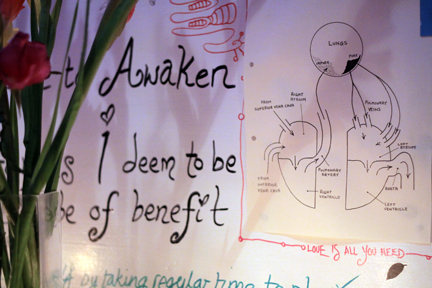
Generally, the purpose of breathing meditation is to calm the mind and develop inner peace. We can use breathing meditations alone or as a preliminary practice to reduce our distractions.
Simple Breathing Meditation
The first stage of meditation is to stop distractions and make our mind clearer and more lucid. This can be accomplished by practicing a simple breathing meditation. We choose a quiet place to meditate and sit in a comfortable position. We can sit in the traditional cross-legged posture or in any other position that is comfortable. The most important thing is to keep our back straight to prevent our mind from becoming sluggish or sleepy.
We sit with our eyes partially closed and turn our attention to our breathing. We breathe naturally, preferably through the nostrils, without attempting to control our breath, and we try to become aware of the sensation of the breath as it enters and leaves the nostrils. This sensation is our object of meditation. We should try to concentrate on it to the exclusion of everything else.
At first, our mind will be very busy, and we might even feel that the meditation is making our mind busier; but in reality we are just becoming more aware of how busy our mind actually is. There will be a great temptation to follow the different thoughts as they arise, but we should resist this and remain focused single-pointedly on the sensation of the breath. If we discover that our mind has wandered and is following our thoughts, we should immediately return it to the breath. We should repeat this as many times as necessary until the mind settles on the breath.
Benefits of Meditation
If we practice patiently in this way, gradually our distracting thoughts will subside and we will experience a sense of inner peace and relaxation. Our mind will feel lucid and spacious and we will feel refreshed. When the sea is rough, sediment is churned up and the water becomes murky, but when the wind dies down the mud gradually settles and the water becomes clear. In a similar way, when the otherwise incessant flow of our distracting thoughts is calmed through concentrating on the breath, our mind becomes unusually lucid and clear. We should stay with this state of mental calm for a while.
Even though breathing meditation is only a preliminary stage of meditation, it can be quite powerful. We can see from this practice that is is possible to experience inner peace and contentment just by controlling the mind, without having to depend at all upon external conditions.
When the turbulence of distracting thoughts subsides and our mind becomes still, a deep happiness and contentment naturally arises from within. This feeling of contentment and well-being helps us to cope with the busyness and difficulties of daily life. So much of the stress and tension we normally experience comes from our mind, and many of the problems we experience, including ill health, are caused or aggravated by this stress. Just by doing breathing meditation for ten or fifteen minutes each day, we will be able to reduce this stress. We will experience a calm, spacious feeling in the mind, and many of our usual problems will fall away. Difficult situations will become easier to deal with, we will naturally feel warm and well disposed towards other people, and our relationships with others will gradually improve.


You must be logged in to post a comment.