
HUMAN ANATOMY

The human body is the most ingenious assembly of purposeful components you will ever ever find on this planet.

Beneath the envelope of skin and tissue, there are muscles, nerves, a circulatory system for blood, glands, vital organs, and above all, that marvellous system of bones called the Skeleton.

The skeleton not only supports the muscles and body as a whole, protecting those vital organs of brain and lungs but it is also responsible for our basic shape and size (although the last word in that matter comes from the muscles and subcutaneous tissue and skin).

The skeleton consists of 214 bones (which includes the six ossicles found the ears – not listed below).

AXIAL SKELETON

The axial skeleton comprises the skull, the backbone (vertebral column) and the ribs and breastbone (sternum).

APPENDICULAR SKELETON

The appendicular skeleton comprises the legs, arms (limbs) and shoulder and pelvic girdles.

The skeletal bones are classified according to their shape and formation

LONG BONES  found mainly in the limbs, fingers etc

SHORT BONES such as found in the wrist

FLAT BONES like in the shoulder-blades, skull etc

IRREGULAR BONES such as some facial bones and those of the vertebrae etc

SESAMOID BONES like those developed in the tendons of the muscles. The knee-cap is a good example.

SO:

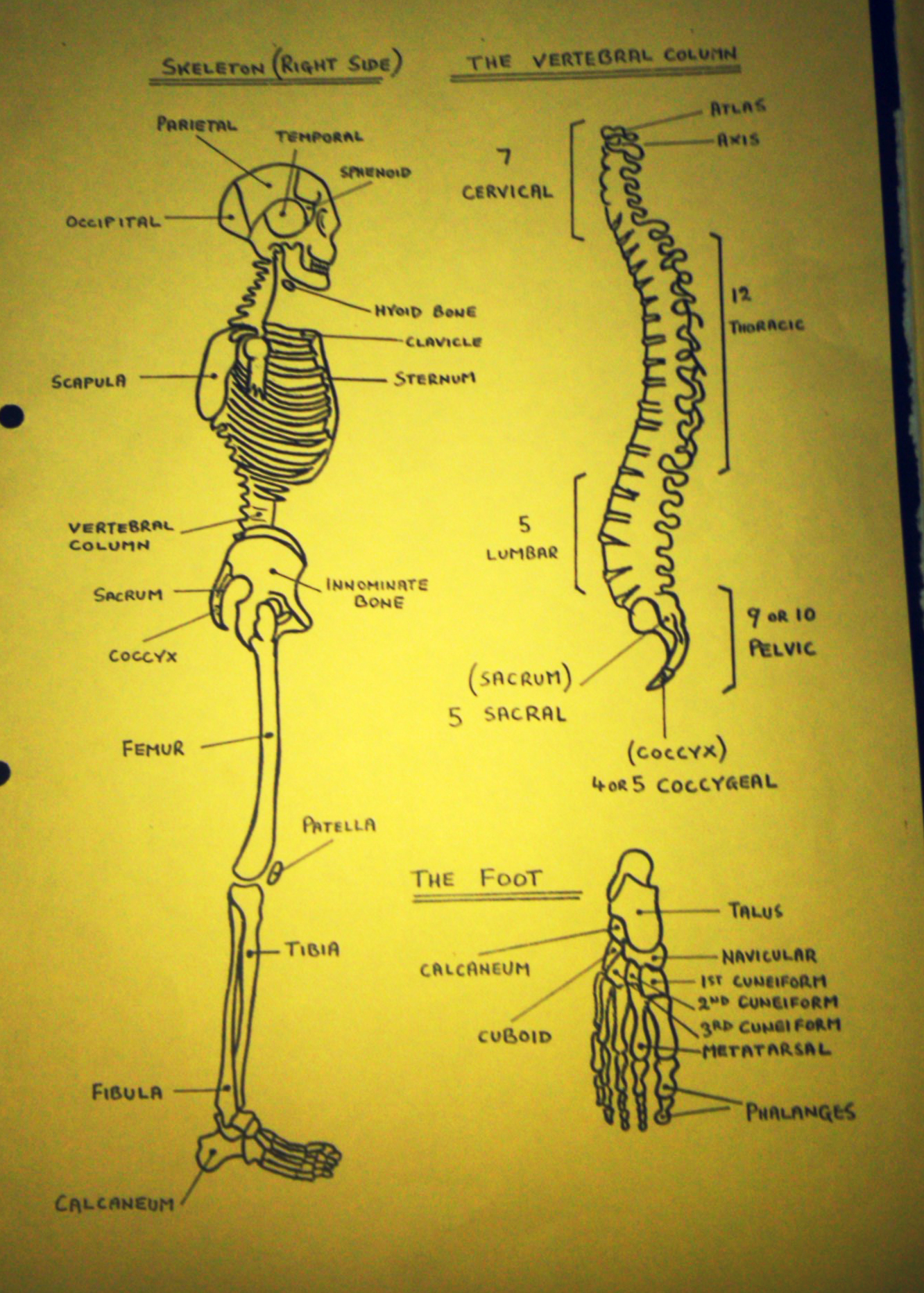
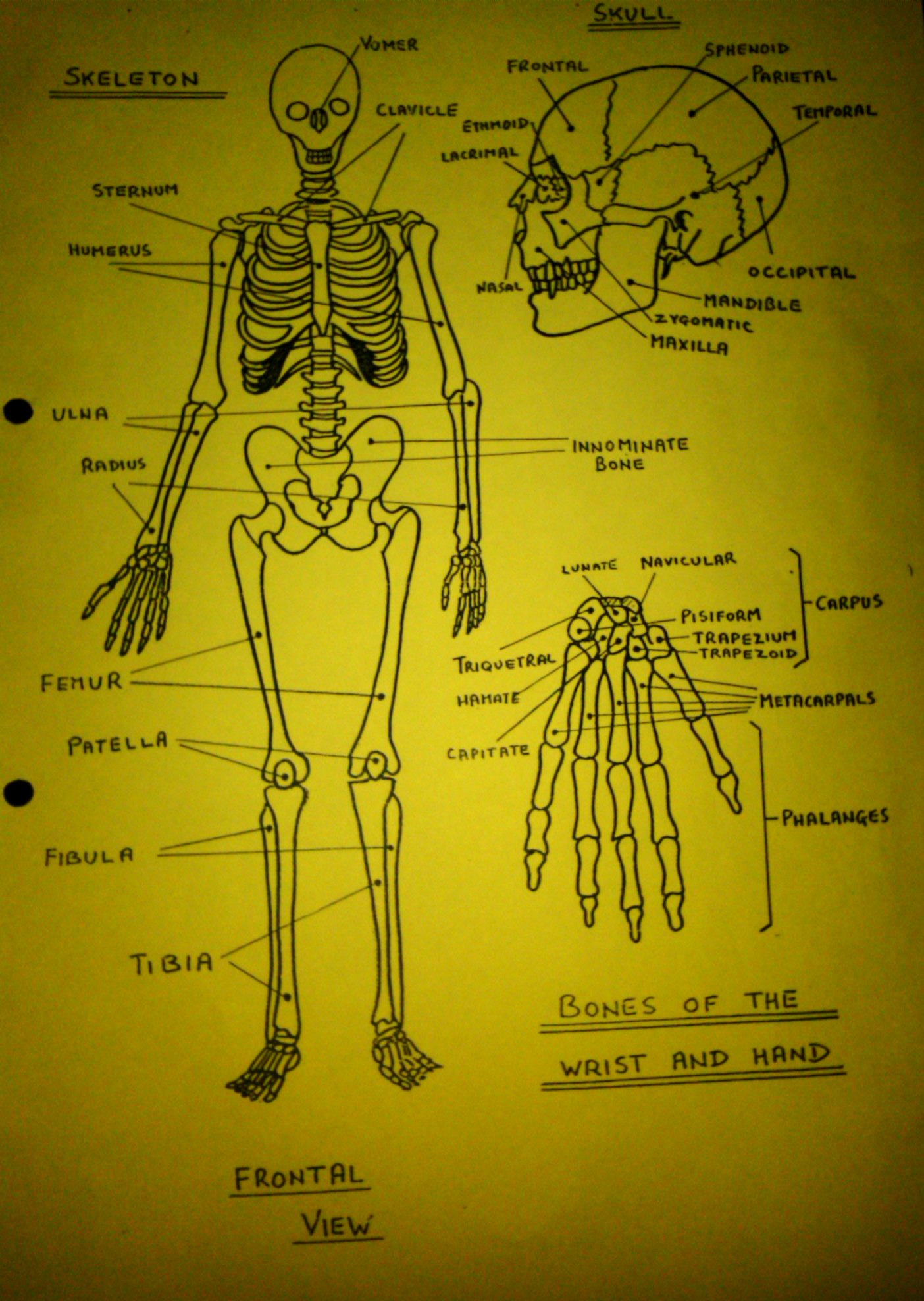
Starting at the top we have the SKULL and the SKULL consists of the Cranium and the Face.

The CRANIUM has 8 bones which are made up of 1 occipital, 2 parietal, 1 frontal, 2 temporal, 1 sphenoid and 1 ethmoid.

The FACE has 14 bones and they are made up of 2 nasal, 2 palatine, 2 lacrimal, 2 zygomatic, 1 vomer, 2 inferior turbinate, 2 maxillae and 1 mandible

The VERTIBRAL Column has 33 bones (sometimes 34). Each separate bone is called a vertebra.

The upper 7 vertebrae (plural of vertebra) are called the Cervical vertebrae, the uppermost two permitting movement of the neck. the first cervical vertebra is called the Atlas and the second is called the Axis. Together these two bones form the Atlanto-axial joint.

Then we have 12 thoracic vertebrae. Then we have 5 lumbar vertebrae. After the lumbar comes the sacral vertebrae which form the sacrum after which comes the tail of the spine, the coccyx, which comprises of 4 (or5) coccygeal vertebrae.

Within the thoracic vertebrae we have what is known as the thoracic cage. it consists of the 12 thoracic vertebrae (already mentioned above) at the back, 12 pairs of ribs at the sides and the sternum at the front.

Uppermost in this cage we have 7 pairs of true ribs, below them, 3 pairs of false ribs and then 2 pairs of floating ribs.

The true ribs (pairs 1-7) are attached directly to the sternum, the false ribs (8-10) are attached indirectly to the sternum (by means of cartilage extending from each rib to the one above and then ribs (11 and 12) are not attached to the sternum in any way (hence the term ‘floating’).

Above this we have the shoulder girdle: the left and right Clavicle (collarbones) and left and right Scapula (shoulderblades).

In isolation in front of the throat rests the hyoid, a small bone.

Attached to each side of the shoulder girdle we have the upper body limbs, otherwise known as the ARMS. Nearest the shoulder is the upper arm bone, the Humerus and then for the lower part you find the Radius and Ulna, placed side by side. Then moving on to the Wrist and Hand, these bones are: The 8 bones of the Carpus, the Navicular (Scaphoid), Lunate (Semilunar), Triquetral, Pisiform, Trapezium, Trapezoid, Capitate and Hamate. Then there 5 Metacarpals (the bones between the fingers and wrist) and then the 14 Phalanges which form the Thumb and 4 Fingers.

BELOW the WAIST we have the PELVIC GIRDLE and this consists of the 5th lumbar vertebrae, the sacrum, the coccyx at the back and 2 Innominate bones which encircle the remainder of the region.

Moving on to the LEGS : You have the Femur (Thigh Bone), the Patella (Knee Bone), the Tibia (Shin Bones) and the Fibula (placed alongside the tibia).

Bones of the FOOT are: 7 tarsus bones, the Calcaneum (heel), Talus, Navicular, Cuboid, 3 Cuneiforms, the 5 metatarsals, and then the 14 phalanges forming the toes.

JOINTS

A joint (or articulation) is a union of two or more bones.

There are 3 main types:

1.Fibrous (immovable) – a fixed joint allowing no movement whatsoever, i.e the joints (sutures) of the flat bones of the skull, like the teeth in their sockets etc.

2.Cartilaginous (slightly moveable) – in this joint the surfaces are separated by some intervening substance such as cartilage … i.e the intervertebral joints of the vertebral column with their intervertebral discs of fibro-cartilage.

3.Synovial (freely moveable) – the ends of the bones forming the joint are covered by hyaline cartilage. ligaments are necessary to bind the bones together, and the joint cavity is filled with synovial fluid and is enclosed by a capsule of fibrous tissue.

Varieties of Synovial Joints:

1.Gliding – small bones of the carpus etc

2.Ball and Socket – hip and shoulder joint

3.Hinge – elbow joint

4.Condyloid – wrist joint

5.Pivot – atlanto-axial joint

6.Saddle – joint between the trapezium and first metacarpal bone (thumb)

IMG01104-20130401-1947

IMG01105-20130401-1947

Biostrata ……….. continues 7

Mind is intelligence, awareness, consciousness, perception, mind exists in and with everything. It is the inherent and most basic quality of active prana. Therefore you will see that the human body, being made up of prana and displaying infinite complex behaviour patterns, is also Mind.

Consciousness makes us see ourselves sometimes as ‘bodies’ and other times as ‘minds’.

It is always the observation (the point of view) which changes, not that which is being observed, and so it is, with every single one of us human beings, we can all be observed as mind, body or spirit.

Now upon having gathered the knowledge of all of the above we can now look at the true nature of Mind and consider too the 3 sections it is divided into …. Conscious, Subconscious and Unconscious.

The human ‘conscious’ mind belongs to the Sensory Stratum, the ‘subconscious’ and ‘unconscious’ belong to the Cellular Stratum, with the ‘unconscious’ reaching all the way down to the Pranic Stratum (after passing through the molecular and atomic strata too).

The conscious mind possesses a number of faculties, ‘Consciousness’ being just one of them.  Consciousness (otherwise termed ‘Awareness’) is introspective and results from exclusive components which make up a unit, i.e the consciousness of ‘cells’ and/or ‘molecules’ and the intelligence displayed therein of those components/units.  When awake and fully conscious, we rely on the combined consciousness of all cells for our normal functioning, together all combinations give us our Awareness.  During sleep however, ‘sensory’ consciousness can become ‘patchy’ as not all cells are still functioning, some have suspended their activities. Sensory experience (in sleep) is fragmentary and incomplete and inclined to seem slightly less ‘real’ than that of the fully awake sensory consciousness. Hence the phenomenon ‘Dreaming’.

All levels of the Biostrata need each other, no one level can exist without the others for this is all about a progressive, unifying process in the development of inert Prana to Human Being.

Communication throughout the Biostrata is strictly from one stratum to the adjacent stratum so it is not possible for say, the Sensory Stratum to communicate directly with the Molecular Stratum, the communication must pass through all intermediate strata wherever the communicating strata are not adjacent with each other. This communication is much the same as any form of communication, whereby it is an influencing of awareness of one entity, reaching out to the awareness of another.Usually this communication is for one of two reasons. Either for controlling the units of another stratum, or for the purpose of being controlled by the units of another stratum.

Consciousness is unique, it belongs to one unit and is its inherant part. when a number of units of one stratum unite they constitute a ‘complete’ unit in a higher stratum and thereby produce a ‘collective unit consciousness’ .. i.e another ‘one exlusive unit’.

Awareness (Human Consciousness) is the ‘agent’ for all communication in the Sensory Stratum, it is not only a ‘receiver’ susceptible to other strata but it is also a ‘transmitter’ which has capability of influencing all units of its own, and other, strata.

The Human Consciousness is better able to communicate with strata below its own level rather than the levels above and this makes it more understandable to us how we can appreciate being ‘stuck’ in the Sensory Strata, often unable to progress upwards to the Spiritual Strata. Consciousness marks the extent of our singular development within the Biostrata, having ascended from the Pranic Stratum and being made up of units of the Cellular, Molecular and Atomic Strata, you will understand that when any unit of the Sensory Stratum is communicating with units of the lower strata, it is indeed actually communicating with parts of itself.  Whenever we use our physical apparatus such as moving limbs or swallowing morsels of food we are communicating within the Cellular Stratum, making appropriate cells action and respond in accordance with our wishes, and those cells composed of molecules and atoms are all receiving communication from the Sensory Stratum, continuing, automatically, down and down the entire number of components until the Pranic Stratum is reached and all necessary communication has been actioned.  You will recognise for instance, when you are hungry, you are made aware of this by Sensory Consciousness, it is a message from the Cellular Stratum telling you (human consciousness) that you must eat. Therefore these are the busiest lines of communication, the interchange of influences between the Sensory Stratum and all strata below.

If you take yourself to your current level of Sensory Stratum you might think that communication on this level is the easiest but alas, even with all the lines of help brought about by Post, Radio, Telephone etc there still remains some of the most difficult, if not impossible obstructions regarding communications between human beings on a Sensory Level.

When a human being (one unit of the sensory stratum) communicates with another human being it is possible for there to be awareness of who is the receiver and who is the transmitter, both can occupy consicousness at the same time, however, when one human is communicating with another, what has to be remembered is that communication is happening with a ‘separate’ consciousness and therefore, this is not as easy as communication with one’s own component cells.  If you have little understanding of your own Sensory Self and all parts below (and above if possible) then you will have greater challenge in communicating with other conscious beings (especially if they have little or no understanding of their development).

Finally, to reach up and communicate to the strata above proves the most challenging and is probably the Sensory Stratum units’ upmost difficult communication. When a human being ‘reaches up’ it is doing so into the ‘unknown’ and the awareness is that of the actual reaching rather than of which level is being reached.  The Spiritual Stratum is intuitive and when the Sensory Stratum does manage to communicate with the Spiritual Stratum it receives intuition and inspiration. Human consciousness must expand and transcend the Sensory Stratum if it is to successfully communicate with the Spirit and the Godhead of the Biostrata. Only when Human consciousness has made itself receptive by negating the significance of all sensory stimuli can it expand, can it reach up, can it communicate with a unit of the Spiritual Stratum and thereupon receive Intuition and Inspiration.

Biostrata ….. continues 6

Now the true nature of development is taking place. Between the Sensory Stratum and that of the Godhead, rests the Spiritual Stratum.

As shown already, the trend is ever upwards as the units of one stratum come together to form units in a higher stratum. Just as the cells join to form human bodies, human bodies also join and unite to form spiritual units.

The spiritual stratum is perhaps the most complex of all the Biostrata for the human bodies from the sensory stratum unite in specialized groups to form a plethora of interrelated unit types, those such as ‘family’ which is first in the field of spiritual unit types what with its genetic bonds and those qualities of unique loyalty. Then coming up closely behind the family unit is the vast and ever-widening racial unit. There are far less racial units than family units in the Spiritual Stratum and here is where complexity kicks in even more so for both family and racial units are dependent upon each other for their components (human bodies) and therein lies the fact that each race becomes composed of a greater number of families because more and more we find families belonging to more than one race.  Parents of differing races come together to make new families. Atop of all this we then have the multi-complex combining of units via nations, cultural societies, religion and religious organizations, politics and political groups, idealists and their seedlings.  Despite all of this mixed up overlapping, the spiritual intelligence is of the highest order, it is the link between the sensory (human) intelligence and the godhead infallible. Spiritual intelligence is infallible at its very best and far more reliable than sensory intelligence at its very worst.

Again, reverting to your triangle Biostrata diagram you will see that the Spiritual Stratum is but one step from the Godhead Infallible.  But what is infallibility?

The Godhead holds ‘exclusive’ rights to infallibility, being the most elevated level of intelligence. Being at the most elevated level of intelligence is always by courtesy of the Godhead for the complete Biostrata is an extension of the Godhead. All essential and absolute qualities for Life becoming ever more fallible and as yet, less vital as disintegration and dissipation co-exist in ever readiness to dilute existence back to the basic Pranic stratum, and as such behaviour and intelligence and all extensions exist only as an inert promise to great propensity.

Within the Biostrata, there are three possible states to existence and they are Life, Stagnation and Deterioration.

True Life exists when progress within the Biostrata is in upward motion, moving toward the Godhead. Any movement in the opposite downward motion is a resulting deterioration, life diminishing descent toward death. Stagnation is the state of there being such an enormous variety of inanimate substances present in the Universe about us. Inhibiting influence causes stagnation within a stratum, almost stopping the upward trend of the Life-state. Life forms from every level of evolution all play a role appropriate to its biostrata status and all of these so to contribute to the ascendance or descendance through life and death.

Life status is an ascent, Death status is from descent but stagnation occurs in an outward direction on a horizontal plane. All interact and influence each other and this can have a stabilizing effect but also ensures no single state can gain supremacy without a struggle.  Life is indeed a struggle, a continual battle against Stagnation and Death.  But deterioration does not just happen, it is brought on by units failing to resist the lure of stagnation. Instead of resisting stagnation, those units who collaborate will eventually lose their vitality and thus must surrender to Deterioration.

Dependent upon which state is exerting the greater influence at the time when stagnation is allowed to succeed on one particular level will rely heavily on whether Life continues or Death ensues and from this we can learn that Stagnation means remaining too long with the bounds of one stratum.

You will see this clearly in this so-called civilized world that there is far too much stagnation. Within the consciousness of almost every human being there is a choice to stay outbound in direction over the whole of the Sensory (mind) stratum of the Biostrata rather than continuing to expand upwards to the Spiritual Stratum and eventually the Godhead. Stagnating in the Sensory Stratum not only increases the struggle for existence but it so weakens life’s upward ‘thrust’ too – as a result, Deterioration’s chances of gaining supremacy greatly improve.

One of the biggest and most valuable lessons to learn from this piece of knowledge is that the most successful, wholesome form of life and living can be experienced whilst ascending the Biostrata. It would be most prudent to seek avoidance from stagnation and deterioration. Remembering that all of this applies to the impermanent Self (the bodily vehicle) for the Essential Self moves in one direction only, and that is toward Godhead enlightenment.

We have only to resist Stagnation in order to deter and delay Deterioration and prolong life as the impermanent Self thus hastening the Essential Self’s ascent to the ultimate haven of spiritual bliss – the Godhead.


Biostrata …. continues 5

We now find ourselves evolved to the stage of the Sensory Stratum and here, development of the intelligence displayed is generally known as ‘Human’ intelligence.  Within the ‘grey’ areas of there being no difference between mind and matter it is sometimes challenging to understand the credibility of this. But think on, your body is made up of cells which ‘display’ intelligence, for their behaviour is that of organised pranic (life source) movement, and as we have seen so far, all the way up through the layers of Biostrata there is intelligence. Thus, this belongs to both mind and matter.

For human intelligence to exist, there is dependence upon sensory images. This is so because when we think, or apply intelligence to problem solving, we are readily using ‘sensory’ images. We have not the capability to think of pure quality or pure quality for we must at all times have available to us, sensory images, better known as ‘symbols’ which represent the quantities and qualities which constitute the subject of our thinking.  For example, if we were to try to think of the pure quantity of SEVEN, we would find that impossible, yet if we produce in the mind, a symbol and/or sensory images that represent SEVEN, we can then immediately begin to envisage that quantity.  We could visualise SEVEN apples or audibly imagine SEVEN chimes of a bell.  The ‘types’ of symbols used are not important but their presence in the imagination is fundamental to being able to ‘think’ about quantities.

Of course we know we have progressed further than this method of ‘quantity’ thinking (albeit the exception in young children in their learning informative years) for we have moved forward to utilise specific written symbols for each number and so to do we have symbolism when ‘thinking’ about quality. LOVE for instance, unless we can produce a sensory image in respect of this, something or someone who portrays the quality of Love, we would find it impossible to think (feel) it.

Qualities are abstract. Like a hole; that is abstract. A hole cannot be perceived purely as a hole, there must be a concrete counterpart. If you have a hole in a piece of wood and then the piece of wood were to be destroyed, there would be no hole. We are only able to think/perceive that hole in relation to the piece of wood it is found within.

So to think of an object of beauty, it has to come with a counterpart, a determination of an occasion, we have to see (perhaps a beautiful face), or hear (a beautiful voice) or smell (a beautiful scent) to have something which directly represents that which is beautiful.

Thus, here we are, in the knowing that the human body belongs to the Sensory Stratum of the Biostrata. Every single human body is the outcome of the upward movement/progression/development of Prana, forever ascending the evolutionary scale of Existence.

With this notion, how then do WE determine the extent of OUR potential progress?

The answer is found within consciousness. If consciousness is dependent upon the senses for information then this clearly indicates that the Sensory Stratum has been reached. If consciousness is mainly relying on impulses, feelings and urges then it is on one of instinctive nature (the Cellular Stratum) … but if thinking about quality and quantity through symbolism is reached, then we are at the Sensory Stratum. By no means however, does this mean we are on a ‘precision instrument’ level, one that is indicative of our development for more often than not, although we ‘occupy’ our main ‘stratum of residence’ we are also reluctant to leave behind the old ‘familiarity’ of acquaintance and experience and thus we continue to cling to the stratum immediately below. So too, do the lower stratum, before completely vacating their residence in their eagerness to ascend the biostrata, reach up immediately above and thus you can find intelligence occupying three strata at the same time.

One may think that ascension through the biostrata is now complete, seeing as we have come to our Senses, but we are still yet to reach the apex of the symbolic triangle.  Next we venture further upward to enter the Spiritual Stratum.


Biostrata …. continues 4

In simple terms, Life is an upward motion/process and movement in any other direction is that of deterioration or failure of development.

Here is a diagram to help with a visual understanding of the Biostrata.  The simple, yet empowering shape of the Triangle is utilised.

The Biostrata

The bottom line represents the Pranic Stratum – that of inert energy, the ‘potential life force’ … that from which all recogniseable existence emerges.

You can see that as we move up to the next level of the triangle we enter the Atomic Stratum – that which relies heavily on the Pranic level for its existence, but which is of lowest order of intelligence with its uncomplicated patterns of behaviour … it provides the basis for all matter.

Lifting up to the next part of the triangle we gain admission to the Molecular Stratum and up again into the Cellular Stratum, a continuum in motion, a trend toward unity, a state of being one.

Always, a number of atoms must unite to form a molecule, a number of molecules must come together to form a cell (thus there are fewer cells than molecules) and this continues with existing numbers of units becoming fewer as the number of elements within each unit increases.

Keep returning to this Illustration to assist in understanding.

From the Cellular Stratum we move cohesively into the Sensory Stratum and this is where the collective activities of the cells move forever upward towards unity, being a whole, and thus commit to their specialised groups to form the Body. Again, it is a large leap, like that of the molecular to the cellular.  What is significant about the progression upward from Cellular to Sensory is the contributory elements taking place in the formation of tissue and cells like that of the storing of hereditory data, the relative positionings of tissue formations and much much more which cannot be shown in the illustration but which exist in other ‘strata’ which rest in between the significant stratum as shown in the diagram.

So now we are in the Sensory Stratum and this is known as such quite simply because we have arrived at our Senses.

Biostrata continues ….. 3

From the beginnings of the Biostrata we are aware that Prana is the vital force, the ‘potential’ life force in everything and seeing as it is indeed  the first stratum it deems logical that the atomic, molecular and cellular strata all have prana manifesting in them.  Prana is capable of manifesting at various levels of mind and matter (all relativity dependant of the observer).  Thus, there is a predetermination of the development of pranic manifestation and progress within the natural laws imposed by ‘original design’ (the groupings, the selective process of atoms and molecules and cells) and is something that is predictable at every stage of development.  So when, at the cellular level of life, cells, eventually ‘die’, is this due to the cell running out of Prana? Atoms form molecules, molecules form cells and so forth in an ever upward development of pranic manifestation. There is the common logic of upward direction toward a higher stratum. However, as soon as no further progress is being made within development, or if atoms, molecules and cells fail to conform to their original design, then they are deemed to be ‘dead’ or inanimate and they will begin to break up and fall back downward through the lower strata. This activity denotes gradual deterioration. A cell will break up into molecules and then the molecules will separate into atoms and so it continues.  This could be nothing more than a re-cycling process whereby during ‘deterioration’ there is assessment of how much decline has taken place and if indeed some atoms and molecules can re-enter the upward development and further contribute to fresh material and life-form then so they shall.  When a cell ‘dies’ it does not mean all Prana has disappeared. The dying cell is merely reversing its direction of movement within the Biostrata. It has the capacity to regenerate.

Therefore it is interesting to observe here, how despite the ‘dying off’ of various components within the ‘life form’, whether they be cells, molecules or atoms, there is an ‘essential design’ maintained by the ‘ever upward’ progression of new components (prana, atoms, molecules, cells) coming up through the Biostrata (resulting from reproduction or selective attraction).  These are once again of original design, and are simply replacing those constituent parts whose term has expired and are in descent, possibly to be drawn again into circulation and ascend the Biostrata as new life-forms if their manifestation can regenerate, re-cycle itself.

Life, as we understand it, is an upward progress through the Biostrata and we should see that all development, progress and retrogression, manifestation, behaviour patterns and all intelligence are under direction of a Supreme Controlling Force. It is notwithstanding that everything in existence, whether it be an atom, a molecule, a cell, a human being or inanimate object, it has to make an upward progression through the Biostrata and has to conform to laws which emanate from the Supreme Controlling Force. Non-compliance of this will produce premature stagnation and deterioration because unless there is compliance with the laws of the supreme controlling force, whether by design or by accident, there can be no progress. Progress is Life in the generally accepted context. There is much opportunity for free expression at every level of the Biostrata, however this can only occur within the ‘essential design’ on the law of life.

Biostrata continued ….. 2

The molecular stratum comes after the Pranic and Atomic stratum … basically, molecules are specialised groups of atoms.  Atoms arrange themselves into categories with each category applying specific characteristics having come together as an ‘expression’ of atomic intelligence (atomic characteristics are mainly determined by the number of electrons orbiting each nucleus), so there is always a selective process responsible in forming groups of atoms. This, in turn, relates to selective processes for grouping atoms into molecules. Molecular intelligence is therefore one level higher in intelligence than atoms but only due to the fact that molecular patterns of behaviour are far more complex than that of atoms and therefore selection processing is more intricate. Atoms will come together to form a molecule by use of interaction, producing a pattern of behaviour within a single molecule.  The molecule’s behaviour is mostly due to the atoms influencing each other by way of attraction or repulsion, so as to maintain equilibrium within a molecule’s precise structural arrangement. When molecules start their process of selection they are mainly extending the faculty of ‘atomic selectivity patterns’ within their formation.  The formation of molecules are but an extension of the same procedure as that of atoms, only more intricate, molecules are moving closer to the development of the human body.

Molecules unite to form living human cells.  The jump from molecules to living human cells is far greater than the jump from atoms to molecules but there are always firmly fixed ‘roots’ of the selectivity processes coming from the Atomic stratum. There are specialised groups of molecules to give us complete cells of every design – muscle, blood, bone, nerves. This development now shows us the growing complexity of each successive stratum and how it utilises the qualities and faculties of its preceding strata. This also allows us to witness the different behaviour patterns increasing during growth and displays the increasing level of intelligence, always gaining in superiority as the strata continue upward. The level of intelligence at the Cellular Strata is outstandingly high, so high that cells seem almost able to think.

The Biostrata ….. 1

The Biostrata deals with life force and the deterioration thereof.

There are 7 Levels of the Biostrata

The Pranic Stratum, The Molecular Stratum, The Cellular Stratum, The Sensory Stratum, The Spiritual Stratum and The Godhead.

Prana (Life Force) can be seen to be both a ‘potential force’ and an ‘active force’ … it is the foundation to all other stratum. Without Prana there would be no fundamental structure to Total Existence.  It is deemed that all ‘matter’ is made up of atoms and that atoms constitute Total Existence, but there are vaccums and voids that exist too and it is these which have to be taken into consideration when relating to the Biostrata.

Thus, the baseline of you, and everything around you is made up of Pranic energy, life force, potential or active. This is the commencement of all matter. However, Prana is latent and its existence only becomes evident when ‘other forces’ cause it to manifest as life and activity.

The Biostrata can only become what it is by an ‘increasing of intelligence’, and therefore as we step up each stratum, we step up in intelligence.

After the ‘Pranic Strata’ there is the stratum known as ‘Atomic’. Everyone knows that an atom is a ball of space in which there are organised groups of ‘particles’, electrons, protons and neutrons. These organised groups act much in the same way as the solar system, so just as the planets orbit the sun, the ‘negative’ electrons and ‘positive’ protons orbit the nucleus of the atom. There is ‘electrical charge’ taking place too with the setting-up of force-fields and attractions and repulsions within the ‘space’ inside the atom. This could all be seen as a ‘nothingness’ inside of the atom but how does this ‘nothingness’ manifest? Prana is the answer. Prana can only make its presence manifest when combined with or influenced by ‘other forces’. Therefore, at this basic level of the Biostrata the ‘atom’ is ‘Prana in motion’. An intelligence operating at the lowest level to bring about the formation of precise patterns, generating a variety of frequencies that will work together to create, in every atom, a highy concentrated mass of physical energy.  Once Prana becomes active, it will display activity in more than one aspect and thus will ‘register’ as intelligence, behaviour, or ‘active’ force in infinite capability of expression and assertion at every level of existence. In the Atomic Stratum, Prana endows every atom with the faculty of being able to attract or repel other atoms, thus constituting self-preservation etc. Most interestingly of all atomic qualities is that of ‘selection’ which enables atoms to congregate in specialised groups to form molecules, in turn displaying a higher level of intelligence and pranic behaviour (the next Stratum of the Biostrata being that of the Molecule). Each progressive strata of existence increases in intelligence over that of the preceding stratum.

Hatha Yoga / Styles

Regardless of your age and/or level of fitness you can find a style of Hatha Yoga that will appeal and be most appropriate for your particular body and/or personality. Throughout all styles of Hatha Yoga, basic asanas (postures) and pranayamas (breathing exercises) remain the same, however it is within their order, how they are approached and where attention is focused that differentiates them. The emphasis may be on the postures, the breath, the rhythmic movements, the philosophy or a combination of non-exhaustive factors. There will always be the specific characteristics which reflect any particular teacher’s approach too. All styles and all teachers have their own personalities and it is about finding one which suits you.

Ananda Yoga ~ this method combines physical and spiritual with its purpose to clear and energize the systems of your body in preparation for meditation. Every posture looks toward expanding or heightening self-awareness. It is enhanced through affirmations which are a distinctive feature of this system. This style utilizes series of poses called ‘energization exercises’ which involve tensing and relaxing different parts of the body synchronised with breathing exercises to send energy to all parts. There is emphasis placed on relaxing deeply into the poses reflecting the intention that Hatha Yoga is a preparation for meditation.

Ashtanga Yoga ~ this yoga system is a rigorous practice and can be compared with the training of an elite athlete. There are 240 postures done in six successive series which are all linked by the breath (vinyasa flow). This style of Hatha Yoga represents the most intensive form with its purpose to create heat which in turn produces a cleansing/detoxifying effect on the body. There are equal emphasis placed on strength, flexibility and stamina within Ashtanga practice (also known as ‘Power Yoga’).

Integral Yoga ~ this combines all paths of yoga to benefit all aspects of the individual. One approach is made through asana (postures), pranayama (controlled breathing), selfless study, chanting, prayer, meditation and self-inquiry. Integral Yoga is more meditative than anatomical. This approach encourages one to be ‘at ease in body, peaceful in mind and useful in life’.

Iyengar Yoga ~ this is probably the most widely known technique of Hatha Yoga and is prescribed by yoga master B.K.S Iyengar. It is rigorously scientific and therapeutic and concentrates on alignment, correcting those structural imbalances of the physical body. One will pay close attention to the placement of hands, feet and pelvis as well as gaining alignment of the spine and appendicular frame (arms and legs). There is much attention to detail within Iyengar Yoga and props (wooden blocks, belts, straps, blankets, bolsters) are made available to assist in achieving great symmetry of the skeletal frame and progressing in extension within the posture.

Kripalu Yoga ~ this style of Yoga has been described as ‘meditation in motion’.  There is less concern with the structural detail of the poses more rather how the student feels mentally and emotionally whilst holding the posture. This style encourages a gentle, compassionate and introspective approach and due to the nature of holding the position for a longer time, it helps the practitioner to explore and release any emotional/spiritual obstructions. There are 3 stages to this style of practice, willful practice, will and surrender and surrendering to the body’s wisdom. There are differing intensities offered, gentle, moderate and vigorous. On top of all of this there is spontaneity encouraged through sequences of postures and too in individual postures to be guided by the body’s internal awareness.

Kundalini Yoga ~ this is the ancient practice which is designed to unlock and bring forth the reservoir of energy located deep within the base of the spine. The use of breath, posture, chanting and meditation are all encouraged to stimulate and consciously awaken the ‘kundalini’ through the chakras of energy centres positioned along the spine. The most common breathing exercises to be emphasised are : alternate nostril breathing, diaphragmatic breathing and a dynamic technique called ‘breath of fire’.

Sivananda Yoga ~ this style of Hatha Yoga incorporates a 5 point method of practice. It includes proper exercise, breathing, deep relaxation, vegetarian diet and positive thinking and meditation. The practice herein follows a routine of breathing exercises, sun salutations, a series of postures and then relaxation. Short Mantra chants and prayers will always begin and end each class.

Viniyoga ~ this style is ‘middle of the road’ between exacting Iyengar Yoga and demanding Ashtanga Yoga. Its basis is within the realm of ‘organized course of yoga study’.  There is the combination of asana, pranayama, meditation, text study, counselling, prayer, ritual, chanting and using the powers of imagination. There is a tailoring of the postures to the physical needs of the individual student, the emotional needs and also the cultural heritage. Breathing is considered to be one of the most important parts of the movement and inhalations and exhalations are consciously coordinated and articulated in varying length and ratios. This style of yoga is tutorial on a private one-to-one basis.

Bikram Yoga ~ this style is also known as ‘hot yoga’ for it is practiced within temperatures of 80 degrees or more (supplemented by a humidifier). The 90 minute class consists of 26 hatha yoga postures repeated twice over and there is a pranayama exercise at the beginning and the end of the session. A brief relaxation concludes the class. This style of yoga is exhilarating and an excellent routine for the physically and mentally fit.


The Art of Tantric Sex

tantric sex is meditative, spontaneous and intimate lovemaking … through it you learn to prolong the act of making love and to channel rather than dissipate, potent orgasmic energies moving through you, thereby raising the level of your consciousness ……

tantra transports your sexuality from the plane of doing to the plane of being

there is no goal in tantric sex, only the present moment of perfect and harmonious union … tantra teaches you to revere your sexual partner and to transform the act of sex into a sacrament of love ………….

tantra teaches that lovemaking between a woman and man when entered into with awareness, is a gateway to both sexual and spiritual ecstasy

tantrikas view sexual energy as a divine, all-encompassing life force that sleeps within the individual, permeates the universe, and affects everything we do from birth to death … as sexual beings, we have the ability to raise that energy within ourselves and use it to directly experience alternate or mystical states of consciousness … in effect, we become ‘goddesses’ or ‘gods’; our bodies transformed into temples of female and male divinity

Hunger -v- Appetite

Hunger and appetite are two entirely different features of the human body, hunger being the normal/natural demand for food, appetite the abnormal.  Most people confuse the two.

For the majority of persons who have reached maturity, their natural taste, or ‘Hunger-instinct’ has been made corrupt by ‘Appetite’.   For too long they have not experienced the sensation of genuine hunger and have forgotten exactly what it feels like.  It is a challenge to describe a sensation unless one can recollect the same or a similar sensation experienced at some point during one’s existence.  So to attempt to describe the true sensation of hunger could be like conveying the sound of a violin to someone born ‘stone deaf’ or giving clever description of the whiff of rain to someone born without the sense of smell.

For all those who have disentangled themself from the grip of Appetite then the respective sensations of Hunger and Appetite are easily distinguishable and the precise meaning of each term can be easily acknowledged.  However, to the average person ‘Hunger’ means the foundation of appetite and ‘Appetite’ the result of hunger.  Both words are misrepresented.

Let us take thirst for example.  We all know the sensation of a natural thirst. It is felt in the mouth and throat and can be satisfied only with cool water, as Nature intended.  This natural Thirst is akin to natural Hunger.

Why then, do persons of today’s society deviate from consuming cool water to quench this natural Thirst and instead relent to the abnormal craving for consumption of sweetened flavoured waters, fizzy drinks and caffeine laden concoctions?  How often do you hear a person say that they are ‘so thirsty’ and then see that person reach for a glass of cola or a mug of coffee; or others say they are ‘thirsty’ for a whiskey or a lager.  If nature be in order and these people were really thirsty, or in other words, calling for fluids, pure water would be what they drink for it is only pure water that will gratify natural thirst.

However in these times of unintelligent consumptive society, water will not satisfy this pop or whisky thirst.  Why? The answer is simple; it is a craving, an abnormal appetite – a perverted taste.  The appetite has been created – the habit acquired – and the mastery of it asserted.

You might notice that being the victim of these abnormal ‘thirsts’ you may sporadically experience real thirst and at this point actually will seek water.  This is not a sermon against fancy drink habits; it is merely an illustration between natural instinct and developed habit.

Appetite is an acquired habit of eating or drinking and has little to do with real hunger or thirst.

Man has the ability to acquire an appetite for absolutely anything; be that tobacco or liquor, chewing gum or opium, morphine or caffeine, cocaine or caviar.  Once acquired, an appetite becomes, if anything, stronger than a natural demand.  Man has been known to die of starvation because he/she had spent all their money on drink or narcotics before considering food.  Man steals lies and slays just to gratify their appetite for narcotics.  Who would think of calling this terrible craving of appetite by the name of Hunger?  Yet still we continue to think and speak of as Hunger every craving we have for something to put into the stomach when usually it is merely a symptom of Appetite.

All animals have a natural hunger until it is spoiled by contact with man or woman who tempts it with derivatives of natural food substances, candies and similar articles of miscalled food, much like the young child has a natural hunger until it is spoiled in the same way.  In a child, natural hunger is more or less replaced by acquired appetites, the degree largely dependent upon the wealth and example of its parents – usually, no matter of wealth, the acquirement of false appetite will be as a direct result of those leading by example, i.e the parent/s, who possibly, ignite a fundamentally wrong example.  As the child grows older, it loses all recollection of what real Hunger means.  In fact, people speak of Hunger as a distressing thing, rather than as a natural instinct.

Remember how it feels to go camping and get fresh open-air exercise, to feel natural life again, a taste of real hunger? And then to eat heartily like a young schoolchild with a relish you have not known for years.  You’ll feel hunger in earnest and eat because you have to, not from mere habit, like you do when you’re at home, overloading your stomachs continually.

The story of a party of wealthy people who were shipwrecked whilst on a yachting trip lays example to this.  They were compelled to live on the most meagre fare for ten days.  When rescued they looked the picture of health, rosy, bright-eyed and possessed of the precious gift of good, natural Hunger.

Prior to their shipwreck some of the party had suffered with intestinal dis-ease in one way or another, after the watery washout, they were completely cured because of their experience with scarce food.  During their ten days at sea they had obtained just enough food to properly nourish them and had gotten rid of the waste products of the system that had been poisoning them.  Whether or not they ‘stayed cured’ depended upon whether they again exchanged Hunger for Appetite.

Natural Hunger – like natural Thirst – expresses itself through the nerves of the mouth and throat.  When one is hungry, the thought or mention of food causes a peculiar sensation in the mouth, throat and salivary glands.  The nerves instigate activity, saliva begins to flow and the alimentary canal prepares for work.  The stomach gives no symptoms at all and is not in evidence at such times.  One feels that the ‘taste’ of good wholesome food would be most pleasurable and there are none of those feelings of faintness, emptiness, gnawing etc in the region of the stomach.  These last mentioned symptoms are characteristic of the Appetite habit, which is an insistence that the habit must be continued.  Food must continue to be ‘stuffed’ into the mouth until the Appetite is gratified.

One can return to real Hunger once genuine discipline and self-body knowledge has conquered appetite and allows Hunger to manifest once more.  You can enjoy every mouthful; with even the crust of dry bread giving you much nourishment because it is eaten in a manner that as of yet, is unknown to most of you.

With proper education you can return to nature’s harmony and be well fed and properly nourished and enjoy feast upon feast for you will have cultivated and possessed yourself of that most piquant of all sauces – Hunger.