The human body is the most ingenious assembly of purposeful components you will ever ever find on this planet.
Beneath the envelope of skin and tissue, there are muscles, nerves, a circulatory system for blood, glands, vital organs, and above all, that marvellous system of bones called the Skeleton.
The skeleton not only supports the muscles and body as a whole, protecting those vital organs of brain and lungs but it is also responsible for our basic shape and size (although the last word in that matter comes from the muscles and subcutaneous tissue and skin).
The skeleton consists of 214 bones (which includes the six ossicles found the ears – not listed below).
AXIAL SKELETON
The axial skeleton comprises the skull, the backbone (vertebral column) and the ribs and breastbone (sternum).
APPENDICULAR SKELETON
The appendicular skeleton comprises the legs, arms (limbs) and shoulder and pelvic girdles.
The skeletal bones are classified according to their shape and formation
LONG BONES found mainly in the limbs, fingers etc
SHORT BONES such as found in the wrist
FLAT BONES like in the shoulder-blades, skull etc
IRREGULAR BONES such as some facial bones and those of the vertebrae etc
SESAMOID BONES like those developed in the tendons of the muscles. The knee-cap is a good example.
SO:
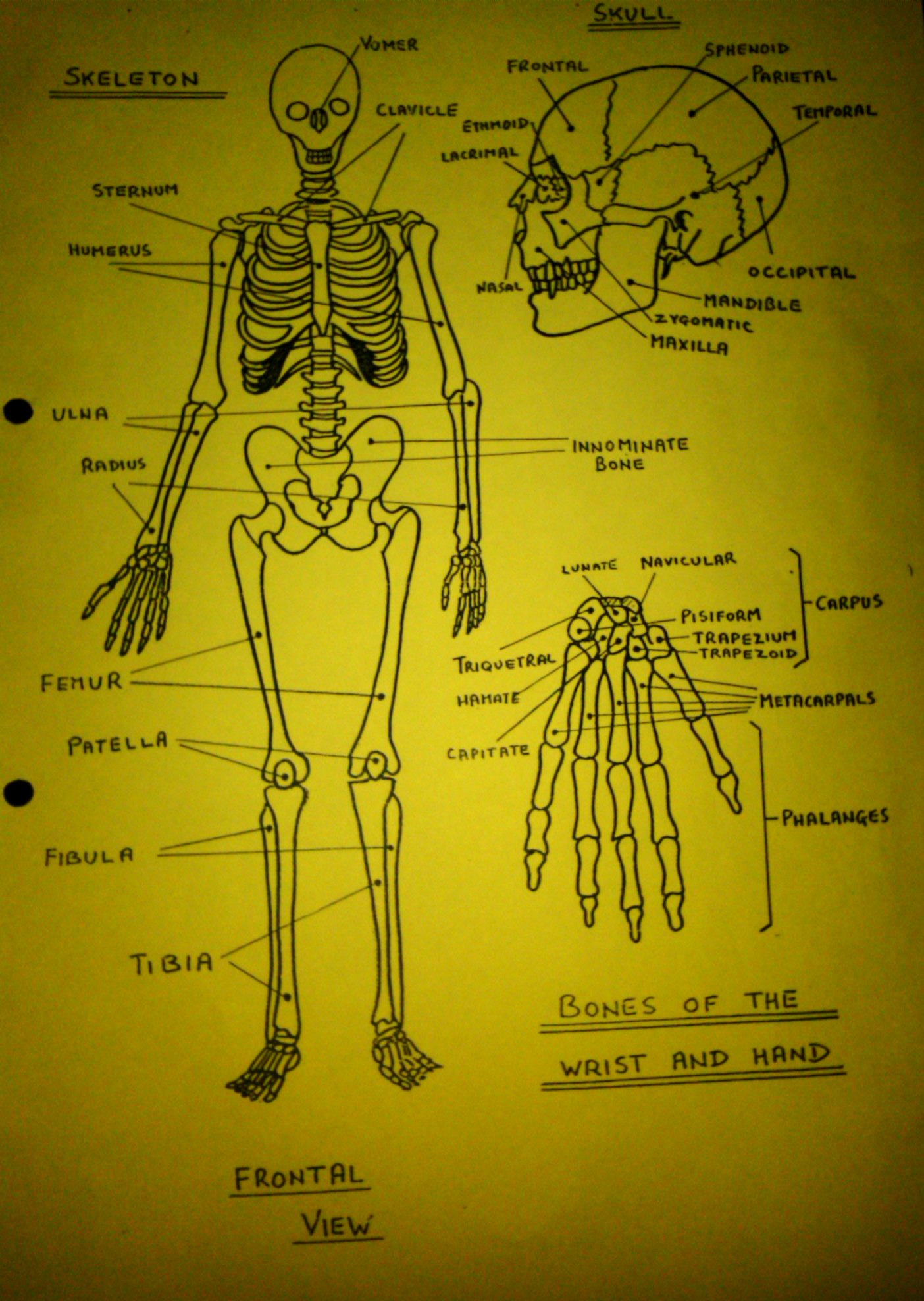
Starting at the top we have the SKULL and the SKULL consists of the Cranium and the Face.
The CRANIUM has 8 bones which are made up of 1 occipital, 2 parietal, 1 frontal, 2 temporal, 1 sphenoid and 1 ethmoid.
The FACE has 14 bones and they are made up of 2 nasal, 2 palatine, 2 lacrimal, 2 zygomatic, 1 vomer, 2 inferior turbinate, 2 maxillae and 1 mandible
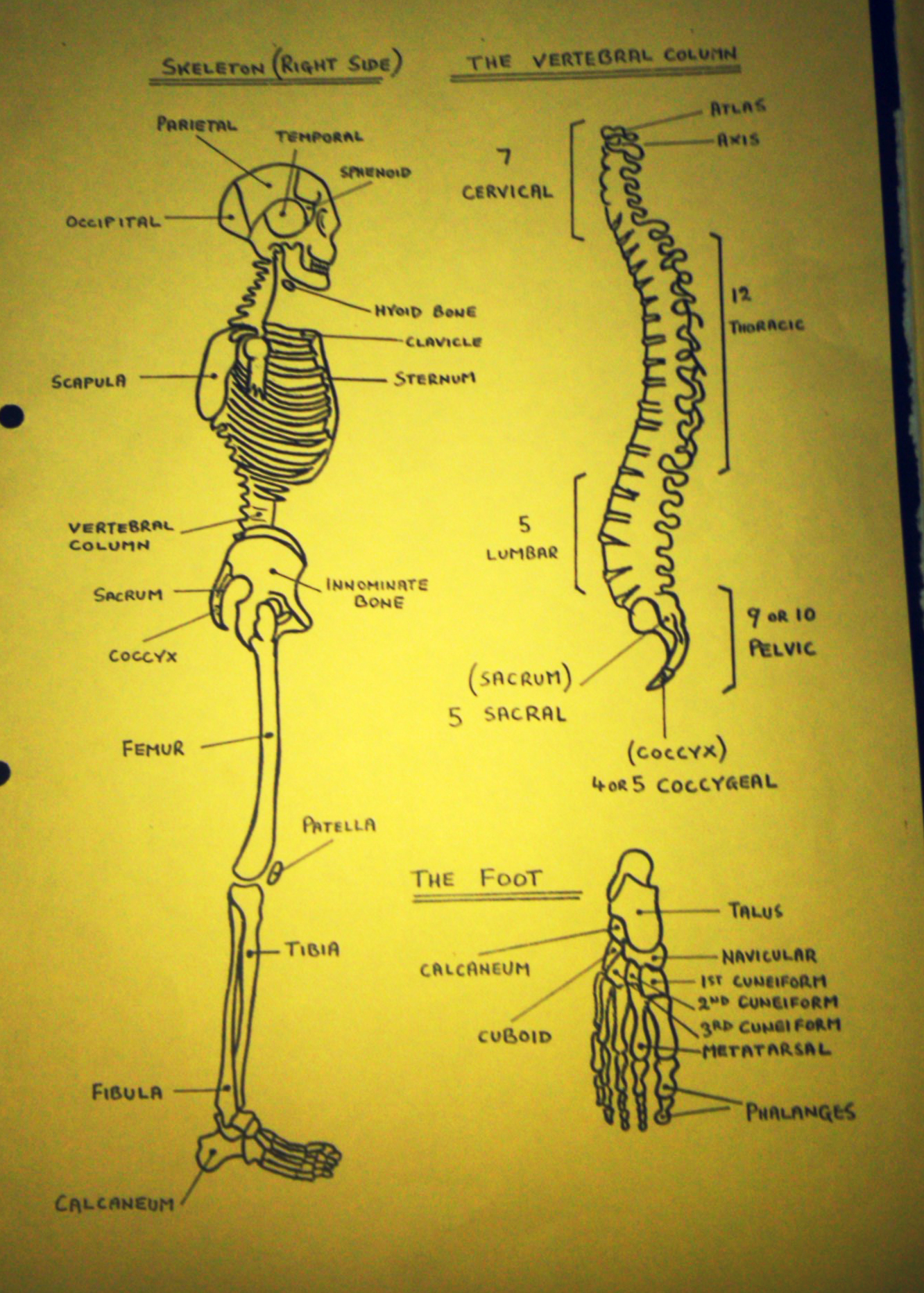
The VERTIBRAL Column has 33 bones (sometimes 34). Each separate bone is called a vertebra.
The upper 7 vertebrae (plural of vertebra) are called the Cervical vertebrae, the uppermost two permitting movement of the neck. the first cervical vertebra is called the Atlas and the second is called the Axis. Together these two bones form the Atlanto-axial joint.
Then we have 12 thoracic vertebrae. Then we have 5 lumbar vertebrae. After the lumbar comes the sacral vertebrae which form the sacrum after which comes the tail of the spine, the coccyx, which comprises of 4 (or5) coccygeal vertebrae.
Within the thoracic vertebrae we have what is known as the thoracic cage. it consists of the 12 thoracic vertebrae (already mentioned above) at the back, 12 pairs of ribs at the sides and the sternum at the front.
Uppermost in this cage we have 7 pairs of true ribs, below them, 3 pairs of false ribs and then 2 pairs of floating ribs.
The true ribs (pairs 1-7) are attached directly to the sternum, the false ribs (8-10) are attached indirectly to the sternum (by means of cartilage extending from each rib to the one above and then ribs (11 and 12) are not attached to the sternum in any way (hence the term ‘floating’).
Above this we have the shoulder girdle: the left and right Clavicle (collarbones) and left and right Scapula (shoulderblades).
In isolation in front of the throat rests the hyoid, a small bone.
Attached to each side of the shoulder girdle we have the upper body limbs, otherwise known as the ARMS. Nearest the shoulder is the upper arm bone, the Humerus and then for the lower part you find the Radius and Ulna, placed side by side. Then moving on to the Wrist and Hand, these bones are: The 8 bones of the Carpus, the Navicular (Scaphoid), Lunate (Semilunar), Triquetral, Pisiform, Trapezium, Trapezoid, Capitate and Hamate. Then there 5 Metacarpals (the bones between the fingers and wrist) and then the 14 Phalanges which form the Thumb and 4 Fingers.
BELOW the WAIST we have the PELVIC GIRDLE and this consists of the 5th lumbar vertebrae, the sacrum, the coccyx at the back and 2 Innominate bones which encircle the remainder of the region.
Moving on to the LEGS : You have the Femur (Thigh Bone), the Patella (Knee Bone), the Tibia (Shin Bones) and the Fibula (placed alongside the tibia).
Bones of the FOOT are: 7 tarsus bones, the Calcaneum (heel), Talus, Navicular, Cuboid, 3 Cuneiforms, the 5 metatarsals, and then the 14 phalanges forming the toes.
JOINTS
A joint (or articulation) is a union of two or more bones.
There are 3 main types:
1.Fibrous (immovable) – a fixed joint allowing no movement whatsoever, i.e the joints (sutures) of the flat bones of the skull, like the teeth in their sockets etc.
2.Cartilaginous (slightly moveable) – in this joint the surfaces are separated by some intervening substance such as cartilage … i.e the intervertebral joints of the vertebral column with their intervertebral discs of fibro-cartilage.
3.Synovial (freely moveable) – the ends of the bones forming the joint are covered by hyaline cartilage. ligaments are necessary to bind the bones together, and the joint cavity is filled with synovial fluid and is enclosed by a capsule of fibrous tissue.
Varieties of Synovial Joints:
1.Gliding – small bones of the carpus etc
2.Ball and Socket – hip and shoulder joint
3.Hinge – elbow joint
4.Condyloid – wrist joint
5.Pivot – atlanto-axial joint
6.Saddle – joint between the trapezium and first metacarpal bone (thumb)




You must be logged in to post a comment.