
HUMAN ANATOMY

The human body is the most ingenious assembly of purposeful components you will ever ever find on this planet.

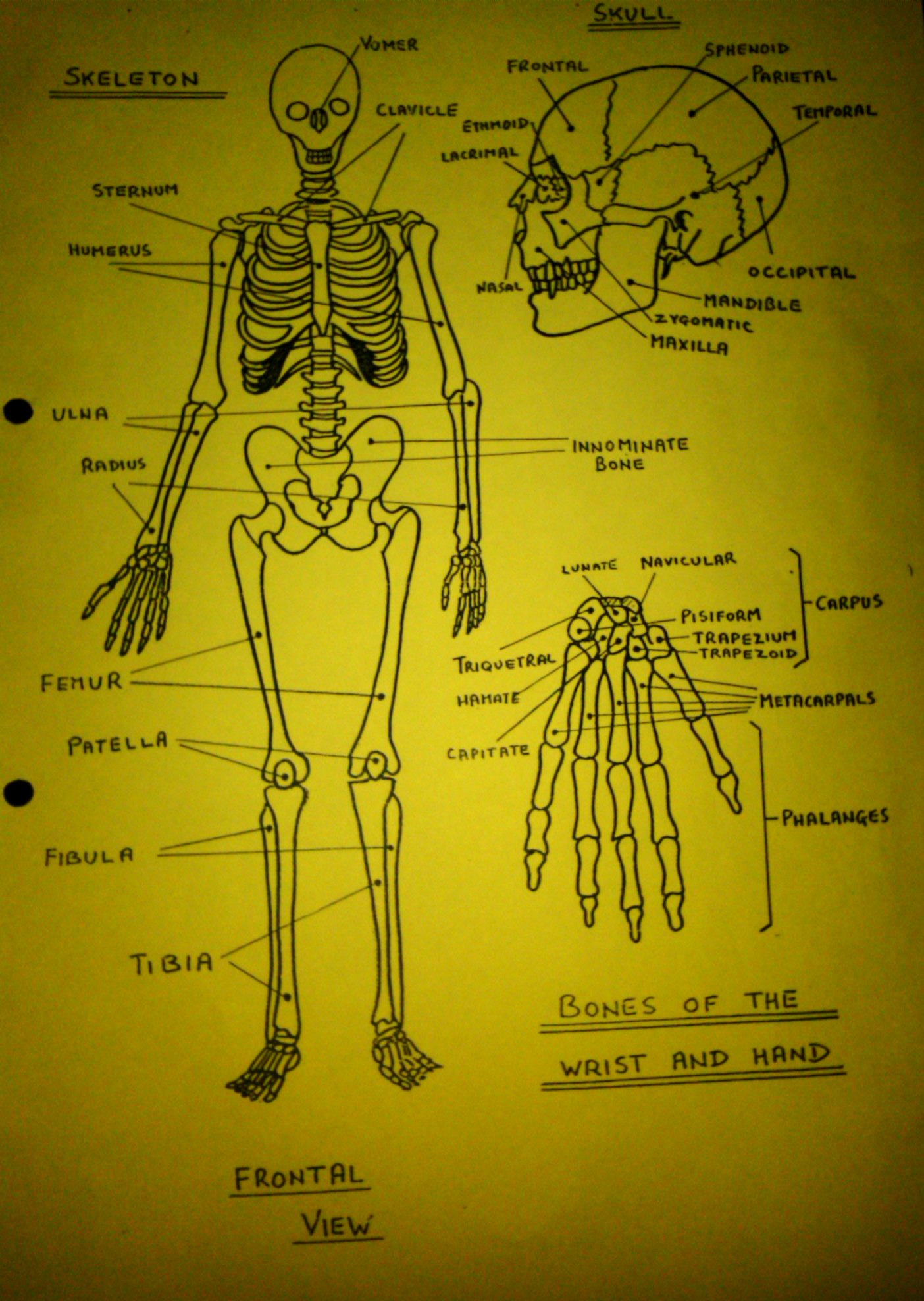
Beneath the envelope of skin and tissue, there are muscles, nerves, a circulatory system for blood, glands, vital organs, and above all, that marvellous system of bones called the Skeleton.

The skeleton not only supports the muscles and body as a whole, protecting those vital organs of brain and lungs but it is also responsible for our basic shape and size (although the last word in that matter comes from the muscles and subcutaneous tissue and skin).

The skeleton consists of 214 bones (which includes the six ossicles found the ears – not listed below).

AXIAL SKELETON

The axial skeleton comprises the skull, the backbone (vertebral column) and the ribs and breastbone (sternum).

APPENDICULAR SKELETON

The appendicular skeleton comprises the legs, arms (limbs) and shoulder and pelvic girdles.

The skeletal bones are classified according to their shape and formation

LONG BONES  found mainly in the limbs, fingers etc

SHORT BONES such as found in the wrist

FLAT BONES like in the shoulder-blades, skull etc

IRREGULAR BONES such as some facial bones and those of the vertebrae etc

SESAMOID BONES like those developed in the tendons of the muscles. The knee-cap is a good example.

SO:

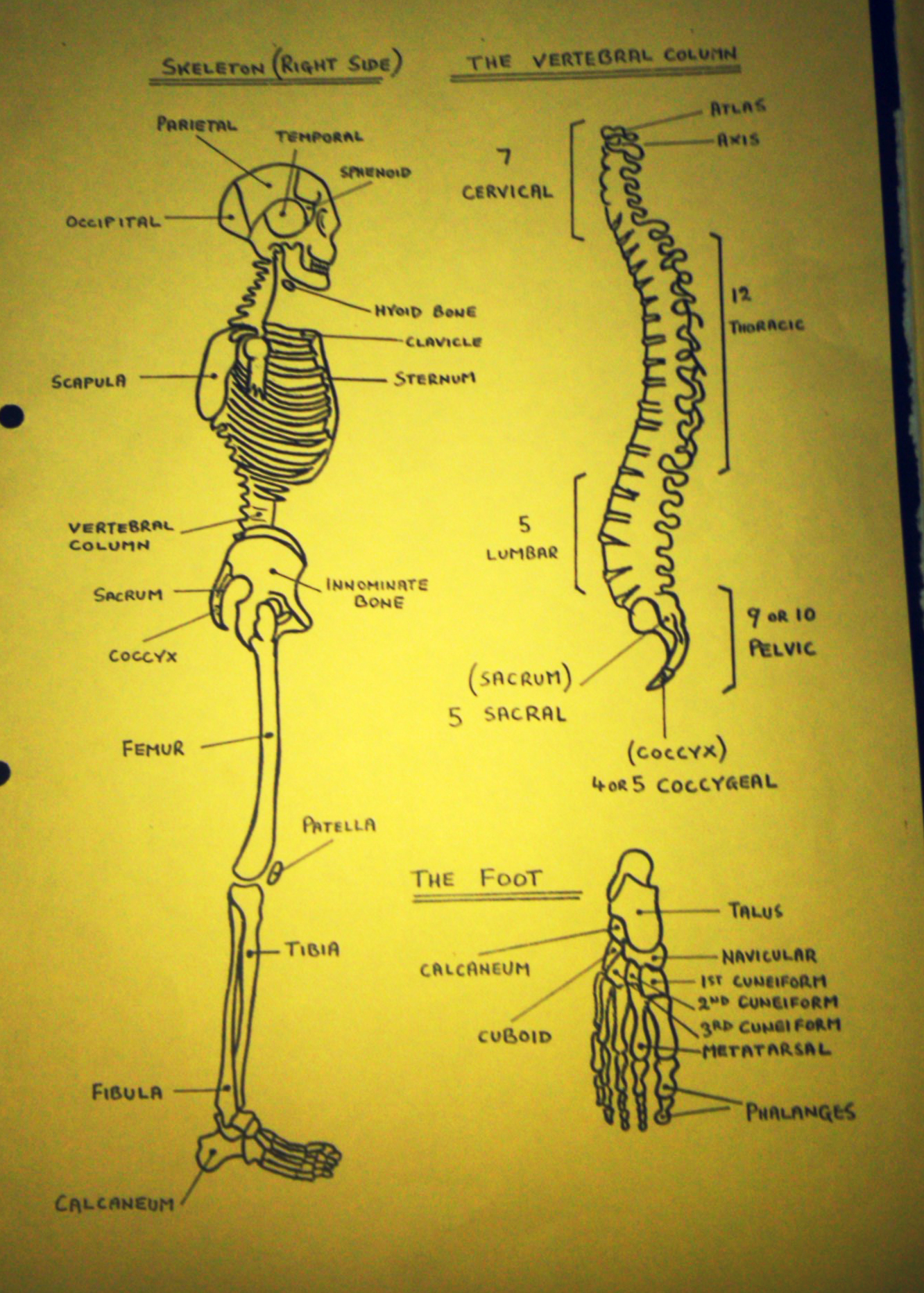
Starting at the top we have the SKULL and the SKULL consists of the Cranium and the Face.

The CRANIUM has 8 bones which are made up of 1 occipital, 2 parietal, 1 frontal, 2 temporal, 1 sphenoid and 1 ethmoid.

The FACE has 14 bones and they are made up of 2 nasal, 2 palatine, 2 lacrimal, 2 zygomatic, 1 vomer, 2 inferior turbinate, 2 maxillae and 1 mandible

The VERTIBRAL Column has 33 bones (sometimes 34). Each separate bone is called a vertebra.

The upper 7 vertebrae (plural of vertebra) are called the Cervical vertebrae, the uppermost two permitting movement of the neck. the first cervical vertebra is called the Atlas and the second is called the Axis. Together these two bones form the Atlanto-axial joint.

Then we have 12 thoracic vertebrae. Then we have 5 lumbar vertebrae. After the lumbar comes the sacral vertebrae which form the sacrum after which comes the tail of the spine, the coccyx, which comprises of 4 (or5) coccygeal vertebrae.

Within the thoracic vertebrae we have what is known as the thoracic cage. it consists of the 12 thoracic vertebrae (already mentioned above) at the back, 12 pairs of ribs at the sides and the sternum at the front.

Uppermost in this cage we have 7 pairs of true ribs, below them, 3 pairs of false ribs and then 2 pairs of floating ribs.

The true ribs (pairs 1-7) are attached directly to the sternum, the false ribs (8-10) are attached indirectly to the sternum (by means of cartilage extending from each rib to the one above and then ribs (11 and 12) are not attached to the sternum in any way (hence the term ‘floating’).

Above this we have the shoulder girdle: the left and right Clavicle (collarbones) and left and right Scapula (shoulderblades).

In isolation in front of the throat rests the hyoid, a small bone.

Attached to each side of the shoulder girdle we have the upper body limbs, otherwise known as the ARMS. Nearest the shoulder is the upper arm bone, the Humerus and then for the lower part you find the Radius and Ulna, placed side by side. Then moving on to the Wrist and Hand, these bones are: The 8 bones of the Carpus, the Navicular (Scaphoid), Lunate (Semilunar), Triquetral, Pisiform, Trapezium, Trapezoid, Capitate and Hamate. Then there 5 Metacarpals (the bones between the fingers and wrist) and then the 14 Phalanges which form the Thumb and 4 Fingers.

BELOW the WAIST we have the PELVIC GIRDLE and this consists of the 5th lumbar vertebrae, the sacrum, the coccyx at the back and 2 Innominate bones which encircle the remainder of the region.

Moving on to the LEGS : You have the Femur (Thigh Bone), the Patella (Knee Bone), the Tibia (Shin Bones) and the Fibula (placed alongside the tibia).

Bones of the FOOT are: 7 tarsus bones, the Calcaneum (heel), Talus, Navicular, Cuboid, 3 Cuneiforms, the 5 metatarsals, and then the 14 phalanges forming the toes.

JOINTS

A joint (or articulation) is a union of two or more bones.

There are 3 main types:

1.Fibrous (immovable) – a fixed joint allowing no movement whatsoever, i.e the joints (sutures) of the flat bones of the skull, like the teeth in their sockets etc.

2.Cartilaginous (slightly moveable) – in this joint the surfaces are separated by some intervening substance such as cartilage … i.e the intervertebral joints of the vertebral column with their intervertebral discs of fibro-cartilage.

3.Synovial (freely moveable) – the ends of the bones forming the joint are covered by hyaline cartilage. ligaments are necessary to bind the bones together, and the joint cavity is filled with synovial fluid and is enclosed by a capsule of fibrous tissue.

Varieties of Synovial Joints:

1.Gliding – small bones of the carpus etc

2.Ball and Socket – hip and shoulder joint

3.Hinge – elbow joint

4.Condyloid – wrist joint

5.Pivot – atlanto-axial joint

6.Saddle – joint between the trapezium and first metacarpal bone (thumb)
IMG01104-20130401-1947

IMG01105-20130401-1947

Biostrata ….. continues 6

Now the true nature of development is taking place. Between the Sensory Stratum and that of the Godhead, rests the Spiritual Stratum.

As shown already, the trend is ever upwards as the units of one stratum come together to form units in a higher stratum. Just as the cells join to form human bodies, human bodies also join and unite to form spiritual units.

The spiritual stratum is perhaps the most complex of all the Biostrata for the human bodies from the sensory stratum unite in specialized groups to form a plethora of interrelated unit types, those such as ‘family’ which is first in the field of spiritual unit types what with its genetic bonds and those qualities of unique loyalty. Then coming up closely behind the family unit is the vast and ever-widening racial unit. There are far less racial units than family units in the Spiritual Stratum and here is where complexity kicks in even more so for both family and racial units are dependent upon each other for their components (human bodies) and therein lies the fact that each race becomes composed of a greater number of families because more and more we find families belonging to more than one race.  Parents of differing races come together to make new families. Atop of all this we then have the multi-complex combining of units via nations, cultural societies, religion and religious organizations, politics and political groups, idealists and their seedlings.  Despite all of this mixed up overlapping, the spiritual intelligence is of the highest order, it is the link between the sensory (human) intelligence and the godhead infallible. Spiritual intelligence is infallible at its very best and far more reliable than sensory intelligence at its very worst.

Again, reverting to your triangle Biostrata diagram you will see that the Spiritual Stratum is but one step from the Godhead Infallible.  But what is infallibility?

The Godhead holds ‘exclusive’ rights to infallibility, being the most elevated level of intelligence. Being at the most elevated level of intelligence is always by courtesy of the Godhead for the complete Biostrata is an extension of the Godhead. All essential and absolute qualities for Life becoming ever more fallible and as yet, less vital as disintegration and dissipation co-exist in ever readiness to dilute existence back to the basic Pranic stratum, and as such behaviour and intelligence and all extensions exist only as an inert promise to great propensity.

Within the Biostrata, there are three possible states to existence and they are Life, Stagnation and Deterioration.

True Life exists when progress within the Biostrata is in upward motion, moving toward the Godhead. Any movement in the opposite downward motion is a resulting deterioration, life diminishing descent toward death. Stagnation is the state of there being such an enormous variety of inanimate substances present in the Universe about us. Inhibiting influence causes stagnation within a stratum, almost stopping the upward trend of the Life-state. Life forms from every level of evolution all play a role appropriate to its biostrata status and all of these so to contribute to the ascendance or descendance through life and death.

Life status is an ascent, Death status is from descent but stagnation occurs in an outward direction on a horizontal plane. All interact and influence each other and this can have a stabilizing effect but also ensures no single state can gain supremacy without a struggle.  Life is indeed a struggle, a continual battle against Stagnation and Death.  But deterioration does not just happen, it is brought on by units failing to resist the lure of stagnation. Instead of resisting stagnation, those units who collaborate will eventually lose their vitality and thus must surrender to Deterioration.

Dependent upon which state is exerting the greater influence at the time when stagnation is allowed to succeed on one particular level will rely heavily on whether Life continues or Death ensues and from this we can learn that Stagnation means remaining too long with the bounds of one stratum.

You will see this clearly in this so-called civilized world that there is far too much stagnation. Within the consciousness of almost every human being there is a choice to stay outbound in direction over the whole of the Sensory (mind) stratum of the Biostrata rather than continuing to expand upwards to the Spiritual Stratum and eventually the Godhead. Stagnating in the Sensory Stratum not only increases the struggle for existence but it so weakens life’s upward ‘thrust’ too – as a result, Deterioration’s chances of gaining supremacy greatly improve.

One of the biggest and most valuable lessons to learn from this piece of knowledge is that the most successful, wholesome form of life and living can be experienced whilst ascending the Biostrata. It would be most prudent to seek avoidance from stagnation and deterioration. Remembering that all of this applies to the impermanent Self (the bodily vehicle) for the Essential Self moves in one direction only, and that is toward Godhead enlightenment.

We have only to resist Stagnation in order to deter and delay Deterioration and prolong life as the impermanent Self thus hastening the Essential Self’s ascent to the ultimate haven of spiritual bliss – the Godhead.


Biostrata …. continues 5

We now find ourselves evolved to the stage of the Sensory Stratum and here, development of the intelligence displayed is generally known as ‘Human’ intelligence.  Within the ‘grey’ areas of there being no difference between mind and matter it is sometimes challenging to understand the credibility of this. But think on, your body is made up of cells which ‘display’ intelligence, for their behaviour is that of organised pranic (life source) movement, and as we have seen so far, all the way up through the layers of Biostrata there is intelligence. Thus, this belongs to both mind and matter.

For human intelligence to exist, there is dependence upon sensory images. This is so because when we think, or apply intelligence to problem solving, we are readily using ‘sensory’ images. We have not the capability to think of pure quality or pure quality for we must at all times have available to us, sensory images, better known as ‘symbols’ which represent the quantities and qualities which constitute the subject of our thinking.  For example, if we were to try to think of the pure quantity of SEVEN, we would find that impossible, yet if we produce in the mind, a symbol and/or sensory images that represent SEVEN, we can then immediately begin to envisage that quantity.  We could visualise SEVEN apples or audibly imagine SEVEN chimes of a bell.  The ‘types’ of symbols used are not important but their presence in the imagination is fundamental to being able to ‘think’ about quantities.

Of course we know we have progressed further than this method of ‘quantity’ thinking (albeit the exception in young children in their learning informative years) for we have moved forward to utilise specific written symbols for each number and so to do we have symbolism when ‘thinking’ about quality. LOVE for instance, unless we can produce a sensory image in respect of this, something or someone who portrays the quality of Love, we would find it impossible to think (feel) it.

Qualities are abstract. Like a hole; that is abstract. A hole cannot be perceived purely as a hole, there must be a concrete counterpart. If you have a hole in a piece of wood and then the piece of wood were to be destroyed, there would be no hole. We are only able to think/perceive that hole in relation to the piece of wood it is found within.

So to think of an object of beauty, it has to come with a counterpart, a determination of an occasion, we have to see (perhaps a beautiful face), or hear (a beautiful voice) or smell (a beautiful scent) to have something which directly represents that which is beautiful.

Thus, here we are, in the knowing that the human body belongs to the Sensory Stratum of the Biostrata. Every single human body is the outcome of the upward movement/progression/development of Prana, forever ascending the evolutionary scale of Existence.

With this notion, how then do WE determine the extent of OUR potential progress?

The answer is found within consciousness. If consciousness is dependent upon the senses for information then this clearly indicates that the Sensory Stratum has been reached. If consciousness is mainly relying on impulses, feelings and urges then it is on one of instinctive nature (the Cellular Stratum) … but if thinking about quality and quantity through symbolism is reached, then we are at the Sensory Stratum. By no means however, does this mean we are on a ‘precision instrument’ level, one that is indicative of our development for more often than not, although we ‘occupy’ our main ‘stratum of residence’ we are also reluctant to leave behind the old ‘familiarity’ of acquaintance and experience and thus we continue to cling to the stratum immediately below. So too, do the lower stratum, before completely vacating their residence in their eagerness to ascend the biostrata, reach up immediately above and thus you can find intelligence occupying three strata at the same time.

One may think that ascension through the biostrata is now complete, seeing as we have come to our Senses, but we are still yet to reach the apex of the symbolic triangle.  Next we venture further upward to enter the Spiritual Stratum.


Biostrata …. continues 4

In simple terms, Life is an upward motion/process and movement in any other direction is that of deterioration or failure of development.

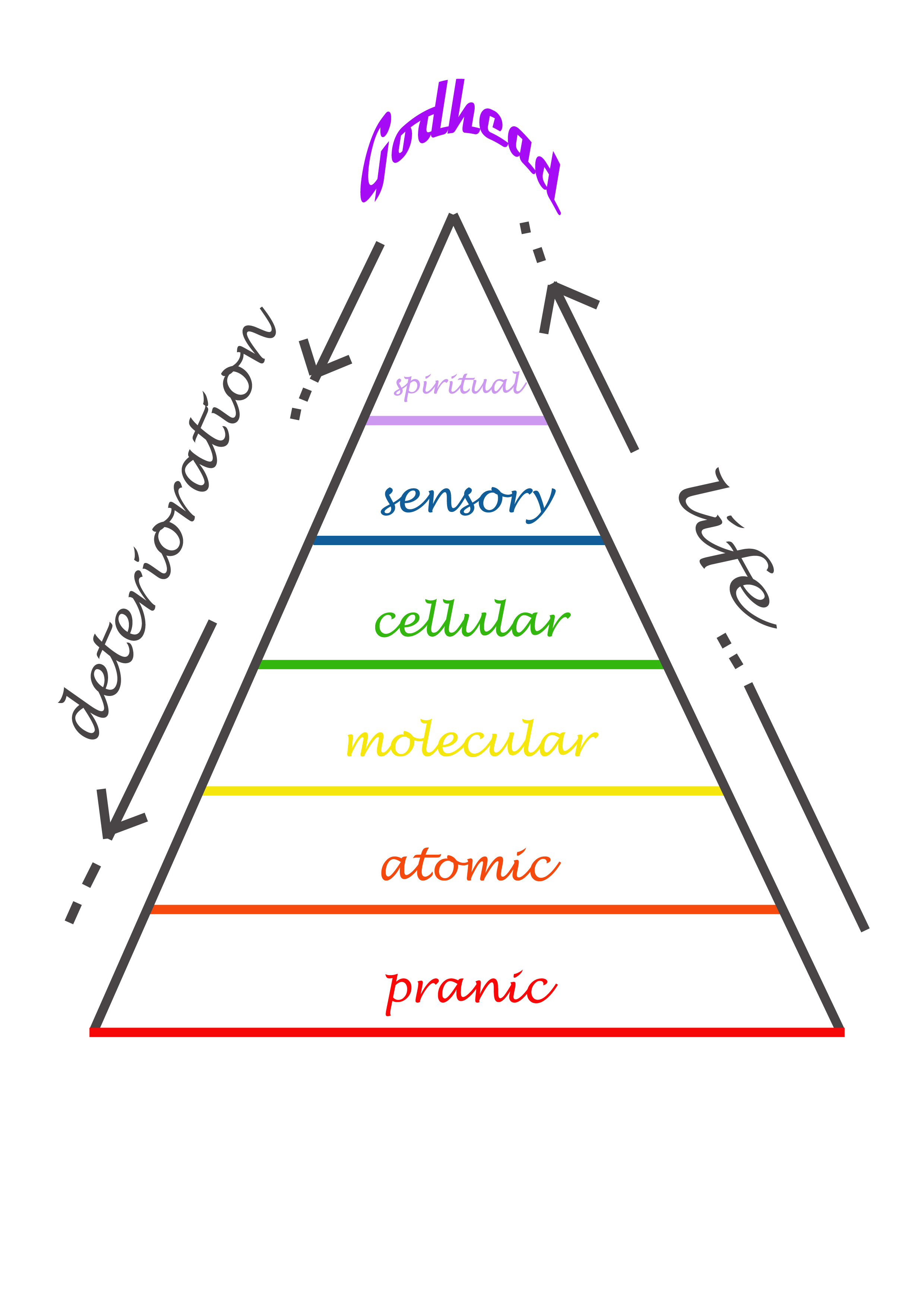
Here is a diagram to help with a visual understanding of the Biostrata.  The simple, yet empowering shape of the Triangle is utilised.

The Biostrata

The bottom line represents the Pranic Stratum – that of inert energy, the ‘potential life force’ … that from which all recogniseable existence emerges.

You can see that as we move up to the next level of the triangle we enter the Atomic Stratum – that which relies heavily on the Pranic level for its existence, but which is of lowest order of intelligence with its uncomplicated patterns of behaviour … it provides the basis for all matter.

Lifting up to the next part of the triangle we gain admission to the Molecular Stratum and up again into the Cellular Stratum, a continuum in motion, a trend toward unity, a state of being one.

Always, a number of atoms must unite to form a molecule, a number of molecules must come together to form a cell (thus there are fewer cells than molecules) and this continues with existing numbers of units becoming fewer as the number of elements within each unit increases.

Keep returning to this Illustration to assist in understanding.

From the Cellular Stratum we move cohesively into the Sensory Stratum and this is where the collective activities of the cells move forever upward towards unity, being a whole, and thus commit to their specialised groups to form the Body. Again, it is a large leap, like that of the molecular to the cellular.  What is significant about the progression upward from Cellular to Sensory is the contributory elements taking place in the formation of tissue and cells like that of the storing of hereditory data, the relative positionings of tissue formations and much much more which cannot be shown in the illustration but which exist in other ‘strata’ which rest in between the significant stratum as shown in the diagram.

So now we are in the Sensory Stratum and this is known as such quite simply because we have arrived at our Senses.

Yoga Nature

Yoga is a Science. It is an Art. It is an Order to which every boy and girl, man and woman can adhere toward in their lifetime to become healthy and whole.  Dedication, discipline and direction are all required to bring oneself from infancy to healthy normal maturity.  During all stages of growth, maintenance of one’s general health and well-being requires self-control and perseverance.  An understanding of the self will lead to the development of mind body unification and ultimately physical welfare.  The science of Yoga encompasses all aspects of ‘how to’ gain a normal state of health. It is profound, there are foundations to be laid, it is a way of life.

The fundamental birthplace of Yoga teaches the path of a natural mode of living.  On this modern planet in which we inhabit, this can prove challenging. Can we return to ‘Nature’?  Have we time to turn our view away from the dazzling mad rush of modern civilisation? Fashion and Social ambition demeans and befools us. In short, it controls us. The repercussions thereafter, obliterate us.  In the cradle of Yoga, one can receive nourishment, warmth and protection. In your Yoga practice you gain first, nature, second, nature, third, nature.  A return to whence it began.

The ordinary way, true earth, natural magnetism, is still with us.  The most vigorous races of the world still live, still inhabit this wondrous earth, as they have done for centuries.  They require little other than what nature gives. This last remaining vital force is bestowed on us all.

Attention now, to the self, is inherent.  It is how nature, and all living beings, will survive.  Observation and awareness to ‘natural magnetism’ and ‘vitality’ will teach all that a Yoga Nature and the answers therein, will show earth’s way.  The Earth is like a battery, charged with magnetism and ready and willing to give forth its strength to all beings. Apply the ‘test of nature’ to all theory and know that it has valuable ‘order’ and is a trusted friend.

Seeking to maintain a healthy, normal, natural body? Assume the title of ‘Yogi’, reverse the trend of ignorance, and endeavour to lead the Yogi plan of physical life.

One can be loyal, as far as possible, to the continuous practice of Yoga, in order to gain insight and experience of Nature’s plans and methods. All systems and techniques within Yoga will indicate how to reach normal functions of the body.  With this adherence followed, a natural state of health and well-being can be achieved.  Yoga’s key note is ‘Health’ and its main purpose is to help all conform to a standard of healthy living.  That which keeps a human healthy can make an unhealthy human healthy.  Yoga (and all branches thereof) exploits a sane, natural, normal and healthy manner of living, and if followed, will benefit all. Yoga stays close to nature and advocates a return to natural methods of life in preference of those which mislead us into obliteration.

Yoga will demand your attention and observation and will teach you how to take command over your rebellious self. Yoga will call to action your responsiveness, your ‘will’, and will show you how to do everything you can to achieve health and well-being.  Yoga will re-ignite your belief in the Intelligence behind all Life. Engagement with the great Life Principle will allow us to survive, to all be well within our bodies.

Put your yearning for something new into Yoga practice; through this you will get a good fair start on the road to the knowledge you seek.

Yoga and Premenstrual Syndrome

Premenstrual Syndrome (PMS) is experienced by all women at one time or another during their lifespan. It is still unknown as to why such symptoms as headaches, stomach cramps, breast tenderness, bloating, weight gain and irritability occur, however through the realms of Ayurveda and Homeopathy, the physicians therein believe that lifestyle factors which disrupt the body’s natural rhythm, creating hormonal imbalances play a significant part in generating all symptoms. Lack of exercise, bad eating habits, overworking, tension, stress, travel and difficulties in relationships will all contribute to cyclic patterns of anxiety, mood swings, emotional turbulence and depression, which all equate to PMS.

Gynecologist and obstetrician, Dr.Guy Abraham developed a classification system for PMS back in 1980. Four types grouped PMS, Type A (Anxiety) often accompanied by mood swings and irritability. Type C (Craving) would result with headaches, fatigue and sugar cravings. Type D (Depression) would have results in the region of memory loss and confusion and Type H (Water H2O retention) would result in weight gain, tender breasts and bloatedness (not to mention the further psychological distress that attaches itself to weight gain and negative body image). Any woman could suffer any combination of any of the above, with symptoms altering with every menstrual cycle depending on the earlier lifestyle factors mentioned earlier plus hormone fluctuations and dominations.

Based on the four main types of PMS outlined above there are self-help measures recommended.  Specially selected Yoga positions will provide not only immediate relief for the discomfort of PMS but will give continual opportunity for inner renewal and long-term benefits in reducing (and in some cases eradicating) all symptoms therein.

Yoga Postures for Type A (Anxiety) : The Corpse Pose, The Crocodile, The Child’s Pose All three of these are simple relaxation poses. In turn they will allow the mind to focus inward and relax deeply and completely whilst focusing the breath on the organs such as the abdomen, pelvis and back muscles.

Yoga Postures for Type C (Craving) : The Bow, The Bridge (modified) These two postures will stimulate blood flow to the abdomen and pelvic areas thus helping to regulate sugar levels and metabolism. Further within these 2 poses the ovaries, uterus and abdominal organs will be stretched and toned. Performing these positions will increase energy and lift the mood bringing with it a sense of rejuvenation and relieving of carbohydrate cravings. This type of PMS will translate the need for glucose to that of the need for sugar and/or chocolate (which contains magnesium which is needed to normalize glucose metabolism) however, unrefined sugar and chocolate have the side effect of a ‘let-down’ feeling, fatigue and headaches.

Type D (Depression) : Upward Facing DogThis dog posture is excellent for stimulating both the front and back of the body and bringing renewed strength to the lumbar and pelvic area. Gazing upward together with stretching skyward help counteract the downward pull of gravity, and that too of depression.

Type H (H20 Retention) : Wide-Angle Pose, The Plough                                                                                                                Gentle inversions help relieve and reverse the effects of water retention, especially in the feet, ankles and lower legs. Blood and energy circulation is stimulated, the entire pelvic region is opened and energized thus counteracting swelling. Care is to be taken to not do full inverted postures whilst on your menses.

All of the above postures, practiced regularly, during and in between the menstrual cycle, will all contribute to lessening the discomfort of PMS symptoms.

Hatha Yoga / Styles

Regardless of your age and/or level of fitness you can find a style of Hatha Yoga that will appeal and be most appropriate for your particular body and/or personality. Throughout all styles of Hatha Yoga, basic asanas (postures) and pranayamas (breathing exercises) remain the same, however it is within their order, how they are approached and where attention is focused that differentiates them. The emphasis may be on the postures, the breath, the rhythmic movements, the philosophy or a combination of non-exhaustive factors. There will always be the specific characteristics which reflect any particular teacher’s approach too. All styles and all teachers have their own personalities and it is about finding one which suits you.

Ananda Yoga ~ this method combines physical and spiritual with its purpose to clear and energize the systems of your body in preparation for meditation. Every posture looks toward expanding or heightening self-awareness. It is enhanced through affirmations which are a distinctive feature of this system. This style utilizes series of poses called ‘energization exercises’ which involve tensing and relaxing different parts of the body synchronised with breathing exercises to send energy to all parts. There is emphasis placed on relaxing deeply into the poses reflecting the intention that Hatha Yoga is a preparation for meditation.

Ashtanga Yoga ~ this yoga system is a rigorous practice and can be compared with the training of an elite athlete. There are 240 postures done in six successive series which are all linked by the breath (vinyasa flow). This style of Hatha Yoga represents the most intensive form with its purpose to create heat which in turn produces a cleansing/detoxifying effect on the body. There are equal emphasis placed on strength, flexibility and stamina within Ashtanga practice (also known as ‘Power Yoga’).

Integral Yoga ~ this combines all paths of yoga to benefit all aspects of the individual. One approach is made through asana (postures), pranayama (controlled breathing), selfless study, chanting, prayer, meditation and self-inquiry. Integral Yoga is more meditative than anatomical. This approach encourages one to be ‘at ease in body, peaceful in mind and useful in life’.

Iyengar Yoga ~ this is probably the most widely known technique of Hatha Yoga and is prescribed by yoga master B.K.S Iyengar. It is rigorously scientific and therapeutic and concentrates on alignment, correcting those structural imbalances of the physical body. One will pay close attention to the placement of hands, feet and pelvis as well as gaining alignment of the spine and appendicular frame (arms and legs). There is much attention to detail within Iyengar Yoga and props (wooden blocks, belts, straps, blankets, bolsters) are made available to assist in achieving great symmetry of the skeletal frame and progressing in extension within the posture.

Kripalu Yoga ~ this style of Yoga has been described as ‘meditation in motion’.  There is less concern with the structural detail of the poses more rather how the student feels mentally and emotionally whilst holding the posture. This style encourages a gentle, compassionate and introspective approach and due to the nature of holding the position for a longer time, it helps the practitioner to explore and release any emotional/spiritual obstructions. There are 3 stages to this style of practice, willful practice, will and surrender and surrendering to the body’s wisdom. There are differing intensities offered, gentle, moderate and vigorous. On top of all of this there is spontaneity encouraged through sequences of postures and too in individual postures to be guided by the body’s internal awareness.

Kundalini Yoga ~ this is the ancient practice which is designed to unlock and bring forth the reservoir of energy located deep within the base of the spine. The use of breath, posture, chanting and meditation are all encouraged to stimulate and consciously awaken the ‘kundalini’ through the chakras of energy centres positioned along the spine. The most common breathing exercises to be emphasised are : alternate nostril breathing, diaphragmatic breathing and a dynamic technique called ‘breath of fire’.

Sivananda Yoga ~ this style of Hatha Yoga incorporates a 5 point method of practice. It includes proper exercise, breathing, deep relaxation, vegetarian diet and positive thinking and meditation. The practice herein follows a routine of breathing exercises, sun salutations, a series of postures and then relaxation. Short Mantra chants and prayers will always begin and end each class.

Viniyoga ~ this style is ‘middle of the road’ between exacting Iyengar Yoga and demanding Ashtanga Yoga. Its basis is within the realm of ‘organized course of yoga study’.  There is the combination of asana, pranayama, meditation, text study, counselling, prayer, ritual, chanting and using the powers of imagination. There is a tailoring of the postures to the physical needs of the individual student, the emotional needs and also the cultural heritage. Breathing is considered to be one of the most important parts of the movement and inhalations and exhalations are consciously coordinated and articulated in varying length and ratios. This style of yoga is tutorial on a private one-to-one basis.

Bikram Yoga ~ this style is also known as ‘hot yoga’ for it is practiced within temperatures of 80 degrees or more (supplemented by a humidifier). The 90 minute class consists of 26 hatha yoga postures repeated twice over and there is a pranayama exercise at the beginning and the end of the session. A brief relaxation concludes the class. This style of yoga is exhilarating and an excellent routine for the physically and mentally fit.


Bliss Yantra

ImageMeditating upon the Bliss Design is like looking through a doorway to the creative, sensuous self. Observing beauty through the senses of sight, sound, touch and taste creates a bliss-filled meditative experience and allows us to access the subtle realms.

The healing arts of aromatherapy, colour therapy and sound therapy facilitate this sensual connection. Surrounding yourself with beauty and comfort brings inner harmony: wearing smooth fabrics, eating delicious food and creating delight in your environment, all feed and nourish the senses and guide their perception inward to a refuge of silence.

Venus – the planet of love – is associated with the Bliss Yantra. Romance, love, devotion and the sensuous side of relating are all highlighted through this design. If you are seeking these qualities, this design enhances the energy of attraction. The Bliss Yantra generates optimism and idealism, the ability to connect to positive outcomes and the best possible situation in all situations. Seeing the inherent beauty within and around you generates positive qualities and a sense of calm and joy in the mind.

By repeating this Mantra (either externally or internally) while working with the visual Yantra, the quality of Bliss will present itself to you…..

I honour the positivity and beauty that surrounds me

Oṁ śuṁ śukrāya namaḥ

(om shoom shoo-cry-yah nahm-ah-ha)

Swadhaya through Pranayama

Our breathing not only connects us with the outer world, but it also connects our body, mind, emotions and spirit. Sit quietly with eyes closed and spine erect but supple.  Begin to relax more and more into this very simple posture. Simply follow the breath going in and out of one’s nose. Then follow the actual movement of the air into and out of the lungs. Observe the body and sense where the breath is taking place. Does it take place in the shoulders, the chest or the lower abdomen? Do your shoulders go up when you inhale? does your belly go out or in? Do you feel your breathing in your ribs, your back and your pelvis? As you sense your breathing, are your inhalations and exhalations taking place evenly and harmoniously or do they seem to pull in one direction or another? What tensions do you feel? What does your breathing ‘sound’ like? As you sense the location of your breath, do you feel peaceful, agitated, angry, joyful, sad, bored or wilful? Are you being stubborn or rigid in your thinking? What are you thinking and feeling?

In addition, at the more advanced levels of this work with breathing, one can even sense a certain quality of energy that seems to enter with each breath, and one can follow the movement of this energy in one’s body. The purpose here is simply to observe – not to analyze, judge or manipulate.

Do self-study at least 20 minutes at the beginning of each day.

Swadhyaya through Yoga

Yoga is a philosophy of life, which is not restricted to just Asanas and Pranayama. It is a path of all-round development of an individual’s physical, mental, emotional and spiritual self. As the Vishnu-Purana states that self-study and yoga are not ultimately two separate things but both arise together from each other. Through Yoga and study, we have a chance to observe how our bodies, breath, mind and emotions have responded. For example, when you do a Yoga pose, you follow instructions. You learn as to how to get into the pose and how to align all body parts in tune with gravity. This is just the knowledge and the foundation of the yoga posture. But the power of the practice comes when we add observation or consciousness to the knowledge i.e Swadhyaya. Though consciousness already exists in the body, it needs to be tapped through Swadhyaya. Then in each pose, we align the body mindfully in tune with gravity for maximum balance, space and freedom to the spine, inner organs and to the breath. This observation leads to a deeper understanding and a communion with each asana. In the same way you can add the quality of curiosity, observation and exploration in each step of your life. Whatever you do, do it mindfully and consciously instead of doing it mechanically. It is true that mechanical repetition only dulls, but where there is profound attention one never stops seeing deeper and deeper. The next time you step into your Yoga pose or into your daily routine, add Swadhyaya to it.

Breathing Meditation

Generally, the purpose of breathing meditation is to calm the mind and develop inner peace.  We can use breathing meditations alone or as a preliminary practice to reduce our distractions.

Simple Breathing Meditation

The first stage of meditation is to stop distractions and make our mind clearer and more lucid. This can be accomplished by practicing a simple breathing meditation. We choose a quiet place to meditate and sit in a comfortable position. We can sit in the traditional cross-legged posture or in any other position that is comfortable. The most important thing is to keep our back straight to prevent our mind from becoming sluggish or sleepy.

We sit with our eyes partially closed and turn our attention to our breathing. We breathe naturally, preferably through the nostrils, without attempting to control our breath, and we try to become aware of the sensation of the breath as it enters and leaves the nostrils. This sensation is our object of meditation. We should try to concentrate on it to the exclusion of everything else.

At first, our mind will be very busy, and we might even feel that the meditation is making our mind busier; but in reality we are just becoming more aware of how busy our mind actually is. There will be a great temptation to follow the different thoughts as they arise, but we should resist this and remain focused single-pointedly on the sensation of the breath. If we discover that our mind has wandered and is following our thoughts, we should immediately return it to the breath. We should repeat this as many times as necessary until the mind settles on the breath.

Benefits of Meditation

If we practice patiently in this way, gradually our distracting thoughts will subside and we will experience a sense of inner peace and relaxation. Our mind will feel lucid and spacious and we will feel refreshed. When the sea is rough, sediment is churned up and the water becomes murky, but when the wind dies down the mud gradually settles and the water becomes clear. In a similar way, when the otherwise incessant flow of our distracting thoughts is calmed through concentrating on the breath, our mind becomes unusually lucid and clear. We should stay with this state of mental calm for a while.

Even though breathing meditation is only a preliminary stage of meditation, it can be quite powerful. We can see from this practice that is is possible to experience inner peace and contentment just by controlling the mind, without having to depend at all upon external conditions.

When the turbulence of distracting thoughts subsides and our mind becomes still, a deep happiness and contentment naturally arises from within.  This feeling of contentment and well-being helps us to cope with the busyness and difficulties of daily life. So much of the stress and tension we normally experience comes from our mind, and many of the problems we experience, including ill health, are caused or aggravated by this stress. Just by doing breathing meditation for ten or fifteen minutes each day, we will be able to reduce this stress. We will experience a calm, spacious feeling in the mind, and many of our usual problems will fall away. Difficult situations will become easier to deal with, we will naturally feel warm and well disposed towards other people, and our relationships with others will gradually improve.

PSYCHOLOGY (part 1)

Psychology is the study of the mind. It is a vast and complex subject.

Here, we deal with the mind in general, in a very straightforward, easy-to-understand study.

THE MiND

Mind is tangible. It consists mainly of thoughts, ideas, reasoning, awareness, perceptions, concepts, memories. It is creative, calculating, scheming, imaginative. Although completely non-material and non-physical, mind is a kind of receptacle for everything one experiences throughout life.

UNCONSCIOUS MIND

In order to give a little substance to mind, let us, in imagination construct a working model – a representation of mind in symbolic form. Firstly, imagine a sphere, the solid interior of which represents the Unconscious Mind: that part of mind which is normally inaccessible: that part of mind which contains a complete record of all past experience.

SUBCONSCIOUS MIND

The surface of the sphere can represent the Subconscious Mind. The subconscious, although accessible, functions in a very special way – secretive and somewhat obscure. It deals with a continuous influx of impressions drawn in from every direction. As long as the impressions continue to strike the surface of the sphere (sub-conscious) in darkness, they occur as subconscious impressions, incapable of entering consciousness.

Using the imagination once again, imagine a dense population of ‘tiny men’ covering the entire surface of the sphere (subconscious). These ‘tiny men’ represent Subconscious Response to the continuous influx of impressions and are of course influenced by all impressions that reach the subconscious.

Each impression acts as a stimulus, and each stimulus demands some kind of response. A response coming from a group of ‘tiny men’ receiving an impression, could be negative or positive. If positive, it could be either Instinctive or Conditioned. The ability to respond instinctively is inherent in humans from before birth, whereas conditioned responses are the outcome of training or learning (conditioning).

The ‘tiny men’ are most obedient; but they lack such faculties as initiative, reason etc. They are only able to respond as they have always responded to stimuli. In fact, it could be said that they represent that motivating force known as Habit.

CONSCIOUSNESS AND THE CONSCIOUS MIND

Now practically all that has so far been mentioned has been to do with the unconscious and the subconscious. What then of the Conscious Mind and Consciousness?

If we use the imagination yet again and imagine a helicopter of convenient size, in flight around the sphere, at a distance from the sphere’s surface (subconscious) and imagine also, a searchlight fixed to the underside of the helicopter, its beam of light scanning the activities of the ‘tiny men’, then we shall have a fair representation of consciousness. As for the conscious mind, of which consciousness is a part, that can be best represented by the helicopter, its equipment and crew members.

the following explains exactly what each symbol represents:

HELICOPTER – several crew members occupy the helicopter. The Pilot represents the Will, whereas other crew members represent various faculties of the conscious mind such as Reason, Logic, Decision etc

SEARCHLIGHT BEAM – the beam of light from the searchlight represents Attention and can be moved by the helicopter to illuminate any part of the surface of the sphere (subconscious) within its focus

ILLUMINATED AREA – the ‘populated’ area of the sphere’s surface illuminated by the beam of light from the searchlight, represents Consciousness.