Biostrata ……….. continues 7

Mind is intelligence, awareness, consciousness, perception, mind exists in and with everything. It is the inherent and most basic quality of active prana. Therefore you will see that the human body, being made up of prana and displaying infinite complex behaviour patterns, is also Mind.

Consciousness makes us see ourselves sometimes as ‘bodies’ and other times as ‘minds’.

It is always the observation (the point of view) which changes, not that which is being observed, and so it is, with every single one of us human beings, we can all be observed as mind, body or spirit.

Now upon having gathered the knowledge of all of the above we can now look at the true nature of Mind and consider too the 3 sections it is divided into …. Conscious, Subconscious and Unconscious.

The human ‘conscious’ mind belongs to the Sensory Stratum, the ‘subconscious’ and ‘unconscious’ belong to the Cellular Stratum, with the ‘unconscious’ reaching all the way down to the Pranic Stratum (after passing through the molecular and atomic strata too).

The conscious mind possesses a number of faculties, ‘Consciousness’ being just one of them.  Consciousness (otherwise termed ‘Awareness’) is introspective and results from exclusive components which make up a unit, i.e the consciousness of ‘cells’ and/or ‘molecules’ and the intelligence displayed therein of those components/units.  When awake and fully conscious, we rely on the combined consciousness of all cells for our normal functioning, together all combinations give us our Awareness.  During sleep however, ‘sensory’ consciousness can become ‘patchy’ as not all cells are still functioning, some have suspended their activities. Sensory experience (in sleep) is fragmentary and incomplete and inclined to seem slightly less ‘real’ than that of the fully awake sensory consciousness. Hence the phenomenon ‘Dreaming’.

All levels of the Biostrata need each other, no one level can exist without the others for this is all about a progressive, unifying process in the development of inert Prana to Human Being.

Communication throughout the Biostrata is strictly from one stratum to the adjacent stratum so it is not possible for say, the Sensory Stratum to communicate directly with the Molecular Stratum, the communication must pass through all intermediate strata wherever the communicating strata are not adjacent with each other. This communication is much the same as any form of communication, whereby it is an influencing of awareness of one entity, reaching out to the awareness of another.Usually this communication is for one of two reasons. Either for controlling the units of another stratum, or for the purpose of being controlled by the units of another stratum.

Consciousness is unique, it belongs to one unit and is its inherant part. when a number of units of one stratum unite they constitute a ‘complete’ unit in a higher stratum and thereby produce a ‘collective unit consciousness’ .. i.e another ‘one exlusive unit’.

Awareness (Human Consciousness) is the ‘agent’ for all communication in the Sensory Stratum, it is not only a ‘receiver’ susceptible to other strata but it is also a ‘transmitter’ which has capability of influencing all units of its own, and other, strata.

The Human Consciousness is better able to communicate with strata below its own level rather than the levels above and this makes it more understandable to us how we can appreciate being ‘stuck’ in the Sensory Strata, often unable to progress upwards to the Spiritual Strata. Consciousness marks the extent of our singular development within the Biostrata, having ascended from the Pranic Stratum and being made up of units of the Cellular, Molecular and Atomic Strata, you will understand that when any unit of the Sensory Stratum is communicating with units of the lower strata, it is indeed actually communicating with parts of itself.  Whenever we use our physical apparatus such as moving limbs or swallowing morsels of food we are communicating within the Cellular Stratum, making appropriate cells action and respond in accordance with our wishes, and those cells composed of molecules and atoms are all receiving communication from the Sensory Stratum, continuing, automatically, down and down the entire number of components until the Pranic Stratum is reached and all necessary communication has been actioned.  You will recognise for instance, when you are hungry, you are made aware of this by Sensory Consciousness, it is a message from the Cellular Stratum telling you (human consciousness) that you must eat. Therefore these are the busiest lines of communication, the interchange of influences between the Sensory Stratum and all strata below.

If you take yourself to your current level of Sensory Stratum you might think that communication on this level is the easiest but alas, even with all the lines of help brought about by Post, Radio, Telephone etc there still remains some of the most difficult, if not impossible obstructions regarding communications between human beings on a Sensory Level.

When a human being (one unit of the sensory stratum) communicates with another human being it is possible for there to be awareness of who is the receiver and who is the transmitter, both can occupy consicousness at the same time, however, when one human is communicating with another, what has to be remembered is that communication is happening with a ‘separate’ consciousness and therefore, this is not as easy as communication with one’s own component cells.  If you have little understanding of your own Sensory Self and all parts below (and above if possible) then you will have greater challenge in communicating with other conscious beings (especially if they have little or no understanding of their development).

Finally, to reach up and communicate to the strata above proves the most challenging and is probably the Sensory Stratum units’ upmost difficult communication. When a human being ‘reaches up’ it is doing so into the ‘unknown’ and the awareness is that of the actual reaching rather than of which level is being reached.  The Spiritual Stratum is intuitive and when the Sensory Stratum does manage to communicate with the Spiritual Stratum it receives intuition and inspiration. Human consciousness must expand and transcend the Sensory Stratum if it is to successfully communicate with the Spirit and the Godhead of the Biostrata. Only when Human consciousness has made itself receptive by negating the significance of all sensory stimuli can it expand, can it reach up, can it communicate with a unit of the Spiritual Stratum and thereupon receive Intuition and Inspiration.

Biostrata …. continues 5

We now find ourselves evolved to the stage of the Sensory Stratum and here, development of the intelligence displayed is generally known as ‘Human’ intelligence.  Within the ‘grey’ areas of there being no difference between mind and matter it is sometimes challenging to understand the credibility of this. But think on, your body is made up of cells which ‘display’ intelligence, for their behaviour is that of organised pranic (life source) movement, and as we have seen so far, all the way up through the layers of Biostrata there is intelligence. Thus, this belongs to both mind and matter.

For human intelligence to exist, there is dependence upon sensory images. This is so because when we think, or apply intelligence to problem solving, we are readily using ‘sensory’ images. We have not the capability to think of pure quality or pure quality for we must at all times have available to us, sensory images, better known as ‘symbols’ which represent the quantities and qualities which constitute the subject of our thinking.  For example, if we were to try to think of the pure quantity of SEVEN, we would find that impossible, yet if we produce in the mind, a symbol and/or sensory images that represent SEVEN, we can then immediately begin to envisage that quantity.  We could visualise SEVEN apples or audibly imagine SEVEN chimes of a bell.  The ‘types’ of symbols used are not important but their presence in the imagination is fundamental to being able to ‘think’ about quantities.

Of course we know we have progressed further than this method of ‘quantity’ thinking (albeit the exception in young children in their learning informative years) for we have moved forward to utilise specific written symbols for each number and so to do we have symbolism when ‘thinking’ about quality. LOVE for instance, unless we can produce a sensory image in respect of this, something or someone who portrays the quality of Love, we would find it impossible to think (feel) it.

Qualities are abstract. Like a hole; that is abstract. A hole cannot be perceived purely as a hole, there must be a concrete counterpart. If you have a hole in a piece of wood and then the piece of wood were to be destroyed, there would be no hole. We are only able to think/perceive that hole in relation to the piece of wood it is found within.

So to think of an object of beauty, it has to come with a counterpart, a determination of an occasion, we have to see (perhaps a beautiful face), or hear (a beautiful voice) or smell (a beautiful scent) to have something which directly represents that which is beautiful.

Thus, here we are, in the knowing that the human body belongs to the Sensory Stratum of the Biostrata. Every single human body is the outcome of the upward movement/progression/development of Prana, forever ascending the evolutionary scale of Existence.

With this notion, how then do WE determine the extent of OUR potential progress?

The answer is found within consciousness. If consciousness is dependent upon the senses for information then this clearly indicates that the Sensory Stratum has been reached. If consciousness is mainly relying on impulses, feelings and urges then it is on one of instinctive nature (the Cellular Stratum) … but if thinking about quality and quantity through symbolism is reached, then we are at the Sensory Stratum. By no means however, does this mean we are on a ‘precision instrument’ level, one that is indicative of our development for more often than not, although we ‘occupy’ our main ‘stratum of residence’ we are also reluctant to leave behind the old ‘familiarity’ of acquaintance and experience and thus we continue to cling to the stratum immediately below. So too, do the lower stratum, before completely vacating their residence in their eagerness to ascend the biostrata, reach up immediately above and thus you can find intelligence occupying three strata at the same time.

One may think that ascension through the biostrata is now complete, seeing as we have come to our Senses, but we are still yet to reach the apex of the symbolic triangle.  Next we venture further upward to enter the Spiritual Stratum.


Biostrata …. continues 4

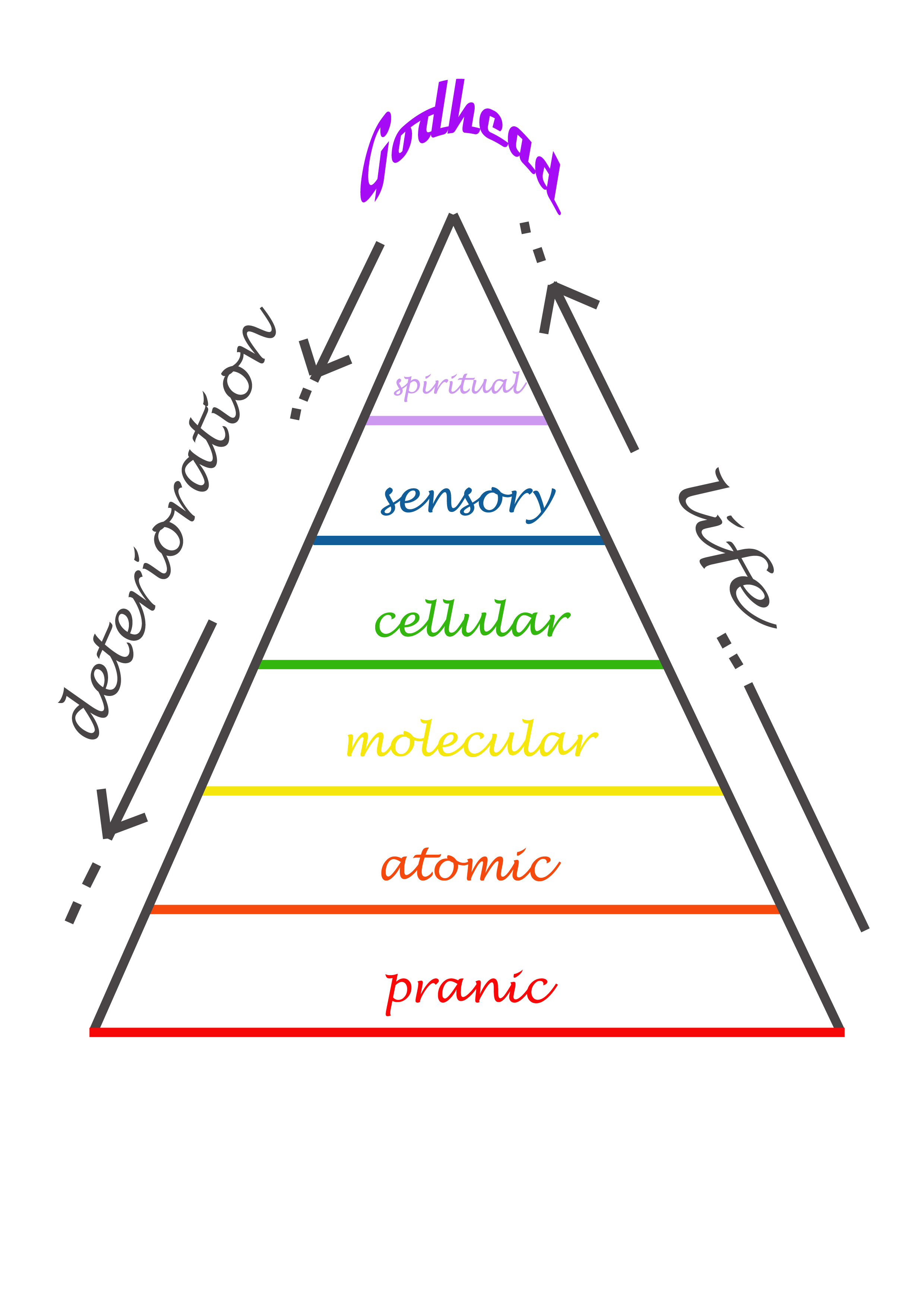
In simple terms, Life is an upward motion/process and movement in any other direction is that of deterioration or failure of development.

Here is a diagram to help with a visual understanding of the Biostrata.  The simple, yet empowering shape of the Triangle is utilised.

The Biostrata

The bottom line represents the Pranic Stratum – that of inert energy, the ‘potential life force’ … that from which all recogniseable existence emerges.

You can see that as we move up to the next level of the triangle we enter the Atomic Stratum – that which relies heavily on the Pranic level for its existence, but which is of lowest order of intelligence with its uncomplicated patterns of behaviour … it provides the basis for all matter.

Lifting up to the next part of the triangle we gain admission to the Molecular Stratum and up again into the Cellular Stratum, a continuum in motion, a trend toward unity, a state of being one.

Always, a number of atoms must unite to form a molecule, a number of molecules must come together to form a cell (thus there are fewer cells than molecules) and this continues with existing numbers of units becoming fewer as the number of elements within each unit increases.

Keep returning to this Illustration to assist in understanding.

From the Cellular Stratum we move cohesively into the Sensory Stratum and this is where the collective activities of the cells move forever upward towards unity, being a whole, and thus commit to their specialised groups to form the Body. Again, it is a large leap, like that of the molecular to the cellular.  What is significant about the progression upward from Cellular to Sensory is the contributory elements taking place in the formation of tissue and cells like that of the storing of hereditory data, the relative positionings of tissue formations and much much more which cannot be shown in the illustration but which exist in other ‘strata’ which rest in between the significant stratum as shown in the diagram.

So now we are in the Sensory Stratum and this is known as such quite simply because we have arrived at our Senses.

Biostrata continues ….. 3

From the beginnings of the Biostrata we are aware that Prana is the vital force, the ‘potential’ life force in everything and seeing as it is indeed  the first stratum it deems logical that the atomic, molecular and cellular strata all have prana manifesting in them.  Prana is capable of manifesting at various levels of mind and matter (all relativity dependant of the observer).  Thus, there is a predetermination of the development of pranic manifestation and progress within the natural laws imposed by ‘original design’ (the groupings, the selective process of atoms and molecules and cells) and is something that is predictable at every stage of development.  So when, at the cellular level of life, cells, eventually ‘die’, is this due to the cell running out of Prana? Atoms form molecules, molecules form cells and so forth in an ever upward development of pranic manifestation. There is the common logic of upward direction toward a higher stratum. However, as soon as no further progress is being made within development, or if atoms, molecules and cells fail to conform to their original design, then they are deemed to be ‘dead’ or inanimate and they will begin to break up and fall back downward through the lower strata. This activity denotes gradual deterioration. A cell will break up into molecules and then the molecules will separate into atoms and so it continues.  This could be nothing more than a re-cycling process whereby during ‘deterioration’ there is assessment of how much decline has taken place and if indeed some atoms and molecules can re-enter the upward development and further contribute to fresh material and life-form then so they shall.  When a cell ‘dies’ it does not mean all Prana has disappeared. The dying cell is merely reversing its direction of movement within the Biostrata. It has the capacity to regenerate.

Therefore it is interesting to observe here, how despite the ‘dying off’ of various components within the ‘life form’, whether they be cells, molecules or atoms, there is an ‘essential design’ maintained by the ‘ever upward’ progression of new components (prana, atoms, molecules, cells) coming up through the Biostrata (resulting from reproduction or selective attraction).  These are once again of original design, and are simply replacing those constituent parts whose term has expired and are in descent, possibly to be drawn again into circulation and ascend the Biostrata as new life-forms if their manifestation can regenerate, re-cycle itself.

Life, as we understand it, is an upward progress through the Biostrata and we should see that all development, progress and retrogression, manifestation, behaviour patterns and all intelligence are under direction of a Supreme Controlling Force. It is notwithstanding that everything in existence, whether it be an atom, a molecule, a cell, a human being or inanimate object, it has to make an upward progression through the Biostrata and has to conform to laws which emanate from the Supreme Controlling Force. Non-compliance of this will produce premature stagnation and deterioration because unless there is compliance with the laws of the supreme controlling force, whether by design or by accident, there can be no progress. Progress is Life in the generally accepted context. There is much opportunity for free expression at every level of the Biostrata, however this can only occur within the ‘essential design’ on the law of life.

Om/Aum

om

Om/Aum is the ultimate Mantra (repeated sacred word).

Aum/Om has its own symbol

it represents the conscious, the subconscious and the unconscious in everything

The word Om is mighty and omnipresent.

It is believed that Om is the ancestor of Amen.


Om emphasises balance.

Paramahansa Yogananda states: ‘the infinite potencies of sound derive from the Creative Word, Aum, the cosmic vibratory power behind all atomic energies’.

Any word spoken with clear realization and deep concentration has a materializing value. Loud or silent repetition of inspiring words has been found effective in Coueism (a method of self-help stressing autosuggestion) and similar systems of psychotherapy. The secret lies in the stepping-up of the mind’s vibratory rate.

Molecular vibration never ceases. Inherent tendencies are equal to the sum-total of impressions/stimuli that you imbibe, which then live on in the mind. Repetition of creative sound is the greatest stimulus that can be given to the spirit, by repeating the Om/Aum mantra, one is keeping great company with one’s own mind. Light enters, ‘the self’ will become manifest.

With AUM, the first letter A is the root sound, the key, pronounced without touching any part of the tongue or palate. The second letter, U rolls from the very root to the end of the sounding board of the mouth. The M, and third letter represents the last sound in the series, being produced with the lips closed. With this in mind it becomes clear to see that Om(Aum) represents the whole phenomena of sound-producing and shows all possibility and range of word making, it is in short the matrix of sound and nature.

Yoga is Good For You

Yoga is good for what ails you.

Just for starters Yoga helps manage or control anxiety, arthritis, asthma, back pain, blood pressure, carpal tunnel syndrome, chronic fatigue, depression, diabetes, epilepsy, headaches, heart disease, multiple sclerosis, stress and other conditions and diseases.

On top of all that Yoga improves your muscle tone, flexibility, strength and stamina, it reduces stress and tension, boosts self-esteem, improves concentration and creativity, lowers fat, improves blood circulation, stimulates the immune system and creates a sense of well-being and calm.

That’s all just scratching the surface. If you delve further, deeper, you find connection to your transcendent Self and gain true happiness, liberation and enlightenment.


Hatha Yoga / Styles

Regardless of your age and/or level of fitness you can find a style of Hatha Yoga that will appeal and be most appropriate for your particular body and/or personality. Throughout all styles of Hatha Yoga, basic asanas (postures) and pranayamas (breathing exercises) remain the same, however it is within their order, how they are approached and where attention is focused that differentiates them. The emphasis may be on the postures, the breath, the rhythmic movements, the philosophy or a combination of non-exhaustive factors. There will always be the specific characteristics which reflect any particular teacher’s approach too. All styles and all teachers have their own personalities and it is about finding one which suits you.

Ananda Yoga ~ this method combines physical and spiritual with its purpose to clear and energize the systems of your body in preparation for meditation. Every posture looks toward expanding or heightening self-awareness. It is enhanced through affirmations which are a distinctive feature of this system. This style utilizes series of poses called ‘energization exercises’ which involve tensing and relaxing different parts of the body synchronised with breathing exercises to send energy to all parts. There is emphasis placed on relaxing deeply into the poses reflecting the intention that Hatha Yoga is a preparation for meditation.

Ashtanga Yoga ~ this yoga system is a rigorous practice and can be compared with the training of an elite athlete. There are 240 postures done in six successive series which are all linked by the breath (vinyasa flow). This style of Hatha Yoga represents the most intensive form with its purpose to create heat which in turn produces a cleansing/detoxifying effect on the body. There are equal emphasis placed on strength, flexibility and stamina within Ashtanga practice (also known as ‘Power Yoga’).

Integral Yoga ~ this combines all paths of yoga to benefit all aspects of the individual. One approach is made through asana (postures), pranayama (controlled breathing), selfless study, chanting, prayer, meditation and self-inquiry. Integral Yoga is more meditative than anatomical. This approach encourages one to be ‘at ease in body, peaceful in mind and useful in life’.

Iyengar Yoga ~ this is probably the most widely known technique of Hatha Yoga and is prescribed by yoga master B.K.S Iyengar. It is rigorously scientific and therapeutic and concentrates on alignment, correcting those structural imbalances of the physical body. One will pay close attention to the placement of hands, feet and pelvis as well as gaining alignment of the spine and appendicular frame (arms and legs). There is much attention to detail within Iyengar Yoga and props (wooden blocks, belts, straps, blankets, bolsters) are made available to assist in achieving great symmetry of the skeletal frame and progressing in extension within the posture.

Kripalu Yoga ~ this style of Yoga has been described as ‘meditation in motion’.  There is less concern with the structural detail of the poses more rather how the student feels mentally and emotionally whilst holding the posture. This style encourages a gentle, compassionate and introspective approach and due to the nature of holding the position for a longer time, it helps the practitioner to explore and release any emotional/spiritual obstructions. There are 3 stages to this style of practice, willful practice, will and surrender and surrendering to the body’s wisdom. There are differing intensities offered, gentle, moderate and vigorous. On top of all of this there is spontaneity encouraged through sequences of postures and too in individual postures to be guided by the body’s internal awareness.

Kundalini Yoga ~ this is the ancient practice which is designed to unlock and bring forth the reservoir of energy located deep within the base of the spine. The use of breath, posture, chanting and meditation are all encouraged to stimulate and consciously awaken the ‘kundalini’ through the chakras of energy centres positioned along the spine. The most common breathing exercises to be emphasised are : alternate nostril breathing, diaphragmatic breathing and a dynamic technique called ‘breath of fire’.

Sivananda Yoga ~ this style of Hatha Yoga incorporates a 5 point method of practice. It includes proper exercise, breathing, deep relaxation, vegetarian diet and positive thinking and meditation. The practice herein follows a routine of breathing exercises, sun salutations, a series of postures and then relaxation. Short Mantra chants and prayers will always begin and end each class.

Viniyoga ~ this style is ‘middle of the road’ between exacting Iyengar Yoga and demanding Ashtanga Yoga. Its basis is within the realm of ‘organized course of yoga study’.  There is the combination of asana, pranayama, meditation, text study, counselling, prayer, ritual, chanting and using the powers of imagination. There is a tailoring of the postures to the physical needs of the individual student, the emotional needs and also the cultural heritage. Breathing is considered to be one of the most important parts of the movement and inhalations and exhalations are consciously coordinated and articulated in varying length and ratios. This style of yoga is tutorial on a private one-to-one basis.

Bikram Yoga ~ this style is also known as ‘hot yoga’ for it is practiced within temperatures of 80 degrees or more (supplemented by a humidifier). The 90 minute class consists of 26 hatha yoga postures repeated twice over and there is a pranayama exercise at the beginning and the end of the session. A brief relaxation concludes the class. This style of yoga is exhilarating and an excellent routine for the physically and mentally fit.


Bliss Yantra

ImageMeditating upon the Bliss Design is like looking through a doorway to the creative, sensuous self. Observing beauty through the senses of sight, sound, touch and taste creates a bliss-filled meditative experience and allows us to access the subtle realms.

The healing arts of aromatherapy, colour therapy and sound therapy facilitate this sensual connection. Surrounding yourself with beauty and comfort brings inner harmony: wearing smooth fabrics, eating delicious food and creating delight in your environment, all feed and nourish the senses and guide their perception inward to a refuge of silence.

Venus – the planet of love – is associated with the Bliss Yantra. Romance, love, devotion and the sensuous side of relating are all highlighted through this design. If you are seeking these qualities, this design enhances the energy of attraction. The Bliss Yantra generates optimism and idealism, the ability to connect to positive outcomes and the best possible situation in all situations. Seeing the inherent beauty within and around you generates positive qualities and a sense of calm and joy in the mind.

By repeating this Mantra (either externally or internally) while working with the visual Yantra, the quality of Bliss will present itself to you…..

I honour the positivity and beauty that surrounds me

Oṁ śuṁ śukrāya namaḥ

(om shoom shoo-cry-yah nahm-ah-ha)

Hawaii’s Ancient Meditation Practices ~ 3 Techniques from the Islands

ALO-HA

The Alo-Ha meditation is a good base technique. ‘When we’re born, we’re very connected to our soul and our physical self, but as we get into our lives we become separated further and further. Meditation can help reunite your body and your soul.’ The meditation is broken into two components – ‘Alo’ means being connected as one, ‘Ha’ is the essence of life, where the evolutionary process unfolds. ‘Meditation is about focus, focus, focus and the Alo-Ha brings the meditator’s attention back to focus’.

Alo-Ha can be performed anywhere. The practitioner should naturally inhale on the Alo and exhale on the Ha. ‘Observe yourself, observe your breath, feel every muscle that moves from the natural movement of the breath.’

KUKULU OKE AO

Known as ‘The Pillar of Light’ and speaks to the native Hawaiians unique relationship with the earth. Both the human and the earth’s templates are the same. ‘Templates are blueprints of all matter’. They are sound and light grids. Often our templates are shut down, limiting our connection to the earth. Kukulu o kea o is used to bring harmony into a dis-harmonic environment.  ‘Our body is programmable by language and thoughts’. Every thought we have affects our body and creates a frequency or combination of density and light. Most of us are stuck in density, unable to access the higher light frequency of our being.

During this meditation, visualise a teardrop. Many symbols were envisioned by kahuna and passed down through the generations in secret. The teardrop represents the energetic fields or ‘encasements’ for our higher bodies, which is linked to our higher level of consciousness. The meditator visualizes a multi-dimensional teardrop moving with the exhale breath like a lizard, from the mind’s eye or pineal gland, along the spine, down to the sacrum, or ‘core of the earth.’ The earth’s piko, or chakra, has a pale silver colour. This colour is brought into the teardrop.

Next, the teardrop is brought about 12 inches below the meditator’s feet or seat if sitting, with a cord that is pale silver and connected to the earth’s core. From here the practitioner ‘opens’ their template that is about four feet in diameter. The cord is expanded to match the diameter of the template and then lifted up and around the body and into the universe. The teardrop is then taken through the spine up to three feet above the head, and then expanded into the earth’s atmosphere.

Ha ‘EHIKU

This final meditation enables hearing. Here, ‘ha’ means the essence of life from which the evolutionary process unfolds. ”Ehiku’ means seven, the number of times the meditation is to be repeated. Breathing is key. Whether the meditator breathes through their nose or mouth is inconsequential, although it is advised to close the throat a bit to control the breath.

On an inhalation of seven seconds the practitioner is to focus on their desired result or goal through a stated thought such as ‘I am healthy’. The next step is to hold the breath for seven seconds. During a seven second exhale, thanks is given through a stated thought, such as: ‘Thank You’. Your thoughts create many things, and the power behind this meditation is infinite. You are responsible for your personal energies.

Equipped with the knowledge of these three meditations, practitioners should be invigorated and ready to seize the day. There are secrets in our chants that have all the information you really need to be successful in life, healthy in life and to be on a path. It’s not that Hawaiians have all the answers, but we have part of the puzzle.

Dr.Maka’ala Yates, founder of the Hawaiian Healing Academy.

Swadhaya through Pranayama

Our breathing not only connects us with the outer world, but it also connects our body, mind, emotions and spirit. Sit quietly with eyes closed and spine erect but supple.  Begin to relax more and more into this very simple posture. Simply follow the breath going in and out of one’s nose. Then follow the actual movement of the air into and out of the lungs. Observe the body and sense where the breath is taking place. Does it take place in the shoulders, the chest or the lower abdomen? Do your shoulders go up when you inhale? does your belly go out or in? Do you feel your breathing in your ribs, your back and your pelvis? As you sense your breathing, are your inhalations and exhalations taking place evenly and harmoniously or do they seem to pull in one direction or another? What tensions do you feel? What does your breathing ‘sound’ like? As you sense the location of your breath, do you feel peaceful, agitated, angry, joyful, sad, bored or wilful? Are you being stubborn or rigid in your thinking? What are you thinking and feeling?

In addition, at the more advanced levels of this work with breathing, one can even sense a certain quality of energy that seems to enter with each breath, and one can follow the movement of this energy in one’s body. The purpose here is simply to observe – not to analyze, judge or manipulate.

Do self-study at least 20 minutes at the beginning of each day.

Swadhyaya through Yoga

Yoga is a philosophy of life, which is not restricted to just Asanas and Pranayama. It is a path of all-round development of an individual’s physical, mental, emotional and spiritual self. As the Vishnu-Purana states that self-study and yoga are not ultimately two separate things but both arise together from each other. Through Yoga and study, we have a chance to observe how our bodies, breath, mind and emotions have responded. For example, when you do a Yoga pose, you follow instructions. You learn as to how to get into the pose and how to align all body parts in tune with gravity. This is just the knowledge and the foundation of the yoga posture. But the power of the practice comes when we add observation or consciousness to the knowledge i.e Swadhyaya. Though consciousness already exists in the body, it needs to be tapped through Swadhyaya. Then in each pose, we align the body mindfully in tune with gravity for maximum balance, space and freedom to the spine, inner organs and to the breath. This observation leads to a deeper understanding and a communion with each asana. In the same way you can add the quality of curiosity, observation and exploration in each step of your life. Whatever you do, do it mindfully and consciously instead of doing it mechanically. It is true that mechanical repetition only dulls, but where there is profound attention one never stops seeing deeper and deeper. The next time you step into your Yoga pose or into your daily routine, add Swadhyaya to it.