
Hawaii’s Ancient Meditation Practices ~ 3 Techniques from the Islands

ALO-HA

The Alo-Ha meditation is a good base technique. ‘When we’re born, we’re very connected to our soul and our physical self, but as we get into our lives we become separated further and further. Meditation can help reunite your body and your soul.’ The meditation is broken into two components – ‘Alo’ means being connected as one, ‘Ha’ is the essence of life, where the evolutionary process unfolds. ‘Meditation is about focus, focus, focus and the Alo-Ha brings the meditator’s attention back to focus’.

Alo-Ha can be performed anywhere. The practitioner should naturally inhale on the Alo and exhale on the Ha. ‘Observe yourself, observe your breath, feel every muscle that moves from the natural movement of the breath.’

KUKULU OKE AO

Known as ‘The Pillar of Light’ and speaks to the native Hawaiians unique relationship with the earth. Both the human and the earth’s templates are the same. ‘Templates are blueprints of all matter’. They are sound and light grids. Often our templates are shut down, limiting our connection to the earth. Kukulu o kea o is used to bring harmony into a dis-harmonic environment.  ‘Our body is programmable by language and thoughts’. Every thought we have affects our body and creates a frequency or combination of density and light. Most of us are stuck in density, unable to access the higher light frequency of our being.

During this meditation, visualise a teardrop. Many symbols were envisioned by kahuna and passed down through the generations in secret. The teardrop represents the energetic fields or ‘encasements’ for our higher bodies, which is linked to our higher level of consciousness. The meditator visualizes a multi-dimensional teardrop moving with the exhale breath like a lizard, from the mind’s eye or pineal gland, along the spine, down to the sacrum, or ‘core of the earth.’ The earth’s piko, or chakra, has a pale silver colour. This colour is brought into the teardrop.

Next, the teardrop is brought about 12 inches below the meditator’s feet or seat if sitting, with a cord that is pale silver and connected to the earth’s core. From here the practitioner ‘opens’ their template that is about four feet in diameter. The cord is expanded to match the diameter of the template and then lifted up and around the body and into the universe. The teardrop is then taken through the spine up to three feet above the head, and then expanded into the earth’s atmosphere.

Ha ‘EHIKU

This final meditation enables hearing. Here, ‘ha’ means the essence of life from which the evolutionary process unfolds. ”Ehiku’ means seven, the number of times the meditation is to be repeated. Breathing is key. Whether the meditator breathes through their nose or mouth is inconsequential, although it is advised to close the throat a bit to control the breath.

On an inhalation of seven seconds the practitioner is to focus on their desired result or goal through a stated thought such as ‘I am healthy’. The next step is to hold the breath for seven seconds. During a seven second exhale, thanks is given through a stated thought, such as: ‘Thank You’. Your thoughts create many things, and the power behind this meditation is infinite. You are responsible for your personal energies.

Equipped with the knowledge of these three meditations, practitioners should be invigorated and ready to seize the day. There are secrets in our chants that have all the information you really need to be successful in life, healthy in life and to be on a path. It’s not that Hawaiians have all the answers, but we have part of the puzzle.

Dr.Maka’ala Yates, founder of the Hawaiian Healing Academy.
Swadhaya through Pranayama

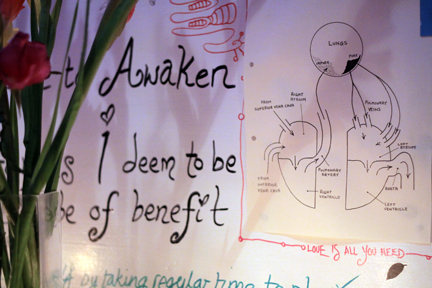
Our breathing not only connects us with the outer world, but it also connects our body, mind, emotions and spirit. Sit quietly with eyes closed and spine erect but supple.  Begin to relax more and more into this very simple posture. Simply follow the breath going in and out of one’s nose. Then follow the actual movement of the air into and out of the lungs. Observe the body and sense where the breath is taking place. Does it take place in the shoulders, the chest or the lower abdomen? Do your shoulders go up when you inhale? does your belly go out or in? Do you feel your breathing in your ribs, your back and your pelvis? As you sense your breathing, are your inhalations and exhalations taking place evenly and harmoniously or do they seem to pull in one direction or another? What tensions do you feel? What does your breathing ‘sound’ like? As you sense the location of your breath, do you feel peaceful, agitated, angry, joyful, sad, bored or wilful? Are you being stubborn or rigid in your thinking? What are you thinking and feeling?

In addition, at the more advanced levels of this work with breathing, one can even sense a certain quality of energy that seems to enter with each breath, and one can follow the movement of this energy in one’s body. The purpose here is simply to observe – not to analyze, judge or manipulate.

Do self-study at least 20 minutes at the beginning of each day.

Swadhyaya through Yoga

Yoga is a philosophy of life, which is not restricted to just Asanas and Pranayama. It is a path of all-round development of an individual’s physical, mental, emotional and spiritual self. As the Vishnu-Purana states that self-study and yoga are not ultimately two separate things but both arise together from each other. Through Yoga and study, we have a chance to observe how our bodies, breath, mind and emotions have responded. For example, when you do a Yoga pose, you follow instructions. You learn as to how to get into the pose and how to align all body parts in tune with gravity. This is just the knowledge and the foundation of the yoga posture. But the power of the practice comes when we add observation or consciousness to the knowledge i.e Swadhyaya. Though consciousness already exists in the body, it needs to be tapped through Swadhyaya. Then in each pose, we align the body mindfully in tune with gravity for maximum balance, space and freedom to the spine, inner organs and to the breath. This observation leads to a deeper understanding and a communion with each asana. In the same way you can add the quality of curiosity, observation and exploration in each step of your life. Whatever you do, do it mindfully and consciously instead of doing it mechanically. It is true that mechanical repetition only dulls, but where there is profound attention one never stops seeing deeper and deeper. The next time you step into your Yoga pose or into your daily routine, add Swadhyaya to it.

Breathing Meditation

Generally, the purpose of breathing meditation is to calm the mind and develop inner peace.  We can use breathing meditations alone or as a preliminary practice to reduce our distractions.

Simple Breathing Meditation

The first stage of meditation is to stop distractions and make our mind clearer and more lucid. This can be accomplished by practicing a simple breathing meditation. We choose a quiet place to meditate and sit in a comfortable position. We can sit in the traditional cross-legged posture or in any other position that is comfortable. The most important thing is to keep our back straight to prevent our mind from becoming sluggish or sleepy.

We sit with our eyes partially closed and turn our attention to our breathing. We breathe naturally, preferably through the nostrils, without attempting to control our breath, and we try to become aware of the sensation of the breath as it enters and leaves the nostrils. This sensation is our object of meditation. We should try to concentrate on it to the exclusion of everything else.

At first, our mind will be very busy, and we might even feel that the meditation is making our mind busier; but in reality we are just becoming more aware of how busy our mind actually is. There will be a great temptation to follow the different thoughts as they arise, but we should resist this and remain focused single-pointedly on the sensation of the breath. If we discover that our mind has wandered and is following our thoughts, we should immediately return it to the breath. We should repeat this as many times as necessary until the mind settles on the breath.

Benefits of Meditation

If we practice patiently in this way, gradually our distracting thoughts will subside and we will experience a sense of inner peace and relaxation. Our mind will feel lucid and spacious and we will feel refreshed. When the sea is rough, sediment is churned up and the water becomes murky, but when the wind dies down the mud gradually settles and the water becomes clear. In a similar way, when the otherwise incessant flow of our distracting thoughts is calmed through concentrating on the breath, our mind becomes unusually lucid and clear. We should stay with this state of mental calm for a while.

Even though breathing meditation is only a preliminary stage of meditation, it can be quite powerful. We can see from this practice that is is possible to experience inner peace and contentment just by controlling the mind, without having to depend at all upon external conditions.

When the turbulence of distracting thoughts subsides and our mind becomes still, a deep happiness and contentment naturally arises from within.  This feeling of contentment and well-being helps us to cope with the busyness and difficulties of daily life. So much of the stress and tension we normally experience comes from our mind, and many of the problems we experience, including ill health, are caused or aggravated by this stress. Just by doing breathing meditation for ten or fifteen minutes each day, we will be able to reduce this stress. We will experience a calm, spacious feeling in the mind, and many of our usual problems will fall away. Difficult situations will become easier to deal with, we will naturally feel warm and well disposed towards other people, and our relationships with others will gradually improve.

TEN RULES FOR LONG LIFE

1.   Listen to your body and understand its needs – both physical and emotional

2.   Live in the present – do not worry about the future or hold on to the past

3.   Take time to mediate and silence your internal dialogue

4.   Stop looking for approval from other people – you are the only judge that matters

5.   Learn to deal with anger

6.   Accept that you create your own world – the world ‘out there’ is all a projection of your inner world

7.   Do not judge

8.   Do not contaminate your body with toxins – either through food and drink or negative emotions

9.   Forget old hurts – replace fear motivated behaviour with love motivated behaviour

10. Live in balance with the world, accept that you are linked to all creation

A Smile


A Smile costs nothing, but gives much

It enriches those who receive it

Without making poorer those who give it

It takes but a moment

But the memory of it lasts forever.

None is so rich or mighty

That he can get along without it

And none is so poor that he cannot be made rich by it

A smile creates happiness in the home

Fosters goodwill in business

and is the countersign of friendship

It brings rest to the weary,

Cheer to the discouraged,

Sunshine to the sad

And it is nature’s best antidote for trouble.

Yet it cannot be bought, begged, borrowed or stolen

For it is something that is of no value to anyone

Until it is given away.

Some people are too tired to give you a smile,

Give them one of yours,

As none needs a smile so much

As he who has no more to give.

FACTSHEET : 5 kinds of Workfare

Currently there are five workfare schemes in use in the UK :-

> The Work Programme : coalitions’ flagship workfare scheme which replaced Labour’s Flexible New Deal in Summer 2011. Claimants are referred to private companies who can organise mandatory unpaid work placements for as long as six months. Refusal means loss of benefits.

> Mandatory Work Activity : the Job Centre can order claimants to work up to 30 hrs a week for a period of four weeks without pay. Refusal to comply means loss of benefits.

> Community Action Programme : currently being trialled in some regions and due to be rolled out nationally in 2013. Similar to the Work Programme but claims to focus more on community service work; these roles will replace many of the low-level public sector jobs that are currently being cut by councils. Refusal means loss of benefits.

> Work Experience : This scheme, alongside Sector Based Work Academies (below) are what the government want you to think the term ‘workfare’ means, because are the least offensive of the workfare schemes. They tend to describe it as voluntary work experience for 18-24 year olds organised through the Job Centre.

The degree to which the scheme is genuinely voluntary is disputed as there are countless reports of lies and intimidation to get jobseekers to participate and after one week the scheme becomes mandatory. Although recently, to save face, the government has emphasised the voluntary aspect and stated that sanctions would no longer be used against people who refuse to participate.

> Sector based Work Academies : similar to work experience but this scheme incorporates a training element alongside unpaid work placements; available through the job centre in conjunction with businesses and training providers. Like work experience the scheme is nominally voluntary, however once a claimant accepts a place the scheme becomes mandatory and withdrawal may result in loss of benefits.

In addition to workfare proper, there are also other ways in which the minimum wage is being undercut. A major one of these is the spread of supposed ‘apprenticeships’. Increasingly, entry-level admin jobs are being advertised as apprenticeships, which means they can pay £100 per week (higher than £67 per week jobseekers allowance for workfare, but lower than the minimum wage). Previously these were normal, paid jobs, but now firms can get cheap labour by rebranding entry-level jobs as apprenticeships and giving a low-level NVQ in admin (which doesn’t help find work, as higher-level admin jobs require experience, not NVQs).