
The Laboratory of the Body

Let’s get to work regarding the process of Digestion.

The first bit of the human apparatus of digestion to be considered by us are the Teeth.  Mother Nature has provided us with teeth so as we can bite, chew, and grind our food into fine bits.  This very first act of biting, chewing and grinding will render the food we place into our mouth to become a duly convenient size and consistency to be effortlessly acted upon by our Saliva and Digestive juices of the stomach, (after which it will have been reduced to a liquid form with nourishing qualities that may be easily assimilated and absorbed by the body). 

But do you really act as if you know what purpose your teeth have been given to you?  Do you honestly use your teeth for the performance of which they were given?  Shockingly, the majority of you bolt your food as if your teeth are merely for show, furthermore generally acting as if Nature had given you a [1]gizzard, by the aid of which it could, like the fowl, grind up and break into small bits the food you had bolted.  Remember this hard knock detail for your general health and wellbeing – ‘your teeth have been given to you for a purpose and if Nature had intended for you to bolt your food she would have indeed provided you with a gizzard instead of teeth’. 

The next organs to be considered are the Salivary Glands.  These glands are six in number, four of which are located under the tongue and jaw and two in the cheeks in the front of the ears, one on each side.  Their best-known function is to manufacture, generate and secrete Saliva, which, when needed, flows out through numerous ducts in different parts of the mouth and mixes with the food which is being chewed or masticated.  When your food is being chewed and masticated thoroughly, the Saliva is able to reach all portions with a correspondingly increased effect.   Your Saliva moistens the food allowing it to be easily swallowed – this function however, being a mere incident to its more important ones.  Saliva’s best-known function (and the one which Western science teaches is the most important one) is its chemical facilitation for it converts starchy food matter into sugar, thus performing the first critical step in the process of digestion.

Here is an ‘awareness signal’.

Do you eat in a manner which allows Nature to put the Saliva to work as designed?  Do you bolt your food after a few perfunctory chews and thus defeat Nature’s plans for which she has gone to so much trouble to perfect.  If you bolt your food, worry not, Nature will manage to ‘get back’ at you for your contempt and disregard of her plans – Nature is the higher intelligence and will always make you pay your debt for your ignorance.

Now let us talk about your ever faithful friend, the Tongue – this tongue of yours, which is so often made to perform the shameful task of assisting in your utterance of angry words, repetition of gossip, possible lying, nagging, swearing and last but not least, complaining.

And yet your tongue has a most important work to perform in the process of nourishing the body with food.  Besides a number of mechanical movements which it performs in eating, whereby helping move your food along together with its service in the act of swallowing, it is the organ of taste and passes critical judgment upon the food asking admittance to your stomach.

If you neglect the natural, normal, and healthy use of your Teeth, Salivary Glands, and Tongue then consequently they will all fail to give you the best service.  But, if you trust them and return to sane and ordinary methods of eating you will find them gladly and optimistically responding to your trust and they will once more give you their full attentive share of service.  They are good friends and servants, but they need a little confidence, trust, and responsibility to bring out their best points and full potential.

After your food has been chewed/masticated and then saturated with Saliva it passes down the throat into the stomach. 

The lower part of your throat (the gullet) performs a peculiar muscular contraction, which pushes downward the particles of food, which act forms part of the method of ‘swallowing’. 

The process of converting the starchy portion of the food into sugar, or glucose, which is begun by the Saliva in the mouth, continues as the food passes into and down the gullet.  This conversion then nearly or entirely ceases once the food reaches the stomach – this fact must be importantly considered when one studies the subject of the advantage of a deliberate habit of eating.  If the food you put into your mouth is hastily chewed and swallowed before it reaches the stomach, it will only have been partially affected by the Saliva and will therefore be in an imperfect condition for Nature’s subsequent work, and because of this, you are opening yourself up to the wider arena of discomfort of improper digestion.

The Stomach itself is a pear-shaped bag with a capacity of about [2]one quart or slightly more in some cases.  The food enters the stomach from the gullet on the upper left-hand side, just below the heart.  The food afterwards leaves the stomach on the lower right hand and enters the small intestine by means of a peculiar sort of valve which is constructed ingeniously so that it allows matter from the stomach to pass easily through it but refuses to allow anything to work back from the intestine into the stomach.  This valve is known as the ‘pyloric valve’ or the ‘pyloric orifice’ (the word ‘pyloric’ being derived from the Greek word which means ‘gatekeeper’) and indeed this little valve acts as a most intelligent gatekeeper, always on the watch, never asleep.

The stomach is your great chemical laboratory in which the food you have put into your mouth, and then bitten, chewed, and masticated undergoes chemical changes which allow it to be taken up by the system and changed into a nourishing material which is then converted into rich, red blood.  This rich red blood will then course all over your body, building up, repairing, strengthening, regenerating, and adding to all parts and organs.  So, you really are what you eat.

The ‘inside’ of the stomach is covered with a lining of delicate mucous membrane which is filled with minute glands, all of which open into the stomach, and around all of this is a very fine network of minute blood-vessels with remarkable thin walls from which the wonderful fluid, the Gastric Juice is manufactured and secreted. The Gastric Juice is a powerful liquid acting as a solvent upon what is called the nitrogenous portions of the food you have imbibed.  It also acts upon the sugar or glucose which has been produced from the starchy food by the Saliva, as previously described.  The Gastric Juice is a bitter sort of liquid, containing a chemical product called Pepsin, this is its active agent and plays a most important part in digestion of your food.

In a normal, healthy person the stomach manufactures/secretes about one gallon of Gastric Juice in every 24 hours and uses the same amount in the process of digesting the food you have eaten.  When the food reaches the stomach the little glands, before mentioned, pour out a sufficient supply of the Gastric Juice which mixes up with the mass of food in your stomach.  Then the stomach sets to work with a ‘churning’ motion which moves the pulpy food round and round, from side to side, and end to end, turning, twisting, kneading constantly until all Gastric Juice has penetrated every part of the food mass and all is well and truly mixed in.  The Instinctive Mind does some wonderful work in the stomach movements and works like a well-oiled machine.  And if the stomach has been treated to properly prepared, well chewed/masticated, in salivated food then the machine is able to turn out a fine job.  But if, as so often occurs, the food is of a quality not fit for the human stomach – i.e. has been bolted, half chewed, not fully salivated, or ‘stuffed’ by a ‘gluttonous’ owner – then there is going to be trouble.  This trouble is shaped by the fact that instead of the normal process of digestion being performed, the stomach is unable to do its work properly and therefore fermentation results and the stomach becomes the holder of a fermenting, putrefying, rotting mass – a ‘yeast pot’.   If you could form an idea of what a cesspool you might well maintain in your stomach (through incorrect digestion) then you might cease to shrug your shoulders at the subject of rational and healthy eating habits.

Let’s delve into this further.

This putrefying ferment, arising from abnormal eating habits often becomes chronic and results in a condition which manifests itself in the symptoms of what is called ‘dyspepsia’, or similar troubles like IBS, gastroesophagealreflux, lactose intolerance and more.  Because of all of the above mentioned incorrect digestion, your food mass remains in your stomach for a long time after each meal, and then when the next meal arrives the stomach, barely having dealt with the previous bolted matter, then has further food to deal with and consequently fermentation continues with the result of a perpetually active ‘yeast pot’ taking up residence.  This condition will in time result in a diminishing normal functioning of your stomach, the surface of which will become slimy, soft, thin, and weak. The glands will get clogged, and your complete digestive apparatus will become impaired and broken. In this event your ‘half digested’ food will pass out into your small intestine tainted with acids arising from fermentation, and over time will result in your entire system becoming gradually poisoned and imperfectly nourished.

The food-mass saturated with the Gastric Juice which has been poured onto it, kneaded, and churned, will leave the Stomach by the Pyloric orifice on the lower right-hand side of the Stomach, and will enter your small intestine.

Your small intestine is a tube-like canal ingeniously coiled upon itself to occupy a comparatively small space, but which is actually more like 20 to 30 feet in length. Its inner walls are lined with a velvety substance, and through the greater part of its length this velvety lining is arranged in transverse shelf-like folds, which maintain a ‘winking’ motion, swaying backward and forward in the intestinal fluids, retarding the passage of food, and providing an increased surface for secretion and absorption. The velvety condition of this mucous lining is caused by numerous minute elevations, which are known as the intestinal ‘villi.’  As soon as the food mass enters the small intestine it is met with a peculiar fluid called Bile. The Bile saturates the food mass and gets thoroughly mixed up and into it. The Bile is a secretion of the liver and is stored and ready for use in a strong bag called the Gall Bladder. About two quarts of bile per day is used in saturating the food as it passes into the small intestine. Its purpose is to assist the Pancreatic Juice in preparing the fatty parts of the food for absorption and to aid in the prevention of decomposition and putrefaction of the food as it passes through the small intestine, it also contributes to the neutralization of the Gastric Juice which has already performed its work. The Pancreatic Juice is secreted by the Pancreas, an elongated organ situated just behind the stomach and its purpose is to act upon the fatty portions of the food and to render them possible of absorption from the Intestines along with the other parts of the food nourishment. It is about one and one-half pints used daily in this work.

The hundreds of thousands of plush-like ‘hairs/villi’ upon the velvety lining of the small intestine maintain a constant waving motion, passing through and in the soft, semi-liquid food which is passing through the small intestine. They are constantly in motion, licking up and absorbing the nourishment that is contained in the food-mass and transmitting it to the system.

The several steps whereby the food is converted into blood and is carried to all parts of the system are as follows:

Mastication, insalivation, deglutition, stomach and intestinal digestion, absorption, circulation, and assimilation.

Let us run over these again so we remember their high importance:

Mastication: performed by the teeth – this is the ‘chewing’ process – the lips, tongue and cheeks assist with this work. Mastication breaks up the food into small enough particles to enable the Saliva to reach in more thoroughly and get a major part of digestion happening before left to the stomach to do all the work.

Insalivation:  this is the process of saturating the masticated food with the Saliva. It pours into and onto the food-mass from the Salivary Glands. Saliva acts upon the cooked starch in the food, changing it into dextrin and then glucose, thus rendering it soluble. This chemical change is rendered possible by the action of the Ptyalin in the Saliva acting as a ferment and changing the chemical constitution of those substances for which it has an affinity.

Digestion: performed in the Stomach and Small Intestines and consists in the conversion of the food-mass into products capable of being absorbed and assimilated. The crux of Digestion begins when food reaches the stomach. The Gastric Juice pours out copiously and, becoming mixed up and churned into the food-mass, it dissolves the Connective Tissue of meat, releases Fat from its envelopes by breaking them up and transforms some of the [3]Albuminous material, such as lean meat, gluten of wheat and white of eggs, into Albuminose, in which form they are capable of being absorbed and assimilated.

The transformation occasioned by stomach digestion is accomplished by the chemical action of an organic ingredient of the Gastric Juice, called Pepsin, and connection with the acid ingredients of the Gastric Juice.

While the process of Digestion is being performed by the stomach the fluid portion of the food-mass, (both that which has entered the stomach as fluids which have been drunken, as well as the fluids liberated from the solid food in the process of digestion) is rapidly taken up by absorbents of the stomach and is carried to the blood.  At the same time, the more solid portions of the food-mass (those which have been impaired at the ‘chewing’ and ‘masticating’ state of the process) are further being churned by the muscular action of the stomach. In about a half-hour from time of eating, the solid portions the food-mass begin slowly to leave the stomach in the form of a grayish, pasty substance, called Chyme, which is a mixture of some of the sugar and salts of the food, of transformed starch or glucose, of softened starch, of broken fat and connective tissue, and of albuminose.

The Chyme, leaving the stomach, enters the small intestine, and encounters the Pancreatic and Intestinal Juices and with the Bile and intestinal digestions ensures. These fluids dissolve most of the food that has not already been softened. Intestinal digestion resolves the Chyme into three substances known as (1) Peptone, (2) Chyle, from the emulsion of Fats, and (3) Glucose, from the transformation of the starchy elements of the food. These substances are primarily carried into the blood and become a part of it, while the undigested food passes out of the small intestine through a trap-door-like valve into the large bowel called the Colon.

Absorption, by which name is known as the process by which the above-named products of the food, resulting from the digestive process, are taken up by the veins and [4]lacteals, is affected by endosmosis.

The water and the fluids liberated from the food-mass by the stomach digestion are rapidly absorbed and carried away by the blood in the portal vein to the liver. The Peptone and Glucose from the small intestines also reaches the portal vein to the liver through the blood-vessels of the intestinal villi. This blood reaches the heart after passing through the liver where it undergoes a process which we will speak of when we reach the subject of the liver. The Chyle, which is the remaining product of the food-mass in the intestines after the Peptone and Glucose have been taken up and carried to the liver, is taken up and passes through the lacteals into the Thoracic Duct and is gradually conveyed to the blood which will be dealt with in greater detail in the worksheet ‘Circulation’.  The facts regarding Circulation it will be explained how the blood carries the nutrients derived from the digested food to all parts of the body, giving to each tissue, cell, organ, and part the material by which it builds up and repairs itself, thus enabling the body to grow and develop.

The liver secretes the bile, which is carried to the small intestine. It also stores a substance called Glycogen, which is formed in the liver from the digested materials brought to it by the portal vein. Glycogen is stored in the liver and is gradually transformed in the intervals of digestion, into Glucose or a substance like grape sugar. The Pancreas secretes the Pancreatic Juices which it pours into the small intestine to aid intestinal digestion where it acts chiefly upon the fatty portions of the food. The Kidneys are located in the loins, behind the intestines. They are two in number and shaped like beans. They purify the blood by removing from it a poisonous substance called urea and other waste products. The fluid secreted by the Kidneys is carried by two tubes, called ureters, to the Bladder. The Bladder is located in the Pelvis and serves as a reservoir for the urine, which consists of waste fluids carrying with it refuse matter of the system.

Before leaving this important subject it should be called to attention that when the food enters the stomach and small intestines improperly masticated and insalivated – when the teeth and Salivary Glands have not been given chance to do their work properly – digestion is interfered with and impeded and the digestive organs are overworked and rendered unable to accomplish what is asked of them.  It is like asking one set of workers to do their own work in addition to the work which should have been previously performed by another set of workers.

The absorbents of the stomach and intestines must absorb something – that is their business – and if you do not give them the proper materials, they will absorb the fermenting and putrefying mass in the stomach and pass it along to the blood. The blood then carries this poor material to all parts of the body, including the Brain, and it is little wonder that humans complain of biliousness, trapped wind, IBS, headaches etc., when they are the perpetrators of their own self-poisoning.


[1] noun

noun: gizzard; plural noun: gizzards

  1. a muscular, thick-walled part of a bird’s stomach for grinding food, typically with grit.

[2] The imperial quart, which is used for both liquid and dry capacity, is equal to one quarter of an imperial gallon, or exactly 1.1365225 litres

[3] albuminous

Adjective: albuminous consisting of, resembling, or containing albumen.  Egg white protein

Anatomy

plural noun: lacteals

  1. the lymphatic vessels of the small intestine which absorb digested fats.

UJJAYI breathing / Ocean Breath

This breath technique / practice calms the mind by focussing on the breath – the interconnectedness of SOUND and PHYSICAL movement and stillness.

Mind and body intertwined. Ocean breath moves you into a state of serenity by overriding distractions (thoughts).

With closed mouth (glottis/larynx) inspire (inhale).

Allow air to pass through your constricted throat making a friction sound, like the Ocean (or imagine that Darth Vada haaaaaa sound)

This victorious (ocean) breath is soft, whispering like the wind through the trees or the waves coming to the shore

Persistent practice can reduce BMI – can improve weight reduction – it soothes the thyroid

Ocean breath stimulates the gland responsible for metabolism – so, if sluggish, utilise this breath to inspire, lift and increase the breath action

It stimulates the Vagus nerve and facilitates a relaxed response

Focus on breathing through the nose, ensure no force is used, have patience …..

JUST BE

Sit Quietly

Watch

Observe Yourself

Grow

Remain quiet for longer periods of time

Allow life to flow through you whilst you sit in stillness

Be gentle and restorative

Breathe in and out taking slightly longer than you normally would

This will assist with an increase in circulation and oxygen flow

Your body and mind respond well to kindliness and tenderness

Re-connect with your natural human rhythms

STOP ! and LISTEN !

Yoga is your guide

It comes to us all at some point in our lives … the calling. But do we listen? do we miss the opportunity to open ourselves to new potential both physically and mentally as a human being. Yoga is a choice. You can choose to ignore the calling and carry on regardless (yoga is for everyone but might not be considered so) or you can make the decision to practice because inherent in you is the realisation that it might just bring those health benefits you’ve been searching for. If you start your practice and then continue with patience and perseverence, not setting yourself any egotistical goals just for the form of the body, but for deeper and more meaningful wisdom of health for the lifetime journey, then you begin to experience changes for the better. You return time and again to your natural built-in state of preservation and maintenance because you feel the improvements taking place in your life. Remember, you are the Guardian of your well-being, and Yoga is your guide.

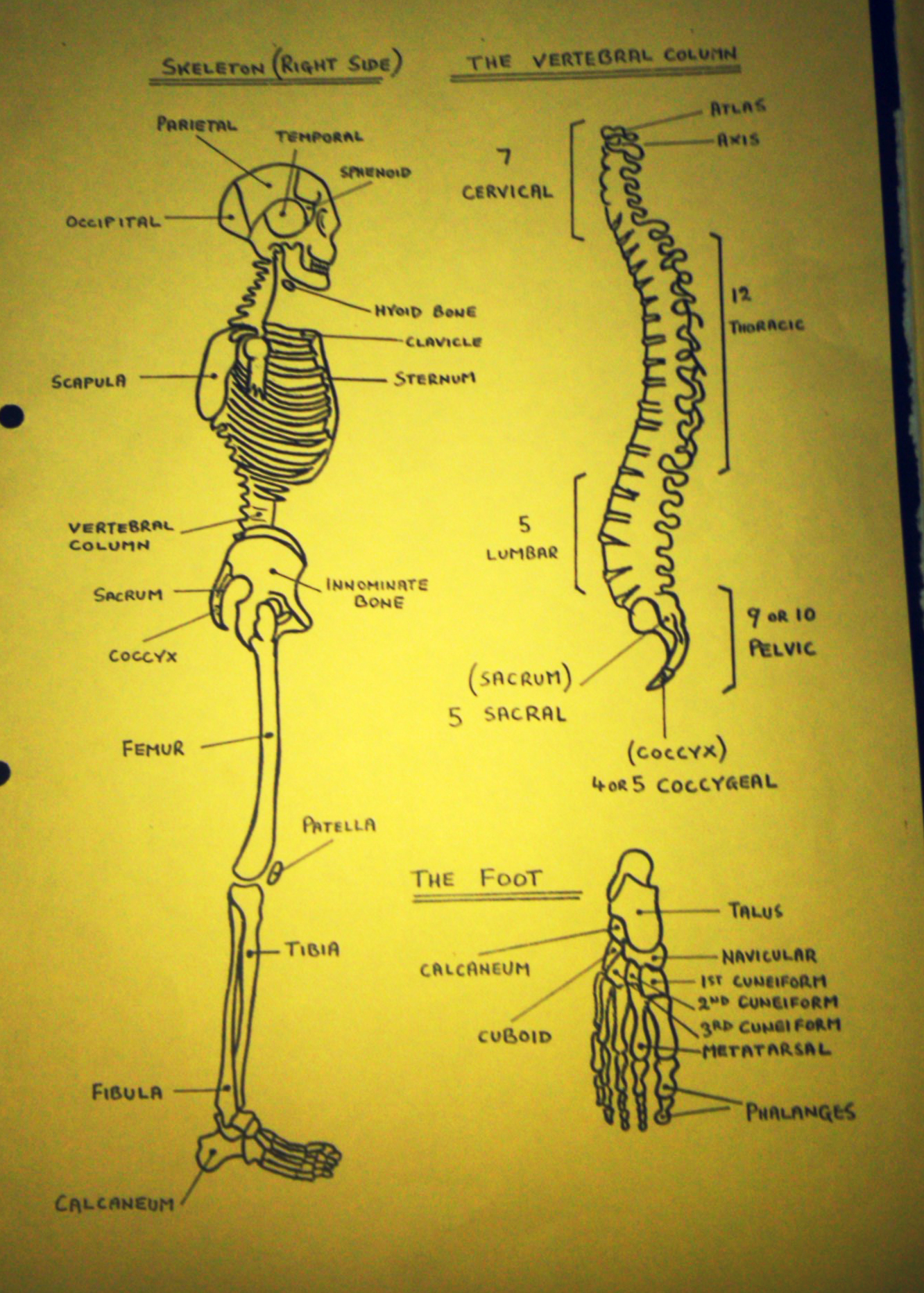
HUMAN ANATOMY

The human body is the most ingenious assembly of purposeful components you will ever ever find on this planet.

Beneath the envelope of skin and tissue, there are muscles, nerves, a circulatory system for blood, glands, vital organs, and above all, that marvellous system of bones called the Skeleton.

The skeleton not only supports the muscles and body as a whole, protecting those vital organs of brain and lungs but it is also responsible for our basic shape and size (although the last word in that matter comes from the muscles and subcutaneous tissue and skin).

The skeleton consists of 214 bones (which includes the six ossicles found the ears – not listed below).

AXIAL SKELETON

The axial skeleton comprises the skull, the backbone (vertebral column) and the ribs and breastbone (sternum).

APPENDICULAR SKELETON

The appendicular skeleton comprises the legs, arms (limbs) and shoulder and pelvic girdles.

The skeletal bones are classified according to their shape and formation

LONG BONES  found mainly in the limbs, fingers etc

SHORT BONES such as found in the wrist

FLAT BONES like in the shoulder-blades, skull etc

IRREGULAR BONES such as some facial bones and those of the vertebrae etc

SESAMOID BONES like those developed in the tendons of the muscles. The knee-cap is a good example.

SO:

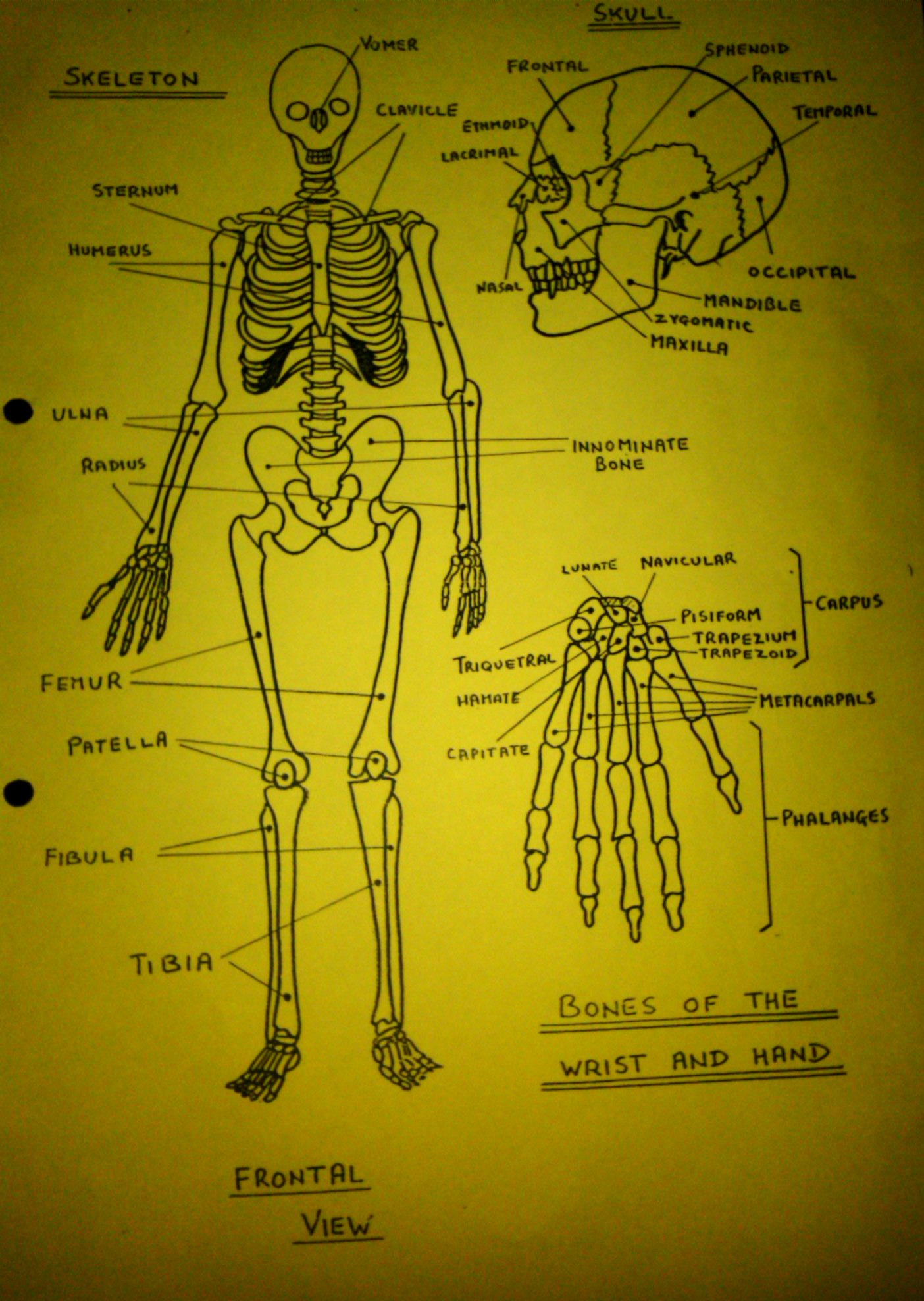
Starting at the top we have the SKULL and the SKULL consists of the Cranium and the Face.

The CRANIUM has 8 bones which are made up of 1 occipital, 2 parietal, 1 frontal, 2 temporal, 1 sphenoid and 1 ethmoid.

The FACE has 14 bones and they are made up of 2 nasal, 2 palatine, 2 lacrimal, 2 zygomatic, 1 vomer, 2 inferior turbinate, 2 maxillae and 1 mandible

The VERTIBRAL Column has 33 bones (sometimes 34). Each separate bone is called a vertebra.

The upper 7 vertebrae (plural of vertebra) are called the Cervical vertebrae, the uppermost two permitting movement of the neck. the first cervical vertebra is called the Atlas and the second is called the Axis. Together these two bones form the Atlanto-axial joint.

Then we have 12 thoracic vertebrae. Then we have 5 lumbar vertebrae. After the lumbar comes the sacral vertebrae which form the sacrum after which comes the tail of the spine, the coccyx, which comprises of 4 (or5) coccygeal vertebrae.

Within the thoracic vertebrae we have what is known as the thoracic cage. it consists of the 12 thoracic vertebrae (already mentioned above) at the back, 12 pairs of ribs at the sides and the sternum at the front.

Uppermost in this cage we have 7 pairs of true ribs, below them, 3 pairs of false ribs and then 2 pairs of floating ribs.

The true ribs (pairs 1-7) are attached directly to the sternum, the false ribs (8-10) are attached indirectly to the sternum (by means of cartilage extending from each rib to the one above and then ribs (11 and 12) are not attached to the sternum in any way (hence the term ‘floating’).

Above this we have the shoulder girdle: the left and right Clavicle (collarbones) and left and right Scapula (shoulderblades).

In isolation in front of the throat rests the hyoid, a small bone.

Attached to each side of the shoulder girdle we have the upper body limbs, otherwise known as the ARMS. Nearest the shoulder is the upper arm bone, the Humerus and then for the lower part you find the Radius and Ulna, placed side by side. Then moving on to the Wrist and Hand, these bones are: The 8 bones of the Carpus, the Navicular (Scaphoid), Lunate (Semilunar), Triquetral, Pisiform, Trapezium, Trapezoid, Capitate and Hamate. Then there 5 Metacarpals (the bones between the fingers and wrist) and then the 14 Phalanges which form the Thumb and 4 Fingers.

BELOW the WAIST we have the PELVIC GIRDLE and this consists of the 5th lumbar vertebrae, the sacrum, the coccyx at the back and 2 Innominate bones which encircle the remainder of the region.

Moving on to the LEGS : You have the Femur (Thigh Bone), the Patella (Knee Bone), the Tibia (Shin Bones) and the Fibula (placed alongside the tibia).

Bones of the FOOT are: 7 tarsus bones, the Calcaneum (heel), Talus, Navicular, Cuboid, 3 Cuneiforms, the 5 metatarsals, and then the 14 phalanges forming the toes.

JOINTS

A joint (or articulation) is a union of two or more bones.

There are 3 main types:

1.Fibrous (immovable) – a fixed joint allowing no movement whatsoever, i.e the joints (sutures) of the flat bones of the skull, like the teeth in their sockets etc.

2.Cartilaginous (slightly moveable) – in this joint the surfaces are separated by some intervening substance such as cartilage … i.e the intervertebral joints of the vertebral column with their intervertebral discs of fibro-cartilage.

3.Synovial (freely moveable) – the ends of the bones forming the joint are covered by hyaline cartilage. ligaments are necessary to bind the bones together, and the joint cavity is filled with synovial fluid and is enclosed by a capsule of fibrous tissue.

Varieties of Synovial Joints:

1.Gliding – small bones of the carpus etc

2.Ball and Socket – hip and shoulder joint

3.Hinge – elbow joint

4.Condyloid – wrist joint

5.Pivot – atlanto-axial joint

6.Saddle – joint between the trapezium and first metacarpal bone (thumb)

IMG01104-20130401-1947

IMG01105-20130401-1947

Biostrata ……….. continues 7

Mind is intelligence, awareness, consciousness, perception, mind exists in and with everything. It is the inherent and most basic quality of active prana. Therefore you will see that the human body, being made up of prana and displaying infinite complex behaviour patterns, is also Mind.

Consciousness makes us see ourselves sometimes as ‘bodies’ and other times as ‘minds’.

It is always the observation (the point of view) which changes, not that which is being observed, and so it is, with every single one of us human beings, we can all be observed as mind, body or spirit.

Now upon having gathered the knowledge of all of the above we can now look at the true nature of Mind and consider too the 3 sections it is divided into …. Conscious, Subconscious and Unconscious.

The human ‘conscious’ mind belongs to the Sensory Stratum, the ‘subconscious’ and ‘unconscious’ belong to the Cellular Stratum, with the ‘unconscious’ reaching all the way down to the Pranic Stratum (after passing through the molecular and atomic strata too).

The conscious mind possesses a number of faculties, ‘Consciousness’ being just one of them.  Consciousness (otherwise termed ‘Awareness’) is introspective and results from exclusive components which make up a unit, i.e the consciousness of ‘cells’ and/or ‘molecules’ and the intelligence displayed therein of those components/units.  When awake and fully conscious, we rely on the combined consciousness of all cells for our normal functioning, together all combinations give us our Awareness.  During sleep however, ‘sensory’ consciousness can become ‘patchy’ as not all cells are still functioning, some have suspended their activities. Sensory experience (in sleep) is fragmentary and incomplete and inclined to seem slightly less ‘real’ than that of the fully awake sensory consciousness. Hence the phenomenon ‘Dreaming’.

All levels of the Biostrata need each other, no one level can exist without the others for this is all about a progressive, unifying process in the development of inert Prana to Human Being.

Communication throughout the Biostrata is strictly from one stratum to the adjacent stratum so it is not possible for say, the Sensory Stratum to communicate directly with the Molecular Stratum, the communication must pass through all intermediate strata wherever the communicating strata are not adjacent with each other. This communication is much the same as any form of communication, whereby it is an influencing of awareness of one entity, reaching out to the awareness of another.Usually this communication is for one of two reasons. Either for controlling the units of another stratum, or for the purpose of being controlled by the units of another stratum.

Consciousness is unique, it belongs to one unit and is its inherant part. when a number of units of one stratum unite they constitute a ‘complete’ unit in a higher stratum and thereby produce a ‘collective unit consciousness’ .. i.e another ‘one exlusive unit’.

Awareness (Human Consciousness) is the ‘agent’ for all communication in the Sensory Stratum, it is not only a ‘receiver’ susceptible to other strata but it is also a ‘transmitter’ which has capability of influencing all units of its own, and other, strata.

The Human Consciousness is better able to communicate with strata below its own level rather than the levels above and this makes it more understandable to us how we can appreciate being ‘stuck’ in the Sensory Strata, often unable to progress upwards to the Spiritual Strata. Consciousness marks the extent of our singular development within the Biostrata, having ascended from the Pranic Stratum and being made up of units of the Cellular, Molecular and Atomic Strata, you will understand that when any unit of the Sensory Stratum is communicating with units of the lower strata, it is indeed actually communicating with parts of itself.  Whenever we use our physical apparatus such as moving limbs or swallowing morsels of food we are communicating within the Cellular Stratum, making appropriate cells action and respond in accordance with our wishes, and those cells composed of molecules and atoms are all receiving communication from the Sensory Stratum, continuing, automatically, down and down the entire number of components until the Pranic Stratum is reached and all necessary communication has been actioned.  You will recognise for instance, when you are hungry, you are made aware of this by Sensory Consciousness, it is a message from the Cellular Stratum telling you (human consciousness) that you must eat. Therefore these are the busiest lines of communication, the interchange of influences between the Sensory Stratum and all strata below.

If you take yourself to your current level of Sensory Stratum you might think that communication on this level is the easiest but alas, even with all the lines of help brought about by Post, Radio, Telephone etc there still remains some of the most difficult, if not impossible obstructions regarding communications between human beings on a Sensory Level.

When a human being (one unit of the sensory stratum) communicates with another human being it is possible for there to be awareness of who is the receiver and who is the transmitter, both can occupy consicousness at the same time, however, when one human is communicating with another, what has to be remembered is that communication is happening with a ‘separate’ consciousness and therefore, this is not as easy as communication with one’s own component cells.  If you have little understanding of your own Sensory Self and all parts below (and above if possible) then you will have greater challenge in communicating with other conscious beings (especially if they have little or no understanding of their development).

Finally, to reach up and communicate to the strata above proves the most challenging and is probably the Sensory Stratum units’ upmost difficult communication. When a human being ‘reaches up’ it is doing so into the ‘unknown’ and the awareness is that of the actual reaching rather than of which level is being reached.  The Spiritual Stratum is intuitive and when the Sensory Stratum does manage to communicate with the Spiritual Stratum it receives intuition and inspiration. Human consciousness must expand and transcend the Sensory Stratum if it is to successfully communicate with the Spirit and the Godhead of the Biostrata. Only when Human consciousness has made itself receptive by negating the significance of all sensory stimuli can it expand, can it reach up, can it communicate with a unit of the Spiritual Stratum and thereupon receive Intuition and Inspiration.

Biostrata ….. continues 6

Now the true nature of development is taking place. Between the Sensory Stratum and that of the Godhead, rests the Spiritual Stratum.

As shown already, the trend is ever upwards as the units of one stratum come together to form units in a higher stratum. Just as the cells join to form human bodies, human bodies also join and unite to form spiritual units.

The spiritual stratum is perhaps the most complex of all the Biostrata for the human bodies from the sensory stratum unite in specialized groups to form a plethora of interrelated unit types, those such as ‘family’ which is first in the field of spiritual unit types what with its genetic bonds and those qualities of unique loyalty. Then coming up closely behind the family unit is the vast and ever-widening racial unit. There are far less racial units than family units in the Spiritual Stratum and here is where complexity kicks in even more so for both family and racial units are dependent upon each other for their components (human bodies) and therein lies the fact that each race becomes composed of a greater number of families because more and more we find families belonging to more than one race.  Parents of differing races come together to make new families. Atop of all this we then have the multi-complex combining of units via nations, cultural societies, religion and religious organizations, politics and political groups, idealists and their seedlings.  Despite all of this mixed up overlapping, the spiritual intelligence is of the highest order, it is the link between the sensory (human) intelligence and the godhead infallible. Spiritual intelligence is infallible at its very best and far more reliable than sensory intelligence at its very worst.

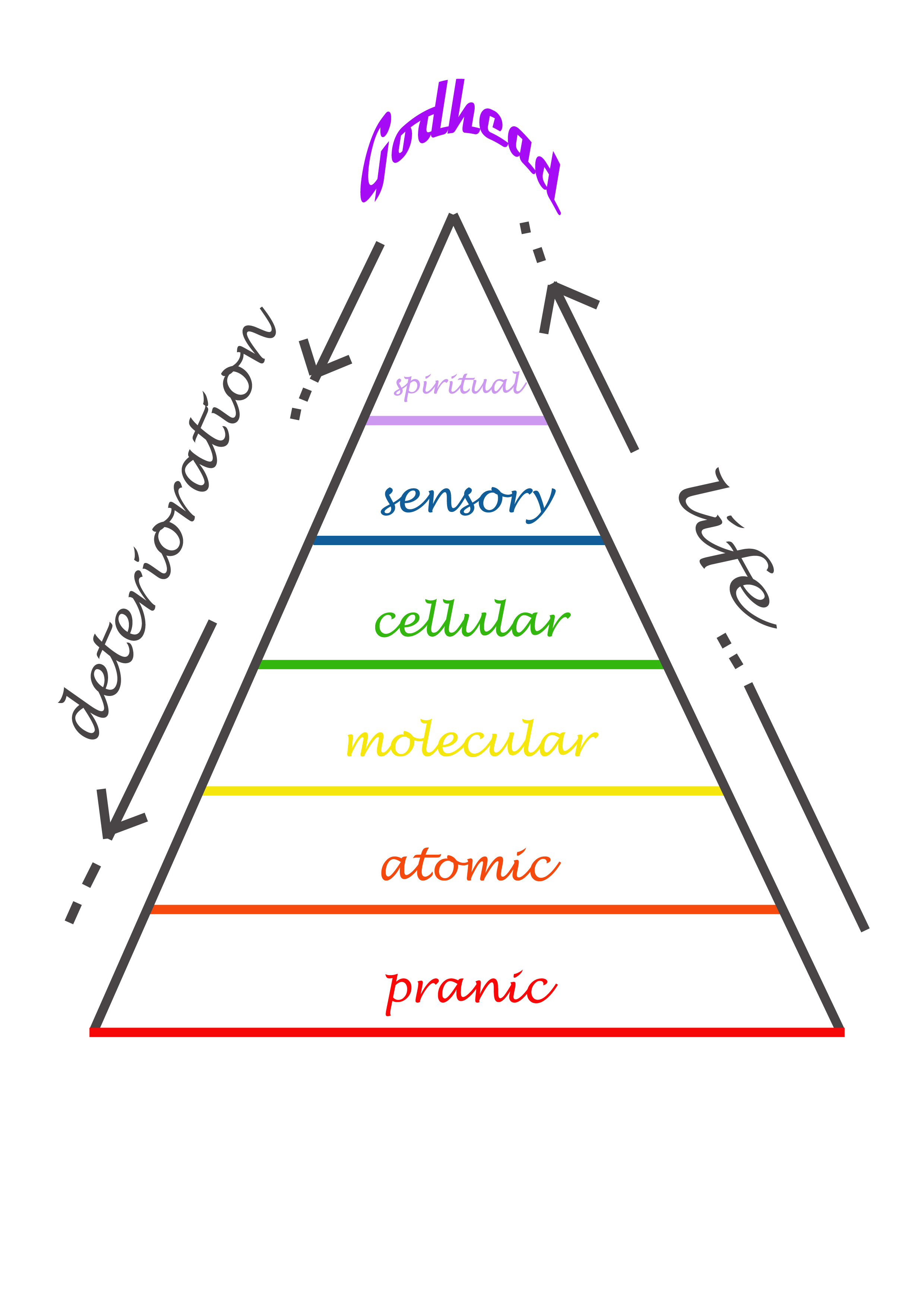
Again, reverting to your triangle Biostrata diagram you will see that the Spiritual Stratum is but one step from the Godhead Infallible.  But what is infallibility?

The Godhead holds ‘exclusive’ rights to infallibility, being the most elevated level of intelligence. Being at the most elevated level of intelligence is always by courtesy of the Godhead for the complete Biostrata is an extension of the Godhead. All essential and absolute qualities for Life becoming ever more fallible and as yet, less vital as disintegration and dissipation co-exist in ever readiness to dilute existence back to the basic Pranic stratum, and as such behaviour and intelligence and all extensions exist only as an inert promise to great propensity.

Within the Biostrata, there are three possible states to existence and they are Life, Stagnation and Deterioration.

True Life exists when progress within the Biostrata is in upward motion, moving toward the Godhead. Any movement in the opposite downward motion is a resulting deterioration, life diminishing descent toward death. Stagnation is the state of there being such an enormous variety of inanimate substances present in the Universe about us. Inhibiting influence causes stagnation within a stratum, almost stopping the upward trend of the Life-state. Life forms from every level of evolution all play a role appropriate to its biostrata status and all of these so to contribute to the ascendance or descendance through life and death.

Life status is an ascent, Death status is from descent but stagnation occurs in an outward direction on a horizontal plane. All interact and influence each other and this can have a stabilizing effect but also ensures no single state can gain supremacy without a struggle.  Life is indeed a struggle, a continual battle against Stagnation and Death.  But deterioration does not just happen, it is brought on by units failing to resist the lure of stagnation. Instead of resisting stagnation, those units who collaborate will eventually lose their vitality and thus must surrender to Deterioration.

Dependent upon which state is exerting the greater influence at the time when stagnation is allowed to succeed on one particular level will rely heavily on whether Life continues or Death ensues and from this we can learn that Stagnation means remaining too long with the bounds of one stratum.

You will see this clearly in this so-called civilized world that there is far too much stagnation. Within the consciousness of almost every human being there is a choice to stay outbound in direction over the whole of the Sensory (mind) stratum of the Biostrata rather than continuing to expand upwards to the Spiritual Stratum and eventually the Godhead. Stagnating in the Sensory Stratum not only increases the struggle for existence but it so weakens life’s upward ‘thrust’ too – as a result, Deterioration’s chances of gaining supremacy greatly improve.

One of the biggest and most valuable lessons to learn from this piece of knowledge is that the most successful, wholesome form of life and living can be experienced whilst ascending the Biostrata. It would be most prudent to seek avoidance from stagnation and deterioration. Remembering that all of this applies to the impermanent Self (the bodily vehicle) for the Essential Self moves in one direction only, and that is toward Godhead enlightenment.

We have only to resist Stagnation in order to deter and delay Deterioration and prolong life as the impermanent Self thus hastening the Essential Self’s ascent to the ultimate haven of spiritual bliss – the Godhead.


Biostrata …. continues 5

We now find ourselves evolved to the stage of the Sensory Stratum and here, development of the intelligence displayed is generally known as ‘Human’ intelligence.  Within the ‘grey’ areas of there being no difference between mind and matter it is sometimes challenging to understand the credibility of this. But think on, your body is made up of cells which ‘display’ intelligence, for their behaviour is that of organised pranic (life source) movement, and as we have seen so far, all the way up through the layers of Biostrata there is intelligence. Thus, this belongs to both mind and matter.

For human intelligence to exist, there is dependence upon sensory images. This is so because when we think, or apply intelligence to problem solving, we are readily using ‘sensory’ images. We have not the capability to think of pure quality or pure quality for we must at all times have available to us, sensory images, better known as ‘symbols’ which represent the quantities and qualities which constitute the subject of our thinking.  For example, if we were to try to think of the pure quantity of SEVEN, we would find that impossible, yet if we produce in the mind, a symbol and/or sensory images that represent SEVEN, we can then immediately begin to envisage that quantity.  We could visualise SEVEN apples or audibly imagine SEVEN chimes of a bell.  The ‘types’ of symbols used are not important but their presence in the imagination is fundamental to being able to ‘think’ about quantities.

Of course we know we have progressed further than this method of ‘quantity’ thinking (albeit the exception in young children in their learning informative years) for we have moved forward to utilise specific written symbols for each number and so to do we have symbolism when ‘thinking’ about quality. LOVE for instance, unless we can produce a sensory image in respect of this, something or someone who portrays the quality of Love, we would find it impossible to think (feel) it.

Qualities are abstract. Like a hole; that is abstract. A hole cannot be perceived purely as a hole, there must be a concrete counterpart. If you have a hole in a piece of wood and then the piece of wood were to be destroyed, there would be no hole. We are only able to think/perceive that hole in relation to the piece of wood it is found within.

So to think of an object of beauty, it has to come with a counterpart, a determination of an occasion, we have to see (perhaps a beautiful face), or hear (a beautiful voice) or smell (a beautiful scent) to have something which directly represents that which is beautiful.

Thus, here we are, in the knowing that the human body belongs to the Sensory Stratum of the Biostrata. Every single human body is the outcome of the upward movement/progression/development of Prana, forever ascending the evolutionary scale of Existence.

With this notion, how then do WE determine the extent of OUR potential progress?

The answer is found within consciousness. If consciousness is dependent upon the senses for information then this clearly indicates that the Sensory Stratum has been reached. If consciousness is mainly relying on impulses, feelings and urges then it is on one of instinctive nature (the Cellular Stratum) … but if thinking about quality and quantity through symbolism is reached, then we are at the Sensory Stratum. By no means however, does this mean we are on a ‘precision instrument’ level, one that is indicative of our development for more often than not, although we ‘occupy’ our main ‘stratum of residence’ we are also reluctant to leave behind the old ‘familiarity’ of acquaintance and experience and thus we continue to cling to the stratum immediately below. So too, do the lower stratum, before completely vacating their residence in their eagerness to ascend the biostrata, reach up immediately above and thus you can find intelligence occupying three strata at the same time.

One may think that ascension through the biostrata is now complete, seeing as we have come to our Senses, but we are still yet to reach the apex of the symbolic triangle.  Next we venture further upward to enter the Spiritual Stratum.


Biostrata …. continues 4

In simple terms, Life is an upward motion/process and movement in any other direction is that of deterioration or failure of development.

Here is a diagram to help with a visual understanding of the Biostrata.  The simple, yet empowering shape of the Triangle is utilised.

The Biostrata

The bottom line represents the Pranic Stratum – that of inert energy, the ‘potential life force’ … that from which all recogniseable existence emerges.

You can see that as we move up to the next level of the triangle we enter the Atomic Stratum – that which relies heavily on the Pranic level for its existence, but which is of lowest order of intelligence with its uncomplicated patterns of behaviour … it provides the basis for all matter.

Lifting up to the next part of the triangle we gain admission to the Molecular Stratum and up again into the Cellular Stratum, a continuum in motion, a trend toward unity, a state of being one.

Always, a number of atoms must unite to form a molecule, a number of molecules must come together to form a cell (thus there are fewer cells than molecules) and this continues with existing numbers of units becoming fewer as the number of elements within each unit increases.

Keep returning to this Illustration to assist in understanding.

From the Cellular Stratum we move cohesively into the Sensory Stratum and this is where the collective activities of the cells move forever upward towards unity, being a whole, and thus commit to their specialised groups to form the Body. Again, it is a large leap, like that of the molecular to the cellular.  What is significant about the progression upward from Cellular to Sensory is the contributory elements taking place in the formation of tissue and cells like that of the storing of hereditory data, the relative positionings of tissue formations and much much more which cannot be shown in the illustration but which exist in other ‘strata’ which rest in between the significant stratum as shown in the diagram.

So now we are in the Sensory Stratum and this is known as such quite simply because we have arrived at our Senses.

Biostrata continues ….. 3

From the beginnings of the Biostrata we are aware that Prana is the vital force, the ‘potential’ life force in everything and seeing as it is indeed  the first stratum it deems logical that the atomic, molecular and cellular strata all have prana manifesting in them.  Prana is capable of manifesting at various levels of mind and matter (all relativity dependant of the observer).  Thus, there is a predetermination of the development of pranic manifestation and progress within the natural laws imposed by ‘original design’ (the groupings, the selective process of atoms and molecules and cells) and is something that is predictable at every stage of development.  So when, at the cellular level of life, cells, eventually ‘die’, is this due to the cell running out of Prana? Atoms form molecules, molecules form cells and so forth in an ever upward development of pranic manifestation. There is the common logic of upward direction toward a higher stratum. However, as soon as no further progress is being made within development, or if atoms, molecules and cells fail to conform to their original design, then they are deemed to be ‘dead’ or inanimate and they will begin to break up and fall back downward through the lower strata. This activity denotes gradual deterioration. A cell will break up into molecules and then the molecules will separate into atoms and so it continues.  This could be nothing more than a re-cycling process whereby during ‘deterioration’ there is assessment of how much decline has taken place and if indeed some atoms and molecules can re-enter the upward development and further contribute to fresh material and life-form then so they shall.  When a cell ‘dies’ it does not mean all Prana has disappeared. The dying cell is merely reversing its direction of movement within the Biostrata. It has the capacity to regenerate.

Therefore it is interesting to observe here, how despite the ‘dying off’ of various components within the ‘life form’, whether they be cells, molecules or atoms, there is an ‘essential design’ maintained by the ‘ever upward’ progression of new components (prana, atoms, molecules, cells) coming up through the Biostrata (resulting from reproduction or selective attraction).  These are once again of original design, and are simply replacing those constituent parts whose term has expired and are in descent, possibly to be drawn again into circulation and ascend the Biostrata as new life-forms if their manifestation can regenerate, re-cycle itself.

Life, as we understand it, is an upward progress through the Biostrata and we should see that all development, progress and retrogression, manifestation, behaviour patterns and all intelligence are under direction of a Supreme Controlling Force. It is notwithstanding that everything in existence, whether it be an atom, a molecule, a cell, a human being or inanimate object, it has to make an upward progression through the Biostrata and has to conform to laws which emanate from the Supreme Controlling Force. Non-compliance of this will produce premature stagnation and deterioration because unless there is compliance with the laws of the supreme controlling force, whether by design or by accident, there can be no progress. Progress is Life in the generally accepted context. There is much opportunity for free expression at every level of the Biostrata, however this can only occur within the ‘essential design’ on the law of life.

Biostrata continued ….. 2

The molecular stratum comes after the Pranic and Atomic stratum … basically, molecules are specialised groups of atoms.  Atoms arrange themselves into categories with each category applying specific characteristics having come together as an ‘expression’ of atomic intelligence (atomic characteristics are mainly determined by the number of electrons orbiting each nucleus), so there is always a selective process responsible in forming groups of atoms. This, in turn, relates to selective processes for grouping atoms into molecules. Molecular intelligence is therefore one level higher in intelligence than atoms but only due to the fact that molecular patterns of behaviour are far more complex than that of atoms and therefore selection processing is more intricate. Atoms will come together to form a molecule by use of interaction, producing a pattern of behaviour within a single molecule.  The molecule’s behaviour is mostly due to the atoms influencing each other by way of attraction or repulsion, so as to maintain equilibrium within a molecule’s precise structural arrangement. When molecules start their process of selection they are mainly extending the faculty of ‘atomic selectivity patterns’ within their formation.  The formation of molecules are but an extension of the same procedure as that of atoms, only more intricate, molecules are moving closer to the development of the human body.

Molecules unite to form living human cells.  The jump from molecules to living human cells is far greater than the jump from atoms to molecules but there are always firmly fixed ‘roots’ of the selectivity processes coming from the Atomic stratum. There are specialised groups of molecules to give us complete cells of every design – muscle, blood, bone, nerves. This development now shows us the growing complexity of each successive stratum and how it utilises the qualities and faculties of its preceding strata. This also allows us to witness the different behaviour patterns increasing during growth and displays the increasing level of intelligence, always gaining in superiority as the strata continue upward. The level of intelligence at the Cellular Strata is outstandingly high, so high that cells seem almost able to think.