
HUMAN ANATOMY

The human body is the most ingenious assembly of purposeful components you will ever ever find on this planet.

Beneath the envelope of skin and tissue, there are muscles, nerves, a circulatory system for blood, glands, vital organs, and above all, that marvellous system of bones called the Skeleton.

The skeleton not only supports the muscles and body as a whole, protecting those vital organs of brain and lungs but it is also responsible for our basic shape and size (although the last word in that matter comes from the muscles and subcutaneous tissue and skin).

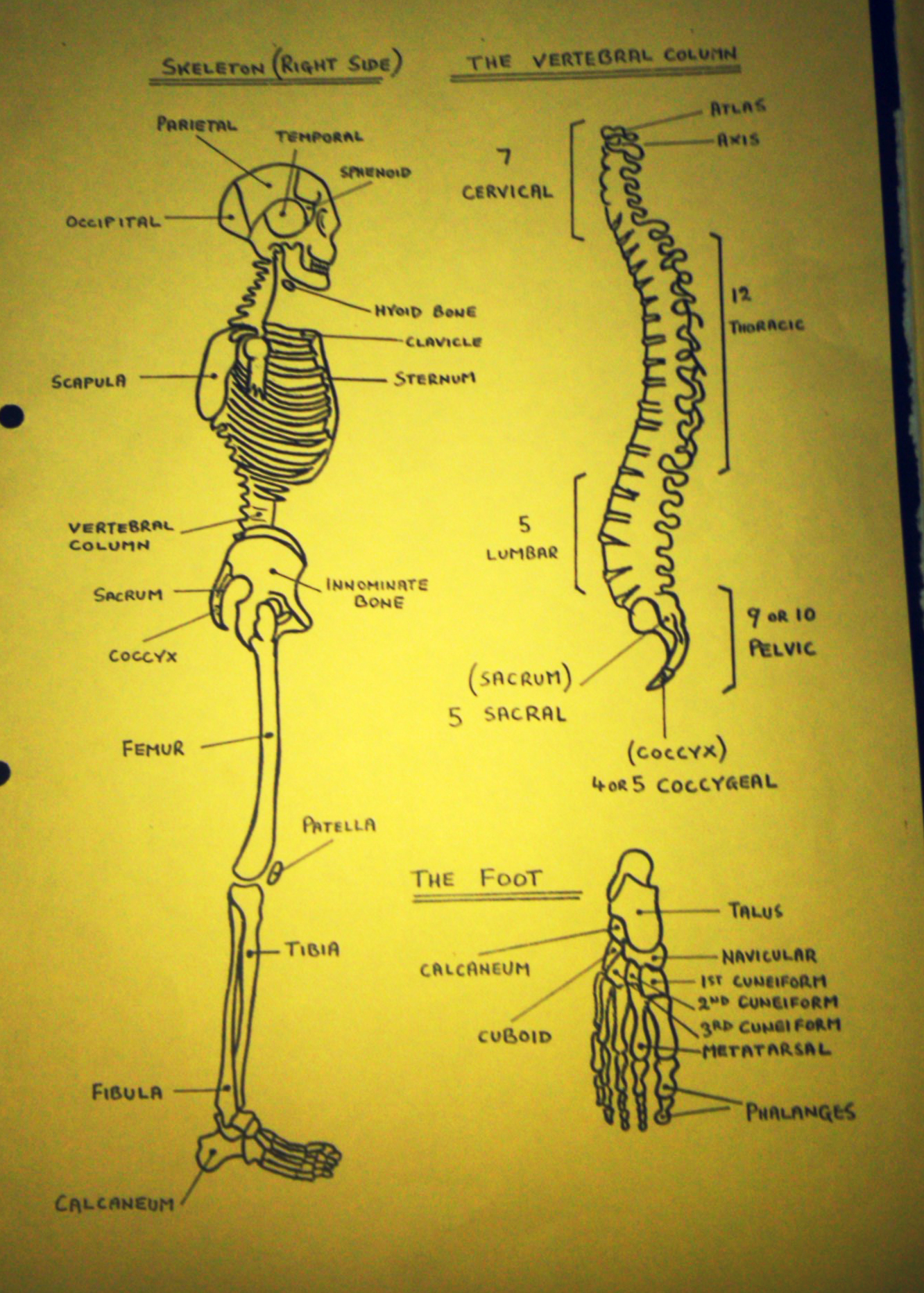
The skeleton consists of 214 bones (which includes the six ossicles found the ears – not listed below).

AXIAL SKELETON

The axial skeleton comprises the skull, the backbone (vertebral column) and the ribs and breastbone (sternum).

APPENDICULAR SKELETON

The appendicular skeleton comprises the legs, arms (limbs) and shoulder and pelvic girdles.

The skeletal bones are classified according to their shape and formation

LONG BONES  found mainly in the limbs, fingers etc

SHORT BONES such as found in the wrist

FLAT BONES like in the shoulder-blades, skull etc

IRREGULAR BONES such as some facial bones and those of the vertebrae etc

SESAMOID BONES like those developed in the tendons of the muscles. The knee-cap is a good example.

SO:

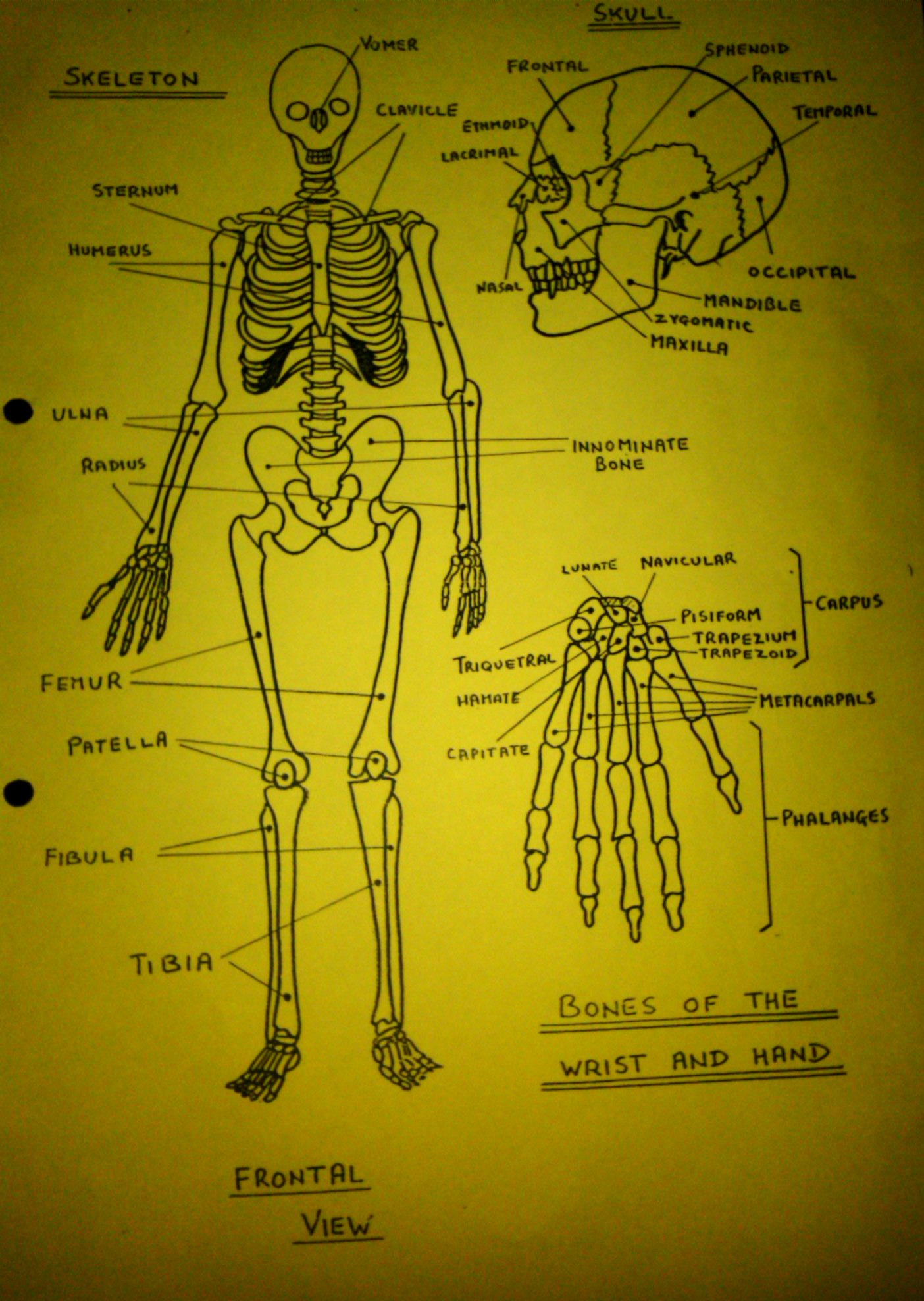
Starting at the top we have the SKULL and the SKULL consists of the Cranium and the Face.

The CRANIUM has 8 bones which are made up of 1 occipital, 2 parietal, 1 frontal, 2 temporal, 1 sphenoid and 1 ethmoid.

The FACE has 14 bones and they are made up of 2 nasal, 2 palatine, 2 lacrimal, 2 zygomatic, 1 vomer, 2 inferior turbinate, 2 maxillae and 1 mandible

The VERTIBRAL Column has 33 bones (sometimes 34). Each separate bone is called a vertebra.

The upper 7 vertebrae (plural of vertebra) are called the Cervical vertebrae, the uppermost two permitting movement of the neck. the first cervical vertebra is called the Atlas and the second is called the Axis. Together these two bones form the Atlanto-axial joint.

Then we have 12 thoracic vertebrae. Then we have 5 lumbar vertebrae. After the lumbar comes the sacral vertebrae which form the sacrum after which comes the tail of the spine, the coccyx, which comprises of 4 (or5) coccygeal vertebrae.

Within the thoracic vertebrae we have what is known as the thoracic cage. it consists of the 12 thoracic vertebrae (already mentioned above) at the back, 12 pairs of ribs at the sides and the sternum at the front.

Uppermost in this cage we have 7 pairs of true ribs, below them, 3 pairs of false ribs and then 2 pairs of floating ribs.

The true ribs (pairs 1-7) are attached directly to the sternum, the false ribs (8-10) are attached indirectly to the sternum (by means of cartilage extending from each rib to the one above and then ribs (11 and 12) are not attached to the sternum in any way (hence the term ‘floating’).

Above this we have the shoulder girdle: the left and right Clavicle (collarbones) and left and right Scapula (shoulderblades).

In isolation in front of the throat rests the hyoid, a small bone.

Attached to each side of the shoulder girdle we have the upper body limbs, otherwise known as the ARMS. Nearest the shoulder is the upper arm bone, the Humerus and then for the lower part you find the Radius and Ulna, placed side by side. Then moving on to the Wrist and Hand, these bones are: The 8 bones of the Carpus, the Navicular (Scaphoid), Lunate (Semilunar), Triquetral, Pisiform, Trapezium, Trapezoid, Capitate and Hamate. Then there 5 Metacarpals (the bones between the fingers and wrist) and then the 14 Phalanges which form the Thumb and 4 Fingers.

BELOW the WAIST we have the PELVIC GIRDLE and this consists of the 5th lumbar vertebrae, the sacrum, the coccyx at the back and 2 Innominate bones which encircle the remainder of the region.

Moving on to the LEGS : You have the Femur (Thigh Bone), the Patella (Knee Bone), the Tibia (Shin Bones) and the Fibula (placed alongside the tibia).

Bones of the FOOT are: 7 tarsus bones, the Calcaneum (heel), Talus, Navicular, Cuboid, 3 Cuneiforms, the 5 metatarsals, and then the 14 phalanges forming the toes.

JOINTS

A joint (or articulation) is a union of two or more bones.

There are 3 main types:

1.Fibrous (immovable) – a fixed joint allowing no movement whatsoever, i.e the joints (sutures) of the flat bones of the skull, like the teeth in their sockets etc.

2.Cartilaginous (slightly moveable) – in this joint the surfaces are separated by some intervening substance such as cartilage … i.e the intervertebral joints of the vertebral column with their intervertebral discs of fibro-cartilage.

3.Synovial (freely moveable) – the ends of the bones forming the joint are covered by hyaline cartilage. ligaments are necessary to bind the bones together, and the joint cavity is filled with synovial fluid and is enclosed by a capsule of fibrous tissue.

Varieties of Synovial Joints:

1.Gliding – small bones of the carpus etc

2.Ball and Socket – hip and shoulder joint

3.Hinge – elbow joint

4.Condyloid – wrist joint

5.Pivot – atlanto-axial joint

6.Saddle – joint between the trapezium and first metacarpal bone (thumb)

IMG01104-20130401-1947

IMG01105-20130401-1947

Biostrata ……….. continues 7

Mind is intelligence, awareness, consciousness, perception, mind exists in and with everything. It is the inherent and most basic quality of active prana. Therefore you will see that the human body, being made up of prana and displaying infinite complex behaviour patterns, is also Mind.

Consciousness makes us see ourselves sometimes as ‘bodies’ and other times as ‘minds’.

It is always the observation (the point of view) which changes, not that which is being observed, and so it is, with every single one of us human beings, we can all be observed as mind, body or spirit.

Now upon having gathered the knowledge of all of the above we can now look at the true nature of Mind and consider too the 3 sections it is divided into …. Conscious, Subconscious and Unconscious.

The human ‘conscious’ mind belongs to the Sensory Stratum, the ‘subconscious’ and ‘unconscious’ belong to the Cellular Stratum, with the ‘unconscious’ reaching all the way down to the Pranic Stratum (after passing through the molecular and atomic strata too).

The conscious mind possesses a number of faculties, ‘Consciousness’ being just one of them.  Consciousness (otherwise termed ‘Awareness’) is introspective and results from exclusive components which make up a unit, i.e the consciousness of ‘cells’ and/or ‘molecules’ and the intelligence displayed therein of those components/units.  When awake and fully conscious, we rely on the combined consciousness of all cells for our normal functioning, together all combinations give us our Awareness.  During sleep however, ‘sensory’ consciousness can become ‘patchy’ as not all cells are still functioning, some have suspended their activities. Sensory experience (in sleep) is fragmentary and incomplete and inclined to seem slightly less ‘real’ than that of the fully awake sensory consciousness. Hence the phenomenon ‘Dreaming’.

All levels of the Biostrata need each other, no one level can exist without the others for this is all about a progressive, unifying process in the development of inert Prana to Human Being.

Communication throughout the Biostrata is strictly from one stratum to the adjacent stratum so it is not possible for say, the Sensory Stratum to communicate directly with the Molecular Stratum, the communication must pass through all intermediate strata wherever the communicating strata are not adjacent with each other. This communication is much the same as any form of communication, whereby it is an influencing of awareness of one entity, reaching out to the awareness of another.Usually this communication is for one of two reasons. Either for controlling the units of another stratum, or for the purpose of being controlled by the units of another stratum.

Consciousness is unique, it belongs to one unit and is its inherant part. when a number of units of one stratum unite they constitute a ‘complete’ unit in a higher stratum and thereby produce a ‘collective unit consciousness’ .. i.e another ‘one exlusive unit’.

Awareness (Human Consciousness) is the ‘agent’ for all communication in the Sensory Stratum, it is not only a ‘receiver’ susceptible to other strata but it is also a ‘transmitter’ which has capability of influencing all units of its own, and other, strata.

The Human Consciousness is better able to communicate with strata below its own level rather than the levels above and this makes it more understandable to us how we can appreciate being ‘stuck’ in the Sensory Strata, often unable to progress upwards to the Spiritual Strata. Consciousness marks the extent of our singular development within the Biostrata, having ascended from the Pranic Stratum and being made up of units of the Cellular, Molecular and Atomic Strata, you will understand that when any unit of the Sensory Stratum is communicating with units of the lower strata, it is indeed actually communicating with parts of itself.  Whenever we use our physical apparatus such as moving limbs or swallowing morsels of food we are communicating within the Cellular Stratum, making appropriate cells action and respond in accordance with our wishes, and those cells composed of molecules and atoms are all receiving communication from the Sensory Stratum, continuing, automatically, down and down the entire number of components until the Pranic Stratum is reached and all necessary communication has been actioned.  You will recognise for instance, when you are hungry, you are made aware of this by Sensory Consciousness, it is a message from the Cellular Stratum telling you (human consciousness) that you must eat. Therefore these are the busiest lines of communication, the interchange of influences between the Sensory Stratum and all strata below.

If you take yourself to your current level of Sensory Stratum you might think that communication on this level is the easiest but alas, even with all the lines of help brought about by Post, Radio, Telephone etc there still remains some of the most difficult, if not impossible obstructions regarding communications between human beings on a Sensory Level.

When a human being (one unit of the sensory stratum) communicates with another human being it is possible for there to be awareness of who is the receiver and who is the transmitter, both can occupy consicousness at the same time, however, when one human is communicating with another, what has to be remembered is that communication is happening with a ‘separate’ consciousness and therefore, this is not as easy as communication with one’s own component cells.  If you have little understanding of your own Sensory Self and all parts below (and above if possible) then you will have greater challenge in communicating with other conscious beings (especially if they have little or no understanding of their development).

Finally, to reach up and communicate to the strata above proves the most challenging and is probably the Sensory Stratum units’ upmost difficult communication. When a human being ‘reaches up’ it is doing so into the ‘unknown’ and the awareness is that of the actual reaching rather than of which level is being reached.  The Spiritual Stratum is intuitive and when the Sensory Stratum does manage to communicate with the Spiritual Stratum it receives intuition and inspiration. Human consciousness must expand and transcend the Sensory Stratum if it is to successfully communicate with the Spirit and the Godhead of the Biostrata. Only when Human consciousness has made itself receptive by negating the significance of all sensory stimuli can it expand, can it reach up, can it communicate with a unit of the Spiritual Stratum and thereupon receive Intuition and Inspiration.

Yoga Nature

Yoga is a Science. It is an Art. It is an Order to which every boy and girl, man and woman can adhere toward in their lifetime to become healthy and whole.  Dedication, discipline and direction are all required to bring oneself from infancy to healthy normal maturity.  During all stages of growth, maintenance of one’s general health and well-being requires self-control and perseverance.  An understanding of the self will lead to the development of mind body unification and ultimately physical welfare.  The science of Yoga encompasses all aspects of ‘how to’ gain a normal state of health. It is profound, there are foundations to be laid, it is a way of life.

The fundamental birthplace of Yoga teaches the path of a natural mode of living.  On this modern planet in which we inhabit, this can prove challenging. Can we return to ‘Nature’?  Have we time to turn our view away from the dazzling mad rush of modern civilisation? Fashion and Social ambition demeans and befools us. In short, it controls us. The repercussions thereafter, obliterate us.  In the cradle of Yoga, one can receive nourishment, warmth and protection. In your Yoga practice you gain first, nature, second, nature, third, nature.  A return to whence it began.

The ordinary way, true earth, natural magnetism, is still with us.  The most vigorous races of the world still live, still inhabit this wondrous earth, as they have done for centuries.  They require little other than what nature gives. This last remaining vital force is bestowed on us all.

Attention now, to the self, is inherent.  It is how nature, and all living beings, will survive.  Observation and awareness to ‘natural magnetism’ and ‘vitality’ will teach all that a Yoga Nature and the answers therein, will show earth’s way.  The Earth is like a battery, charged with magnetism and ready and willing to give forth its strength to all beings. Apply the ‘test of nature’ to all theory and know that it has valuable ‘order’ and is a trusted friend.

Seeking to maintain a healthy, normal, natural body? Assume the title of ‘Yogi’, reverse the trend of ignorance, and endeavour to lead the Yogi plan of physical life.

One can be loyal, as far as possible, to the continuous practice of Yoga, in order to gain insight and experience of Nature’s plans and methods. All systems and techniques within Yoga will indicate how to reach normal functions of the body.  With this adherence followed, a natural state of health and well-being can be achieved.  Yoga’s key note is ‘Health’ and its main purpose is to help all conform to a standard of healthy living.  That which keeps a human healthy can make an unhealthy human healthy.  Yoga (and all branches thereof) exploits a sane, natural, normal and healthy manner of living, and if followed, will benefit all. Yoga stays close to nature and advocates a return to natural methods of life in preference of those which mislead us into obliteration.

Yoga will demand your attention and observation and will teach you how to take command over your rebellious self. Yoga will call to action your responsiveness, your ‘will’, and will show you how to do everything you can to achieve health and well-being.  Yoga will re-ignite your belief in the Intelligence behind all Life. Engagement with the great Life Principle will allow us to survive, to all be well within our bodies.

Put your yearning for something new into Yoga practice; through this you will get a good fair start on the road to the knowledge you seek.

Yoga and Premenstrual Syndrome

Premenstrual Syndrome (PMS) is experienced by all women at one time or another during their lifespan. It is still unknown as to why such symptoms as headaches, stomach cramps, breast tenderness, bloating, weight gain and irritability occur, however through the realms of Ayurveda and Homeopathy, the physicians therein believe that lifestyle factors which disrupt the body’s natural rhythm, creating hormonal imbalances play a significant part in generating all symptoms. Lack of exercise, bad eating habits, overworking, tension, stress, travel and difficulties in relationships will all contribute to cyclic patterns of anxiety, mood swings, emotional turbulence and depression, which all equate to PMS.

Gynecologist and obstetrician, Dr.Guy Abraham developed a classification system for PMS back in 1980. Four types grouped PMS, Type A (Anxiety) often accompanied by mood swings and irritability. Type C (Craving) would result with headaches, fatigue and sugar cravings. Type D (Depression) would have results in the region of memory loss and confusion and Type H (Water H2O retention) would result in weight gain, tender breasts and bloatedness (not to mention the further psychological distress that attaches itself to weight gain and negative body image). Any woman could suffer any combination of any of the above, with symptoms altering with every menstrual cycle depending on the earlier lifestyle factors mentioned earlier plus hormone fluctuations and dominations.

Based on the four main types of PMS outlined above there are self-help measures recommended.  Specially selected Yoga positions will provide not only immediate relief for the discomfort of PMS but will give continual opportunity for inner renewal and long-term benefits in reducing (and in some cases eradicating) all symptoms therein.

Yoga Postures for Type A (Anxiety) : The Corpse Pose, The Crocodile, The Child’s Pose All three of these are simple relaxation poses. In turn they will allow the mind to focus inward and relax deeply and completely whilst focusing the breath on the organs such as the abdomen, pelvis and back muscles.

Yoga Postures for Type C (Craving) : The Bow, The Bridge (modified) These two postures will stimulate blood flow to the abdomen and pelvic areas thus helping to regulate sugar levels and metabolism. Further within these 2 poses the ovaries, uterus and abdominal organs will be stretched and toned. Performing these positions will increase energy and lift the mood bringing with it a sense of rejuvenation and relieving of carbohydrate cravings. This type of PMS will translate the need for glucose to that of the need for sugar and/or chocolate (which contains magnesium which is needed to normalize glucose metabolism) however, unrefined sugar and chocolate have the side effect of a ‘let-down’ feeling, fatigue and headaches.

Type D (Depression) : Upward Facing DogThis dog posture is excellent for stimulating both the front and back of the body and bringing renewed strength to the lumbar and pelvic area. Gazing upward together with stretching skyward help counteract the downward pull of gravity, and that too of depression.

Type H (H20 Retention) : Wide-Angle Pose, The Plough                                                                                                                Gentle inversions help relieve and reverse the effects of water retention, especially in the feet, ankles and lower legs. Blood and energy circulation is stimulated, the entire pelvic region is opened and energized thus counteracting swelling. Care is to be taken to not do full inverted postures whilst on your menses.

All of the above postures, practiced regularly, during and in between the menstrual cycle, will all contribute to lessening the discomfort of PMS symptoms.

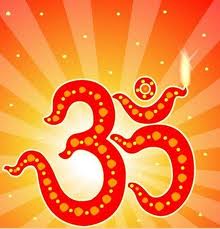
Om/Aum

om

Om/Aum is the ultimate Mantra (repeated sacred word).

Aum/Om has its own symbol

it represents the conscious, the subconscious and the unconscious in everything

The word Om is mighty and omnipresent.

It is believed that Om is the ancestor of Amen.


Om emphasises balance.

Paramahansa Yogananda states: ‘the infinite potencies of sound derive from the Creative Word, Aum, the cosmic vibratory power behind all atomic energies’.

Any word spoken with clear realization and deep concentration has a materializing value. Loud or silent repetition of inspiring words has been found effective in Coueism (a method of self-help stressing autosuggestion) and similar systems of psychotherapy. The secret lies in the stepping-up of the mind’s vibratory rate.

Molecular vibration never ceases. Inherent tendencies are equal to the sum-total of impressions/stimuli that you imbibe, which then live on in the mind. Repetition of creative sound is the greatest stimulus that can be given to the spirit, by repeating the Om/Aum mantra, one is keeping great company with one’s own mind. Light enters, ‘the self’ will become manifest.

With AUM, the first letter A is the root sound, the key, pronounced without touching any part of the tongue or palate. The second letter, U rolls from the very root to the end of the sounding board of the mouth. The M, and third letter represents the last sound in the series, being produced with the lips closed. With this in mind it becomes clear to see that Om(Aum) represents the whole phenomena of sound-producing and shows all possibility and range of word making, it is in short the matrix of sound and nature.

Namaste

Namaste is a word from the ancient Sanskrit language.

Its best interpretation/meaning is ~ the light within me bows and honours the light within you and together we are one, connected by a soul recognition of the universe and beyond.

it is a gentle yet profound reminder to not ‘sell our soul’ or ‘buy into anything that disconnects us from it’

Yoga is Good For You

Yoga is good for what ails you.

Just for starters Yoga helps manage or control anxiety, arthritis, asthma, back pain, blood pressure, carpal tunnel syndrome, chronic fatigue, depression, diabetes, epilepsy, headaches, heart disease, multiple sclerosis, stress and other conditions and diseases.

On top of all that Yoga improves your muscle tone, flexibility, strength and stamina, it reduces stress and tension, boosts self-esteem, improves concentration and creativity, lowers fat, improves blood circulation, stimulates the immune system and creates a sense of well-being and calm.

That’s all just scratching the surface. If you delve further, deeper, you find connection to your transcendent Self and gain true happiness, liberation and enlightenment.


Hatha Yoga / Styles

Regardless of your age and/or level of fitness you can find a style of Hatha Yoga that will appeal and be most appropriate for your particular body and/or personality. Throughout all styles of Hatha Yoga, basic asanas (postures) and pranayamas (breathing exercises) remain the same, however it is within their order, how they are approached and where attention is focused that differentiates them. The emphasis may be on the postures, the breath, the rhythmic movements, the philosophy or a combination of non-exhaustive factors. There will always be the specific characteristics which reflect any particular teacher’s approach too. All styles and all teachers have their own personalities and it is about finding one which suits you.

Ananda Yoga ~ this method combines physical and spiritual with its purpose to clear and energize the systems of your body in preparation for meditation. Every posture looks toward expanding or heightening self-awareness. It is enhanced through affirmations which are a distinctive feature of this system. This style utilizes series of poses called ‘energization exercises’ which involve tensing and relaxing different parts of the body synchronised with breathing exercises to send energy to all parts. There is emphasis placed on relaxing deeply into the poses reflecting the intention that Hatha Yoga is a preparation for meditation.

Ashtanga Yoga ~ this yoga system is a rigorous practice and can be compared with the training of an elite athlete. There are 240 postures done in six successive series which are all linked by the breath (vinyasa flow). This style of Hatha Yoga represents the most intensive form with its purpose to create heat which in turn produces a cleansing/detoxifying effect on the body. There are equal emphasis placed on strength, flexibility and stamina within Ashtanga practice (also known as ‘Power Yoga’).

Integral Yoga ~ this combines all paths of yoga to benefit all aspects of the individual. One approach is made through asana (postures), pranayama (controlled breathing), selfless study, chanting, prayer, meditation and self-inquiry. Integral Yoga is more meditative than anatomical. This approach encourages one to be ‘at ease in body, peaceful in mind and useful in life’.

Iyengar Yoga ~ this is probably the most widely known technique of Hatha Yoga and is prescribed by yoga master B.K.S Iyengar. It is rigorously scientific and therapeutic and concentrates on alignment, correcting those structural imbalances of the physical body. One will pay close attention to the placement of hands, feet and pelvis as well as gaining alignment of the spine and appendicular frame (arms and legs). There is much attention to detail within Iyengar Yoga and props (wooden blocks, belts, straps, blankets, bolsters) are made available to assist in achieving great symmetry of the skeletal frame and progressing in extension within the posture.

Kripalu Yoga ~ this style of Yoga has been described as ‘meditation in motion’.  There is less concern with the structural detail of the poses more rather how the student feels mentally and emotionally whilst holding the posture. This style encourages a gentle, compassionate and introspective approach and due to the nature of holding the position for a longer time, it helps the practitioner to explore and release any emotional/spiritual obstructions. There are 3 stages to this style of practice, willful practice, will and surrender and surrendering to the body’s wisdom. There are differing intensities offered, gentle, moderate and vigorous. On top of all of this there is spontaneity encouraged through sequences of postures and too in individual postures to be guided by the body’s internal awareness.

Kundalini Yoga ~ this is the ancient practice which is designed to unlock and bring forth the reservoir of energy located deep within the base of the spine. The use of breath, posture, chanting and meditation are all encouraged to stimulate and consciously awaken the ‘kundalini’ through the chakras of energy centres positioned along the spine. The most common breathing exercises to be emphasised are : alternate nostril breathing, diaphragmatic breathing and a dynamic technique called ‘breath of fire’.

Sivananda Yoga ~ this style of Hatha Yoga incorporates a 5 point method of practice. It includes proper exercise, breathing, deep relaxation, vegetarian diet and positive thinking and meditation. The practice herein follows a routine of breathing exercises, sun salutations, a series of postures and then relaxation. Short Mantra chants and prayers will always begin and end each class.

Viniyoga ~ this style is ‘middle of the road’ between exacting Iyengar Yoga and demanding Ashtanga Yoga. Its basis is within the realm of ‘organized course of yoga study’.  There is the combination of asana, pranayama, meditation, text study, counselling, prayer, ritual, chanting and using the powers of imagination. There is a tailoring of the postures to the physical needs of the individual student, the emotional needs and also the cultural heritage. Breathing is considered to be one of the most important parts of the movement and inhalations and exhalations are consciously coordinated and articulated in varying length and ratios. This style of yoga is tutorial on a private one-to-one basis.

Bikram Yoga ~ this style is also known as ‘hot yoga’ for it is practiced within temperatures of 80 degrees or more (supplemented by a humidifier). The 90 minute class consists of 26 hatha yoga postures repeated twice over and there is a pranayama exercise at the beginning and the end of the session. A brief relaxation concludes the class. This style of yoga is exhilarating and an excellent routine for the physically and mentally fit.


Branches of Yoga

There are a good handful of individual Yoga practices all with the common goal to unify both body and mind. They are as follows:

Hatha Yoga ~ otherwise known as the ‘forceful path’ which relates to the yoga of physical well-being. In our Western society it is used primarily as a physical therapy and consists of asanas (postures), pranayamas (breathing exercises) and meditation. The word Hatha comes from 2 parts Ha (The Sun) and Tha (The Moon) ….

Raja Yoga ~ considered the highest form of Yoga for Raja means ‘royal’ and within this practice meditation is the focal point. Approaching Raja Yoga consists of great adherence to the 8 limbs of Yoga (see The Yoga Sutras by Patanjali).  This branch of yoga is also known as ‘classical’. Raja yoga typically starts with practicing hatha yoga which prepares the body in health and strength so as to proceed forward into more advanced stages of training ….

Karma Yoga ~ is the path of service with the principle that what one experiences today is created by one’s actions of the past. With that in mind all present efforts become a conscious way to create a future that gives freedom from negativity, narrow-mindedness and selfishness. Karma Yoga is practiced within everyday work and play in a selfless manner and with intention to serve others ….

Bhakti Yoga ~ is the yoga of the heart, the path of devotion to the Devine. This type of yoga builds a positive way to channel all emotions and provides opportunity to cultivate an acceptance and tolerance of everyone you come into contact with …..

Jnana Yoga ~ is the yoga of the mind, it is the way of the wise, the path of the sage or scholar and requires development through many levels of study of the ancient scripts and texts of yogic tradition ….

Tantra Yoga ~ is a pathway of ritual and brings experience of the Divine in everything undertaken. It is the most misunderstood and misinterpreted path of yoga. It is about cultivating the mind with reverence and encouraging a ritualistic and positive approach to life in all manner ….

All above branches/paths of Yoga can be integrated with each other and one can practice and combine any number of expressions to unlock and release one’s full potential as a human being.

Final Examination

the Sanskrit for Prana is ‘moving force’ or ‘life force’ … this force is the fundamental energy and source of all knowledge, it is an upward moving breath which causes spiritual evolution.. it is all-pervading and self auto-energizing… prana is a vital energy .. it permeates the Universe and all individuals at all levels and it’s aim is to both maintain and destroy further creation …… it is both ‘being’ and ‘non-being’, a physical energy, a mental energy (where the mind gathers information) and an intellectual energy (where information is examined and filtered).  Sexual, spiritual and cosmic energy are also activities of Prana.  It is the creator of all things; life is moving because of it … when there is death, individual breath then dissolves into the cosmos.  Without Prana there is no life. Pranayama is the ‘science of Prana’ .. it is first and foremost awareness of the breath. It is the ‘focusing of attention’ to and the ‘observation of’ the breath…. breathing is a dynamic process and there are practical ways to keep attention to it; by focusing on its entrance and exit to the body via the nostrils… by listening to the breath by gently contracting the vocal chords… by following the breath through all areas it passes… through Pranayama one can prepare for the stillness of meditation… the ‘out’ breath is a most important aspect of the body’s elimination processes for one can utilise it as a mechanism to free the mind of any blockages and thus lead to the manifestation of greater clarity…. Pranayama aims to achieve this ‘following of breath’ through the offering of many and various breathing techniques and breath ratios… Pranayama is also the movement of Prana toward Apana (an eliminative derivative of Pranic energy) and Apana toward Prana…..

an excellent way of re-connecting either during or after an argument is to move into the ‘spooning’ position and to lie front to back with the person at the back resting a hand on the front person’s anahata chakra (heart centre)…. both can then lay relaxed and non-goal orientated simply breathing into the abdomens … for greater benefit it is recommended that the faster breather follow the slower breather… this is most often seen as man following woman, but of course, there are exceptions

kundalini is the feminine (shakti, dynamic, creative and energetic) aspect of potential energy which rests at the base of the spinal cord and when awakened, will rise it’s ascension through the psychic centres, the seven chakras (wheels) which lie along the axis of the spine (all of which are consciousness potential) .. this risen kundalini energy will then unite above the crown of the head with its polarity Shiva (the masculine, static quality identified with unmanifest consciousness) and thus pure consciousness unity fuses with the absolute…. the potential of kundalini energy is far-reaching and thus its release must not be forced … it is an awakening and occurrence must happen naturally and with consideration and care …….

familiarity with tantra can help a person to enjoy life to the fullest for tantra is a ‘positive attitude’ toward life… ultimately taking a generally positive attitude toward life will evoke great discovery, adventure and peak experiences … the enjoyment of ‘all and everything’ will be a direct result of this … the same familiarity with tantra will lead to a greater connection to this planet, to nature and to the universal cosmos, it will allow for a higher sense of self which will promote greater values for the self and the universe as a whole… once fundamental good changes become channelled (through processes of tantra) then higher growth ensues …. longevity is a product of all of the above ……….

in the context of tantra the ‘guru’ is one who removes the darkness of ignorance and replaces it with the light of intelligence .. the guru is an essential part of life, his ‘role’ being the essence of all mystical systems …. the guru can be found within all but sometimes this inner relationship is difficult to connect, follow and understand … an external guru can assist with this first linking with the inner ‘self’ guru and thus enlightenment can then continue … the guru aids inner discipline, spiritual energy and primary intention ……..

visualisation is used alongside kegel exercises to increase effectiveness .. the power of the mind is infinite and far-reaching optimum results can be achieved by the strengthening capacity of envisioning images of controlled development … ‘seeing’ the outcome before it occurs is the ultimate path to success ….

the law of karma state is very deep and profound, hence few human beings attain full awareness and understanding of its intricacies … it is generally found through enlightenment, along a spiritual pathway, still unmanifest in much of humankind… it requires continued discipline to perceive the significance, the explanation, the cause…..  continued self-control and order for the human being is not easy when travelling through this modern age of ignorance … (however this modern age is now pivotal to a new time of greater consciousness thus new positive humanitarian karmic light is on the horizon)

a knowledge and arrest of ‘will’ and ‘intent’ is required if one is to foresee, accept and agree with eventuality… for the successful conduct and execution of life and death, great strength and selflessness is paramount… there are many weights to first pull in efforts to become light and lifted in line with the laws of cause and effect …. even when one is unloaded and free in the lightness of intelligence of karma, there is further mass consciousness of dark, unintelligent to contend with, its negative power sometimes draining ….

the greatest thing about karma is that joy will overcome all …. this will be achieved by making no distinction between self and other and having belief that all persons are empty, individually then each will receive karma ….

the true power of karma lies in its latency and infinity for here, time, space and existence have no bounds … karma will return and return again, whenever, wherever, howsoever, simply in relevance to the primary action that occurred …

my experience informs me that every act must have great intent, will and skilfulness, for every act will re-appear with its regenerative force whether that force be negative or positive … reactions have far-reaching effect … if primary action is relative to joy, all will be good …

Hawaii’s Ancient Meditation Practices ~ 3 Techniques from the Islands

ALO-HA

The Alo-Ha meditation is a good base technique. ‘When we’re born, we’re very connected to our soul and our physical self, but as we get into our lives we become separated further and further. Meditation can help reunite your body and your soul.’ The meditation is broken into two components – ‘Alo’ means being connected as one, ‘Ha’ is the essence of life, where the evolutionary process unfolds. ‘Meditation is about focus, focus, focus and the Alo-Ha brings the meditator’s attention back to focus’.

Alo-Ha can be performed anywhere. The practitioner should naturally inhale on the Alo and exhale on the Ha. ‘Observe yourself, observe your breath, feel every muscle that moves from the natural movement of the breath.’

KUKULU OKE AO

Known as ‘The Pillar of Light’ and speaks to the native Hawaiians unique relationship with the earth. Both the human and the earth’s templates are the same. ‘Templates are blueprints of all matter’. They are sound and light grids. Often our templates are shut down, limiting our connection to the earth. Kukulu o kea o is used to bring harmony into a dis-harmonic environment.  ‘Our body is programmable by language and thoughts’. Every thought we have affects our body and creates a frequency or combination of density and light. Most of us are stuck in density, unable to access the higher light frequency of our being.

During this meditation, visualise a teardrop. Many symbols were envisioned by kahuna and passed down through the generations in secret. The teardrop represents the energetic fields or ‘encasements’ for our higher bodies, which is linked to our higher level of consciousness. The meditator visualizes a multi-dimensional teardrop moving with the exhale breath like a lizard, from the mind’s eye or pineal gland, along the spine, down to the sacrum, or ‘core of the earth.’ The earth’s piko, or chakra, has a pale silver colour. This colour is brought into the teardrop.

Next, the teardrop is brought about 12 inches below the meditator’s feet or seat if sitting, with a cord that is pale silver and connected to the earth’s core. From here the practitioner ‘opens’ their template that is about four feet in diameter. The cord is expanded to match the diameter of the template and then lifted up and around the body and into the universe. The teardrop is then taken through the spine up to three feet above the head, and then expanded into the earth’s atmosphere.

Ha ‘EHIKU

This final meditation enables hearing. Here, ‘ha’ means the essence of life from which the evolutionary process unfolds. ”Ehiku’ means seven, the number of times the meditation is to be repeated. Breathing is key. Whether the meditator breathes through their nose or mouth is inconsequential, although it is advised to close the throat a bit to control the breath.

On an inhalation of seven seconds the practitioner is to focus on their desired result or goal through a stated thought such as ‘I am healthy’. The next step is to hold the breath for seven seconds. During a seven second exhale, thanks is given through a stated thought, such as: ‘Thank You’. Your thoughts create many things, and the power behind this meditation is infinite. You are responsible for your personal energies.

Equipped with the knowledge of these three meditations, practitioners should be invigorated and ready to seize the day. There are secrets in our chants that have all the information you really need to be successful in life, healthy in life and to be on a path. It’s not that Hawaiians have all the answers, but we have part of the puzzle.

Dr.Maka’ala Yates, founder of the Hawaiian Healing Academy.